In the Goods and Services Tax (GST) system, accurate reporting and consistency are crucial for efficient tax administration. UQC full form in GST is one of the important tools that facilitate this is the Unique Quantity Code (UQC). UQC is a measuring quantity under the GST system for standard use by all taxpayers. Its application is not limited to the GST portal; it is also used in e-way bills and e-invoicing systems. This makes it essential for GST-registered taxpayers to fully understand UQC Codes and their application in day-to-day business operations.
For businesses struggling with GST compliance, platforms like TMWala can simplify the process by providing automated invoicing solutions that ensure correct UQC application, reducing errors and saving valuable time.
UQC stands for Unique Quantity Code. In simple terms, it refers to a unit of measurement. For instance, 1 kilogram of wheat must be mentioned in the invoice as 1 KGS, while 1 litre of oil should be represented as 1000 MLT. The purpose of UQC is to standardize the measurement of goods and services across all taxpayers, ensuring uniformity in invoicing, reporting, and compliance.
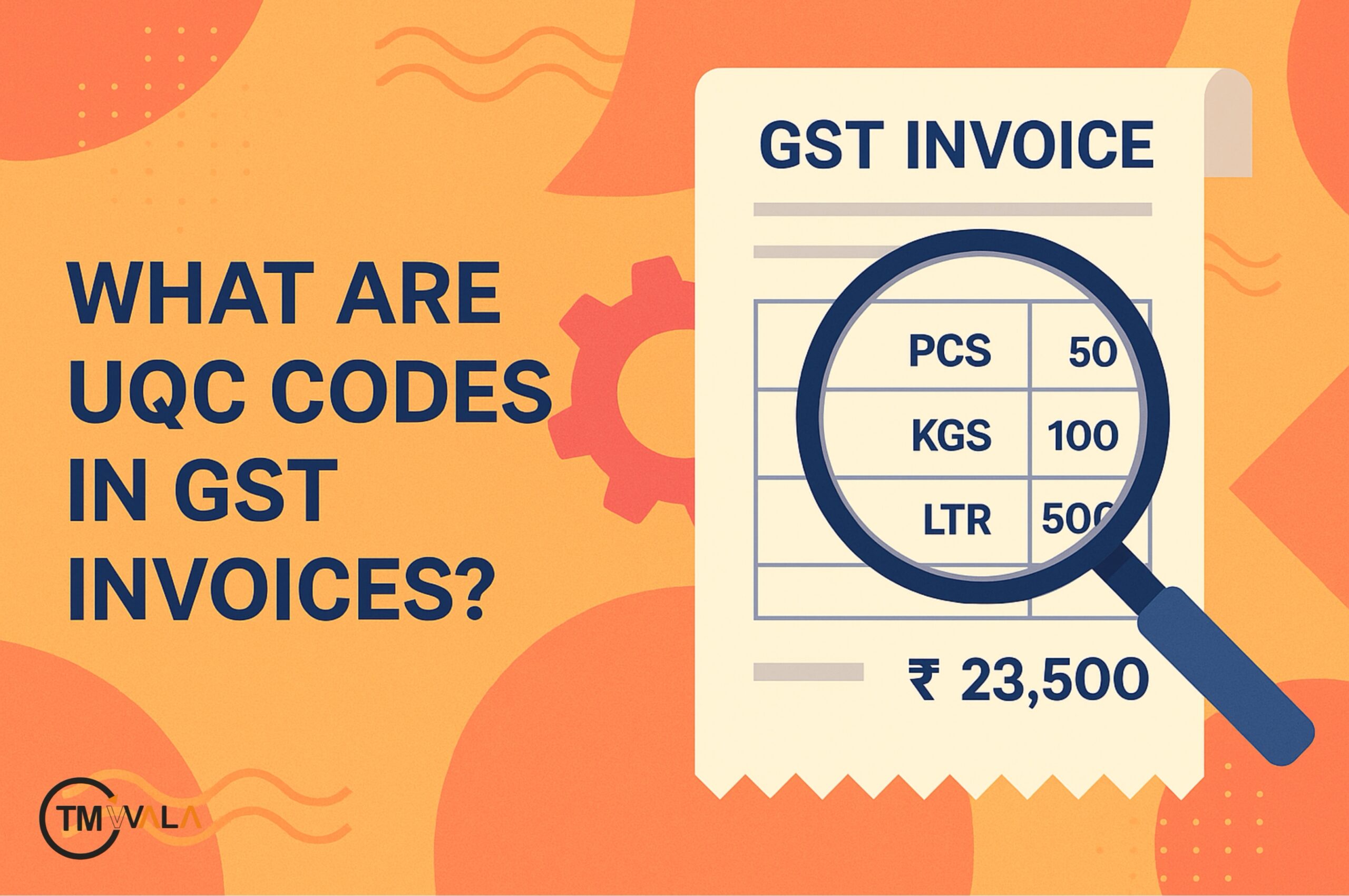
Under GST, the quantity and the unit of measurement must be reported for each taxable supply of goods or services. This is achieved through a standardized three-character code, known as UQC. Using UQC in GST helps prevent confusion or discrepancies regarding quantities reported in invoices, e-way bills, or other GST-related documents. For example, if a company sells 100 metres of fabric, the UQC for this quantity is MTR, written as 100 MTR. Similarly, 100 kilograms of sugar would have a UQC of KGS, while 1 litre of milk would be LTR.
The application of UQC in GST plays a significant role in simplifying compliance, standardizing reporting, and improving data accuracy. The key benefits include:
For GST compliance, every tax invoice, credit note, or debit note must include UQC or a description of the quantity unit. This ensures that the details of the goods or services provided are clear and verifiable. GST invoice format and GST return filing details must reflect UQC wherever applicable. For example, in a GST invoice, the description of goods, HSN code, quantity, UQC, rate, and amount are mandatory fields in a GST invoice.
The UQC must be declared in multiple places during GST return filing:
Many taxpayers often confuse HSN codes with UQC codes, but the two serve distinct purposes. HSN (Harmonised System of Nomenclature) codes classify goods for tax purposes, whereas UQC represents the unit in which goods are measured or services are quantified. While HSN or SAC codes focus on the type of product or service, UQC ensures accurate representation of the quantity being transacted.
GST has not specifically defined quantity codes. As a result, the UQC, in accordance with Customs Rules, is followed. Below is a simplified GST format for easy reference. The first three letters indicate the code, while the rest describe the unit. Taxpayers unable to find an appropriate quantity can use “OTH – Others.”
| Quantity | Quantity Type | UQC Code |
| BAGS | Measure | BAG |
| BALE | Measure | BAL |
| BUNDLES | Measure | BDL |
| BUCKLES | Measure | BKL |
| BILLIONS OF UNITS | Measure | BOU |
| BOX | Measure | BOX |
| BOTTLES | Measure | BTL |
| BUNCHES | Measure | BUN |
| CANS | Measure | CAN |
| CUBIC METER | Volume | CBM |
| CUBIC CENTIMETER | Volume | CCM |
| CENTIMETER | Length | CMS |
| CARTONS | Measure | CTN |
| DOZEN | Measure | DOZ |
| DRUM | Measure | DRM |
| GREAT GROSS | Measure | GGR |
| GRAMS | Weight | GMS |
| GROSS | Measure | GRS |
| GROSS YARDS | Length | GYD |
| KILOGRAMS | Weight | KGS |
| KILOLITER | Volume | KLR |
| KILOMETRE | Length | KME |
| MILLILITRE | Volume | MLT |
| METERS | Length | MTR |
| METRIC TONS | Weight | MTS |
| NUMBERS | Measure | NOS |
| PACKS | Measure | PAC |
| PIECES | Measure | PCS |
| PAIRS | Measure | PRS |
| QUINTAL | Weight | QTL |
| ROLLS | Measure | ROL |
| SETS | Measure | SET |
| SQUARE FEET | Area | SQF |
| SQUARE METERS | Area | SQM |
| SQUARE YARDS | Area | SQY |
| TABLETS | Measure | TBS |
| TEN GROSS | Measure | TGM |
| THOUSANDS | Measure | THD |
| TONNES | Weight | TON |
| TUBES | Measure | TUB |
| US GALLONS | Volume | UGS |
| UNITS | Measure | UNT |
| YARDS | Length | YDS |
| OTHERS | – | OTH |
Despite the simplicity of UQC, some taxpayers face challenges while implementing it. This is often due to:
For smooth compliance, it is advised to use the Government’s GSTR-1 offline tool and select the correct UQC from the dropdown menu. All quantity details must be furnished using the prescribed UQC of the GST Portal, irrespective of the unit of measurement maintained internally.
Standardized and accurate tax reporting under GST depends on the Unit Quantity Code (UQC). UQCs ensure consistency, reduce errors, and simplify compliance for businesses by using a uniform system of measurement. While implementation challenges may exist, they can be effectively addressed through proper training, software updates, and adherence to GST guidelines.
Proper adoption of UQCs benefits businesses by simplifying GST reporting and helps tax authorities by improving audit accuracy and administration. Understanding and integrating UQCs into your GST procedures is therefore essential for maintaining compliance and achieving correct tax reporting.
By following the correct GST invoice format, including GST invoice requirements in India and mandatory fields in GST invoices, and carefully mapping HSN and UQC codes, businesses can make their operations more transparent, standardized, and compliant with Indian GST laws. Platforms like TMWalamake make this process seamless, helping businesses save time, reduce errors, and maintain full GST compliance effortlessly.
Get started instantly
"*" indicates required fields

TMWala
Your one stop shop for all your business registration and compliance needs.
"*" indicates required fields
Choose your Entity Type
Non-MSME/ Large Entitie
Individual/ MSME/ Sole Proprietorships

₹9,000.00 Original price was: ₹9,000.00.₹3,999.00Current price is: ₹3,999.00.
Trademark Application @ ₹3999* (Premium Discounted Plan for MSME/Individual/Sole Proprietorships) Comprehensive
Government Fees
₹4500/-
₹9,000.00 Original price was: ₹9,000.00.₹3,999.00Current price is: ₹3,999.00.
Trademark Application @ ₹3999* (Premium Discounted Plan for Non-MSMEs/Large Entities) Comprehensive
Government Fees
₹9000/-
Choose your Entity Type
Individual/ MSME/ Sole Proprietorships
Non-MSME/ Large Entities

₹3,500.00 Original price was: ₹3,500.00.₹1,999.00Current price is: ₹1,999.00.
Government Fees
₹4500/-
₹3,500.00 Original price was: ₹3,500.00.₹1,999.00Current price is: ₹1,999.00.
Government Fees
₹9000/-
Choose your Entity Type
Individual/ MSME/ Sole Proprietorships
Non-MSME/ Large Entities
₹1,500.00 Original price was: ₹1,500.00.₹999.00Current price is: ₹999.00.
Trademark Application @ ₹999* (Basic Discounted Plan for MSME/Individual/Sole Proprietorships) Best-Selling, Economical & Easy
₹1,500.00 Original price was: ₹1,500.00.₹999.00Current price is: ₹999.00.
Trademark Application @ ₹999* (Basic Discounted Plan for Non-MSMEs/Large Entities) Best-Selling, Economical, Quick and Easy