
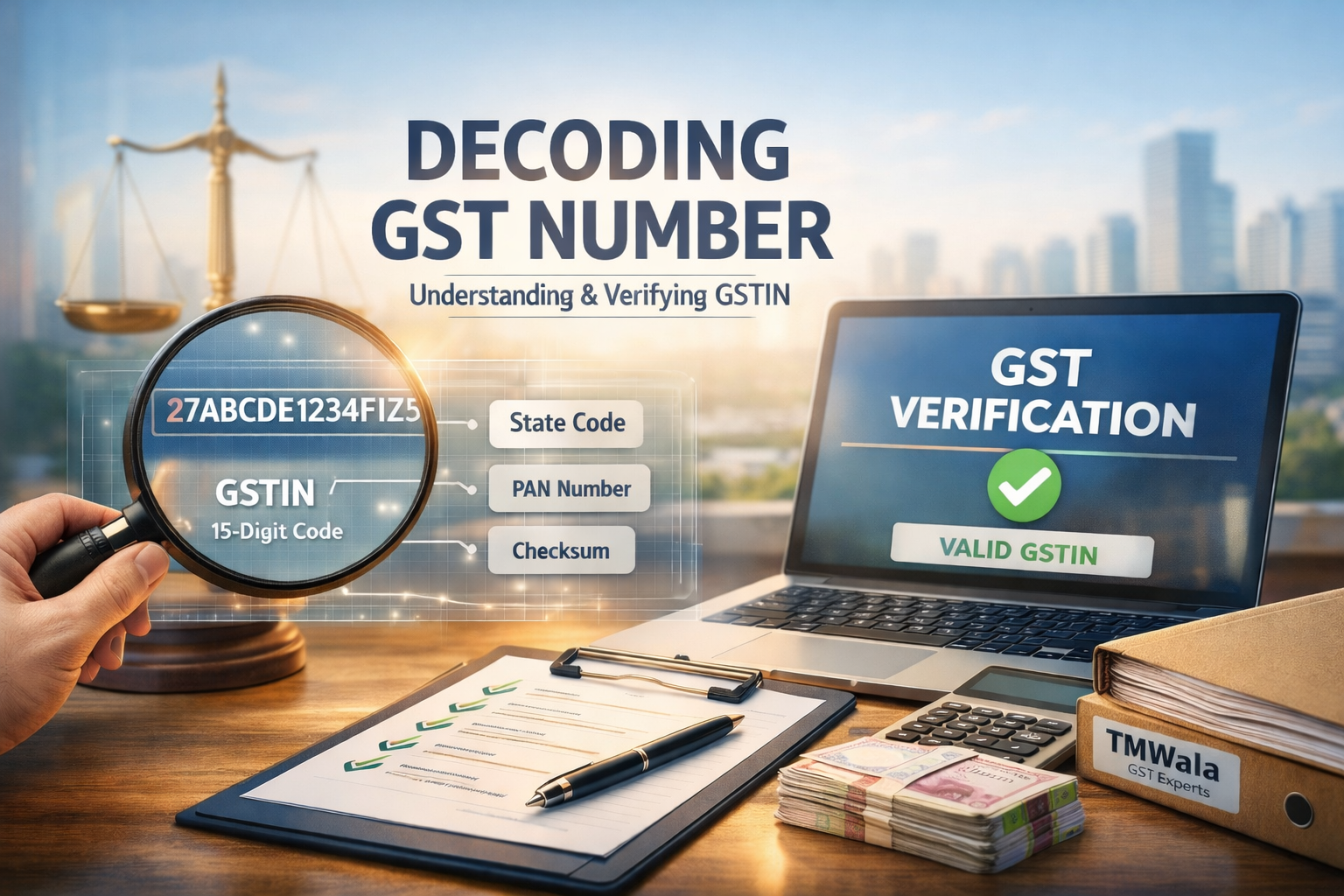
What is a GST number? Why does it matter for every business operating in India?
Under the Goods and Services Tax (GST) regime, a GST Registration Number, commonly known as GSTIN, acts as the official identity of a registered taxpayer. Whether you are a startup, freelancer, MSME, or a large enterprise, knowing the GST number meaning and structure helps ensure compliance and smooth business operations. This article explains the GST number format, its components, benefits, and verification process in a clear and easy-to-understand manner.
Many business owners often ask questions like how many numbers are in GST, how many digits are in the GST number, and how to verify a GST number correctly. In simple terms, the GST registration number format is standardized across India and plays a crucial role in tax administration, invoicing, and GST return filing. You’ll also learn how expert platforms like TMWala can help you manage GST registration and compliance without stress.
A GST Registration Number, officially known as GSTIN, is a 15-digit alphanumeric identification number assigned to businesses registered under GST. If you’re wondering how many digits are in a GST number, the answer is always fifteen, no more, no less.
The GSTIN full form is Goods and Services Tax Identification Number. It replaced older tax identifiers such as VAT TIN, Service Tax Number, and Central Excise Registration after GST was implemented.
The GSTIN helps the government:
For businesses, it enables:
If you operate without a GST number when registration is mandatory, penalties may apply. This is where TMWala can help, guiding you through eligibility checks and ensuring timely GST registration.
The GST number structure is not random. Each digit and character has a specific purpose and meaning. Understanding the GSTIN format allows businesses to identify important information such as the state of registration and the nature of the entity.
GST Registration Number Format (15 Characters)
Here is the standard GST registration number format:
AAABCDE1234F1Z5
Let’s break it down to understand the GST number meaning in detail.
Decoding the GSTIN: Digit-by-Digit Explanation
The first two digits represent the State code in the GST number as per the Indian Census classification.
Example:
This helps identify the state or union territory where the business is registered.
Characters 3 to 12 are derived from the Permanent Account Number (PAN) of the business or individual.
This ensures:
The 13th character shows how many registrations exist under the same PAN in a single state.
For example:
This is useful for businesses with multiple verticals or branches.
The 14th character is usually “Z” and is reserved for future use. It remains constant in almost all GST numbers.
The final digit is a checksum, used for GST number verification. It helps detect errors in the GSTIN and ensures authenticity.
GST Number Example
Here is a GST number example to make things clearer:
27ABCDE1234F2Z5
This also serves as a sample GST number for reference and understanding.
Knowing the GST number structure helps businesses:
Incorrect GSTINs can result in:
With professional assistance from TMWala, businesses can avoid such risks by ensuring accuracy at every step.
GST number verification is crucial before entering into business transactions. The government provides an easy way to check the GST number online through the GST portal.
Steps to Verify GSTIN:
This confirms whether the GST number is active, cancelled, or suspended.
If you’re unsure how to validate GST details or want bulk verification, TMWala can help with expert support and compliance tools.
Understanding the Difference between GSTIN and UIN is important, especially for organizations dealing with international bodies.
GSTIN
UIN (Unique Identification Number)
Thus, GSTIN is for commercial entities, while UIN serves a limited, specialized purpose.
Registering for GST offers multiple advantages:
If you’re confused about eligibility or documentation, TMWala simplifies the process with expert guidance and end-to-end GST services.
To summarize, the GST number is far more than just a registration code. It is a powerful compliance tool that defines a business’s tax identity in India. By understanding how many digits are in the GST number, the GST number format, and the GST number meaning, businesses can operate confidently and stay compliant.
Whether it’s registration, verification, or ongoing compliance, professional assistance can save time and prevent costly errors. Platforms like TMWala ensure that your GST journey from application to filing is smooth, accurate, and stress-free.
If you’re planning to register or need help managing GST, getting expert support today can make all the difference in 2026 and beyond.
Get started instantly
"*" indicates required fields

TMWala
Your one stop shop for all your business registration and compliance needs.
"*" indicates required fields
Choose your Entity Type
Non-MSME/ Large Entitie
Individual/ MSME/ Sole Proprietorships

₹9,000.00 Original price was: ₹9,000.00.₹3,999.00Current price is: ₹3,999.00.
Trademark Application @ ₹3999* (Premium Discounted Plan for MSME/Individual/Sole Proprietorships) Comprehensive
Government Fees
₹4500/-
₹9,000.00 Original price was: ₹9,000.00.₹3,999.00Current price is: ₹3,999.00.
Trademark Application @ ₹3999* (Premium Discounted Plan for Non-MSMEs/Large Entities) Comprehensive
Government Fees
₹9000/-
Choose your Entity Type
Individual/ MSME/ Sole Proprietorships
Non-MSME/ Large Entities

₹3,500.00 Original price was: ₹3,500.00.₹1,999.00Current price is: ₹1,999.00.
Government Fees
₹4500/-
₹3,500.00 Original price was: ₹3,500.00.₹1,999.00Current price is: ₹1,999.00.
Government Fees
₹9000/-
Choose your Entity Type
Individual/ MSME/ Sole Proprietorships
Non-MSME/ Large Entities
₹1,500.00 Original price was: ₹1,500.00.₹999.00Current price is: ₹999.00.
Trademark Application @ ₹999* (Basic Discounted Plan for MSME/Individual/Sole Proprietorships) Best-Selling, Economical & Easy
₹1,500.00 Original price was: ₹1,500.00.₹999.00Current price is: ₹999.00.
Trademark Application @ ₹999* (Basic Discounted Plan for Non-MSMEs/Large Entities) Best-Selling, Economical, Quick and Easy