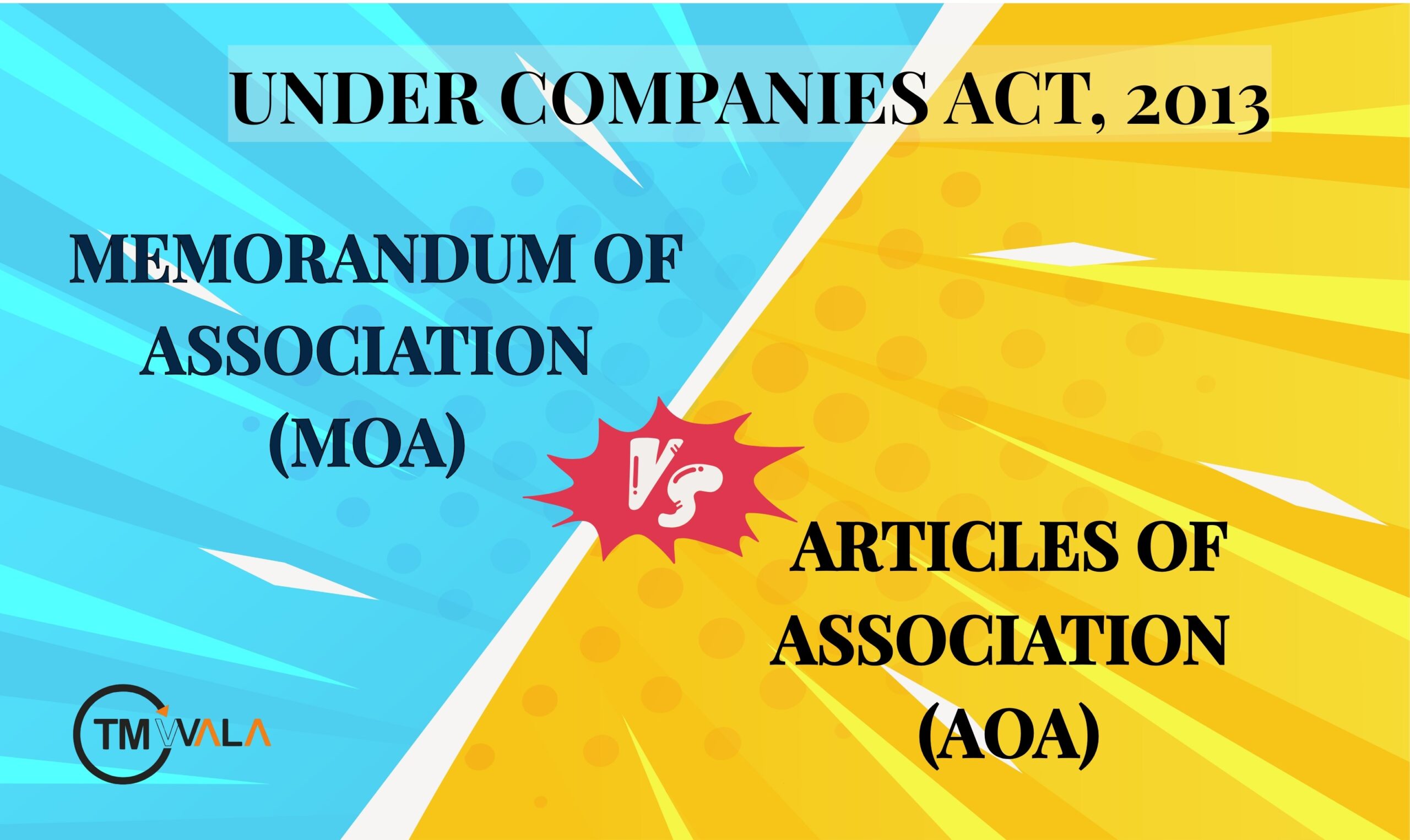
Every company begins its journey with a legal identity, and this identity is built on two fundamental documents: the Memorandum of Association (MOA) and the Articles of Association (AOA). These documents are not mere registration formalities; they define the company’s purpose, powers, and internal governance framework from day one.
For anyone planning to incorporate a business in India, understanding MOA vs AOA is essential. The difference between MOA and AOA under the Companies Act, 2013, determines how far a company can operate and how it must manage its internal affairs. In simple terms, while the MOA establishes what a company can do, the AOA explains how the company will do it.
This article explores the memorandum of association meaning, articles of association meaning, statutory provisions under Section 4 of the Companies Act, 2013, and Section 5 of the Companies Act, 2013, the contents of MOA and AOA, their alteration, and the doctrine of ultra vires, followed by a clear explanation of the MOA and AOA difference.
The Memorandum of Association is the primary constitutional document of a company. It defines the company’s identity, objectives, and the scope within which it is legally permitted to operate.
From a legal standpoint, the MOA acts as a boundary line. Any activity carried out beyond this boundary is treated as invalid in law. This concept is governed by the doctrine of ultra vires, which prevents companies from misusing shareholder funds for purposes not stated in the MOA.
In short, the MOA tells the world why the company exists and what it is legally allowed to do.
| Also, know about the Memorandum of Understanding with TMWala
Section 4 of the Companies Act, 2013, lays down the mandatory requirements of the Memorandum of Association. As per this provision, every MOA must clearly state:
These clauses collectively form the contents of the MOA, ensuring transparency for investors, creditors, and regulators. Because of its public nature, the MOA plays a vital role in building trust and legal clarity.
Drafting an MOA requires precision. Even a minor error in the object clause can restrict future expansion. This is where professional support, such as assistance from TMWalahelps, ensures that your MOA is legally sound and growth-oriented.
The Articles of Association function as the internal rulebook of a company. While the MOA sets the outer limits, the AOA governs daily management and operational procedures.
The articles of association meaning lie in regulating how decisions are made, how authority is exercised, and how rights and responsibilities are distributed among members and directors. Unlike the MOA, the AOA focuses entirely on internal administration.
It covers matters such as the appointment of directors, the conduct of meetings, the issue and transfer of shares, voting rights, and dividend policies.
The legal framework for AOA is provided under Section 5 of the Companies Act, 2013. This section states that the articles shall contain regulations for the management of the company and may include additional provisions necessary for governance.
Section 5 also introduces the concept of entrenchment, allowing companies to make certain provisions harder to amend than others, enhancing long-term stability.
The contents of AOA typically include:
Since AOA governs internal conduct, it must always be consistent with the MOA and the Companies Act.
Understanding the memorandum of association vs articles of association is critical for compliance and risk management.
| Basis | MOA | AOA |
| Purpose | Defines company’s objectives and powers | Governs internal management |
| Legal Status | Supreme constitutional document | Subordinate to MOA |
| Scope | External relations | Internal administration |
| Flexibility | Rigid | Relatively flexible |
| Audience | Public, investors, creditors | Directors and members |
This MOA and AOA difference explains why both documents are equally important yet serve entirely different functions.
Under the Companies Act, 2013, the distinction becomes even clearer:
These statutory safeguards ensure that companies remain accountable and operate within defined legal limits.
The doctrine of ultra vires is directly linked to the MOA. It states that if a company undertakes activities beyond its stated objectives, such acts are void ab initio.
This doctrine protects shareholders and creditors by ensuring that company funds are not diverted into unauthorized ventures. Importantly, even unanimous shareholder consent cannot validate an ultra vires act.
This highlights why drafting the object clause carefully is crucialand why many businesses rely on experts like TMWala to avoid restrictive or vague drafting.
The alteration of MOA and AOA follows different legal procedures:
MOA amendments are prospective and strictly regulated, while AOA amendments can be retrospective if they do not prejudice members’ rights.
Because of these complexities, professional guidance ensures smooth compliance during restructuring or expansion.
The importance of MOA and AOA lies in their role as the backbone of corporate governance. Together, they:
Without these documents, company incorporation in India is legally impossible.
Along with MOA and AOA, companies must submit several documents during registration, including:
Errors in any of these can delay approval. End-to-end support from professionals like TMWala helps businesses complete incorporation smoothly and compliantly.
The difference between MOA and AOA goes far beyond theory; it directly affects how a company operates, grows, and stays compliant. The MOA defines the company’s legal identity and limits, while the AOA ensures structured and transparent internal management.
Understanding MOA vs AOA, statutory provisions under Section 4 and Section 5 of the Companies Act, 2013, and concepts like the doctrine of ultra vires is essential for entrepreneurs, investors, and professionals alike.
When drafted correctly, these documents do more than satisfy legal requirements; they lay the foundation for sustainable business success. For businesses seeking clarity, compliance, and confidence, expert assistance from TMWala can make the entire process seamless.
Get started instantly
"*" indicates required fields
TMWala
Your one stop shop for all your business registration and compliance needs.
"*" indicates required fields
Choose your Entity Type
Non-MSME/ Large Entitie
Individual/ MSME/ Sole Proprietorships
₹9,000.00 Original price was: ₹9,000.00.₹3,999.00Current price is: ₹3,999.00.
Trademark Application @ ₹3999* (Premium Discounted Plan for MSME/Individual/Sole Proprietorships) Comprehensive
Government Fees
₹4500/-
₹9,000.00 Original price was: ₹9,000.00.₹3,999.00Current price is: ₹3,999.00.
Trademark Application @ ₹3999* (Premium Discounted Plan for Non-MSMEs/Large Entities) Comprehensive
Government Fees
₹9000/-
Choose your Entity Type
Individual/ MSME/ Sole Proprietorships
Non-MSME/ Large Entities
₹3,500.00 Original price was: ₹3,500.00.₹1,999.00Current price is: ₹1,999.00.
Government Fees
₹4500/-
₹3,500.00 Original price was: ₹3,500.00.₹1,999.00Current price is: ₹1,999.00.
Government Fees
₹9000/-
Choose your Entity Type
Individual/ MSME/ Sole Proprietorships
Non-MSME/ Large Entities
₹1,500.00 Original price was: ₹1,500.00.₹999.00Current price is: ₹999.00.
Trademark Application @ ₹999* (Basic Discounted Plan for MSME/Individual/Sole Proprietorships) Best-Selling, Economical & Easy
₹1,500.00 Original price was: ₹1,500.00.₹999.00Current price is: ₹999.00.
Trademark Application @ ₹999* (Basic Discounted Plan for Non-MSMEs/Large Entities) Best-Selling, Economical, Quick and Easy