
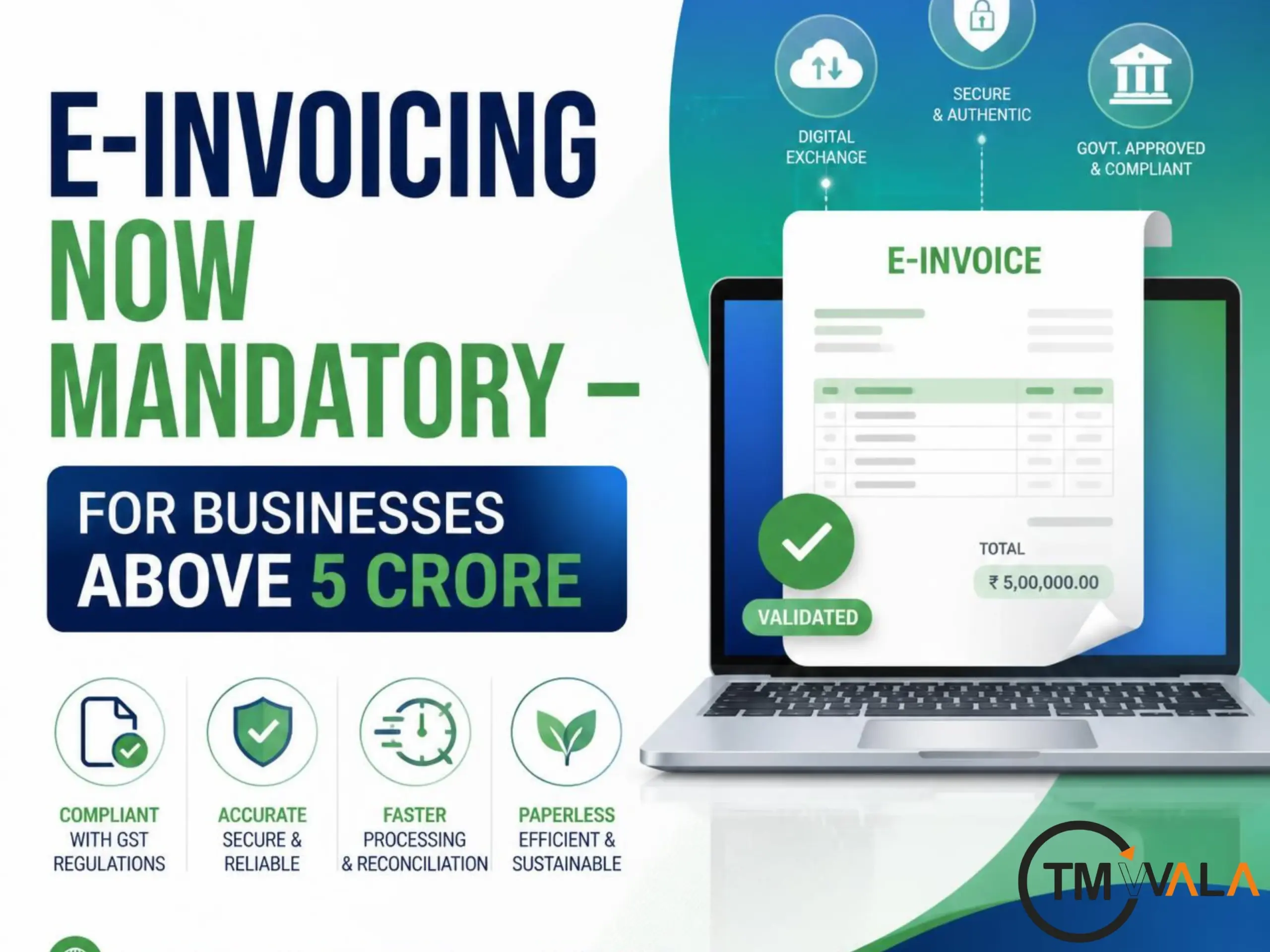
The e-invoice system in GST plays an important role in the compliance procedures under the GST regime in India. Companies which cross the specified turnover limits must generate e-invoices through the e-invoice software system prior to the company issuing tax invoices to customers.
With the authorities tightening compliance under the digital administration of tax laws, it has become very important for companies working with a turnover of more than ₹5 crore per year to be cognizant of the changes in the compliance requirements and the updated norms. Compliance failure can lead to penalties being imposed on the firm and invalid invoices being issued to them.
In case whether the organization is a trader, manufacturer or wholesaler, it is very important that they are updated about the changes in the applicability of GST. TMWala can assist in this regard. Covering various areas and fields ranging from e-invoicing to the different processes of GST registration and compliance, TMWala stands with businesses in their GST endeavours.
A GST e- invoice is not something the Government makes. It is a tax invoice that the supplier makes using their accounting system, and they send it to the Government’s Invoice Registration Portal for checking.
After successful validation, the IRP:
The supplier can only use the GST e invoice if they get a number from the Government, which is the Invoice Reference Number. This is what the Government says the supplier must do according to Rule 48(4) for some taxpayers, like the ones the Government has talked about, who are called notified taxpayers. They must have a GST e invoice, with an Invoice Reference Number.
For more information, visit: https://taxinformation.cbic.gov.in/content/html/tax_repository/gst/rules/cgst_rules/active/chapter6/rule48_v1.00.html
E-invoicing is mandatory for registered persons whose aggregate annual turnover exceeds ₹5 crore in any financial year. The requirement became effective from 1 August 2023.
The turnover is calculated on a Permanent Account Number (PAN) basis and includes the turnover of all GST registrations held under that PAN across India, not just a single GSTIN.
Businesses should regularly review their aggregate turnover to determine whether the GST e-invoice applicability provisions apply to them.
The rules for invoicing and Goods and Services Tax are stated in Rule 48(4) of the Central Goods and Services Tax Rules, 2017.
To make an invoice, certain people who are registered must get an Invoice Reference Number after they upload the details of the invoice to a website. Then there is Rule 48(5), which says that if someone who has to follow Rule 48(4) makes an invoice in a way that is not correct, then that invoice will not be considered a real invoice.
So, people who have to do invoicing have to follow the rules, which is something they have to do by law, because electronic invoicing is a legal requirement for these taxpayers who are notified.
Subject to the applicable turnover threshold and notified exemptions, e-invoicing generally applies to:
The Government has clarified through Circular No. 198/10/2023-GST that supplies made to Government departments or agencies registered only for Tax Deducted at Source (TDS) purposes are treated as supplies to registered persons for the purpose of e-invoicing where the supplier is otherwise covered under Rule 48(4).
Link to the above notification: https://einvoice1.gst.gov.in/Notifications/Notification_No._10_2023.pdf
The government has a rule called Rule 48(4) that says some people who are registered do not have to do e-invoicing.
According to the e-Invoice portal, there are some people who do not have to do this. These people include:
Businesses should always check what the Government says before they think they do not have to follow the rules of e-invoicing. The Government can change the rules at any time. It is a good idea for businesses to check the rules of e-invoicing often.
The official GST e-invoice process consists of the following steps:
Step 1: Make the Invoice
The supplier uses their accounting software to make the tax invoice. They have to make it in a format.
Step 2: Put Invoice Details Online
The supplier uploads the invoice details to a website called the Invoice Registration Portal.
Step 3: Check by Invoice Registration Portal
The Invoice Registration Portal checks the invoice information. It makes sure all the necessary information is there and that the invoice has not been used before.
Step 4: Get a Special Number
If everything is okay, the Invoice Registration Portal gives the invoice a number. This number is called the Invoice Reference Number.
Step 5: Make a QR Code
The Invoice Registration Portal puts a signature on the invoice and makes a QR Code. This QR Code helps people check the invoice details.
Step 6: Get the Final Invoice
The supplier gets the invoice back from the Invoice Registration Portal. The invoice now has the number and the QR Code. The supplier can then give this invoice to the buyer.
To read the process in more detail: https://tutorial.gst.gov.in/downloads/news/e_invoice_overview.pdf
The IRN generation is a step for taxpayers who have to follow Rule 48(4) when they do their GST e- invoice. The Invoice Reference Number is a number that the Invoice Registration Portal gives after it checks the invoice details that the supplier sends. The IRN makes sure that every invoice is real and one of a kind in the GST system. The real invoice also has a QR Code with a digital signature that people can use to check if it is real. When the IRN is ready, the invoice details go to the GST system.
This helps make sure that invoices are not reported more than once and it also supports accurate GST return filing.
The IRN generation is a part of the GST e invoice process, for taxpayers covered under Rule 48(4) and the Invoice Reference Number is used to keep track of invoices in the GST system.
Every GST invoice has to have some information. This is in addition to the GST invoice requirements for e-invoicing. The CGST Rules say what particulars must be on every GST invoice.
For people who have to do e-invoicing, the invoice also needs to have the IRN and QR Code from the IRP.
Some important things that must be on a GST invoice are:
Businesses need to make sure their GST invoices are complete and correct before they upload them to the IRP. They have to be careful and double check the GST invoices. GST invoices are very important for GST. Businesses must get the GST invoices right. GST invoices have to be accurate.
The Government says that people who have to pay taxes and have been told about it must follow Rule 48(4).
Rule 48(5) says that if a company has to use e-invoicing, then any invoice they make without doing it the way will not be considered a real invoice. This shows how important it is for companies to get an IRN before they give out invoices that need to follow the e-invoicing rules. The e-invoicing rules are important. Companies must get an IRN for the e-invoicing.
Businesses should therefore ensure that:
The GST Portal says that taxpayers should know about the e-invoicing process. They should use software that can make invoices in the format.
Businesses can strengthen GST compliance by:
If businesses do these things, they can reduce mistakes when they report things, and they can follow the GST rules better. The GST Portal and the GST e invoice process are important for businesses to understand. Businesses should keep learning about the GST e invoice process to avoid problems.
The GST e-invoice system is an important compliance requirement for businesses with an aggregate turnover exceeding ₹5 crore. Understanding GST e invoice applicability, following the prescribed GST e invoice process, and ensuring timely IRN generation can help businesses meet their GST obligations efficiently. If you need assistance with GST registration, e-invoicing compliance, or other GST-related services, TMWala provides expert guidance to help your business stay compliant with the latest Government regulations.
Get started instantly
"*" indicates required fields

TMWala
Your one stop shop for all your business registration and compliance needs.
"*" indicates required fields
Choose your Entity Type
Non-MSME/ Large Entitie
Individual/ MSME/ Sole Proprietorships

₹9,000.00 Original price was: ₹9,000.00.₹3,999.00Current price is: ₹3,999.00.
Trademark Application @ ₹3999* (Premium Discounted Plan for MSME/Individual/Sole Proprietorships) Comprehensive
Government Fees
₹4500/-
₹9,000.00 Original price was: ₹9,000.00.₹3,999.00Current price is: ₹3,999.00.
Trademark Application @ ₹3999* (Premium Discounted Plan for Non-MSMEs/Large Entities) Comprehensive
Government Fees
₹9000/-
Choose your Entity Type
Individual/ MSME/ Sole Proprietorships
Non-MSME/ Large Entities

₹3,500.00 Original price was: ₹3,500.00.₹1,999.00Current price is: ₹1,999.00.
Government Fees
₹4500/-
₹3,500.00 Original price was: ₹3,500.00.₹1,999.00Current price is: ₹1,999.00.
Government Fees
₹9000/-
Choose your Entity Type
Individual/ MSME/ Sole Proprietorships
Non-MSME/ Large Entities
₹1,500.00 Original price was: ₹1,500.00.₹999.00Current price is: ₹999.00.
Trademark Application @ ₹999* (Basic Discounted Plan for MSME/Individual/Sole Proprietorships) Best-Selling, Economical & Easy
₹1,500.00 Original price was: ₹1,500.00.₹999.00Current price is: ₹999.00.
Trademark Application @ ₹999* (Basic Discounted Plan for Non-MSMEs/Large Entities) Best-Selling, Economical, Quick and Easy