Annual compliance for a private limited company is not one filing. It is a sequence of forms, each with its own deadline, each reporting a different slice of the company to the Registrar of Companies (ROC), Ministry of Corporate Affairs (MCA). Miss one, and the penalty clock starts running per day, with no upper limit on several of these forms.
Most compliance calendars available online repeat the same AOC-4 and MGT-7 dates without explaining why so many small companies still default. The pattern we see most often is not ignorance of the due date. It is founders treating the AGM as a formality to schedule “whenever convenient,” not realising that every downstream form takes its due date from that single meeting. Fix the AGM date, and the rest of the calendar falls into place on its own.
This schedule sets out what a private limited company must file for FY 2026-27 (April 2026 to March 2027), when each form falls due, and what happens if a deadline slips.
Annual compliance for private limited company operations covers every statutory filing a company must submit to the Ministry of Corporate Affairs after the close of a financial year, regardless of whether the company did any business, earned any revenue, or held any board meetings. A dormant company with zero transactions still carries the same ROC filing obligations as an active one.
This includes:
Directors sometimes assume a quiet year means no paperwork. It does not. The obligation is tied to incorporation status under the Companies Act, 2013, not turnover.
Each of the ROC forms for private limited companies reports a specific fact to the Registrar of Companies. Filing the wrong form, or filing it late, does not just cost money. It also puts the company’s active status and the directors’ eligibility at risk.
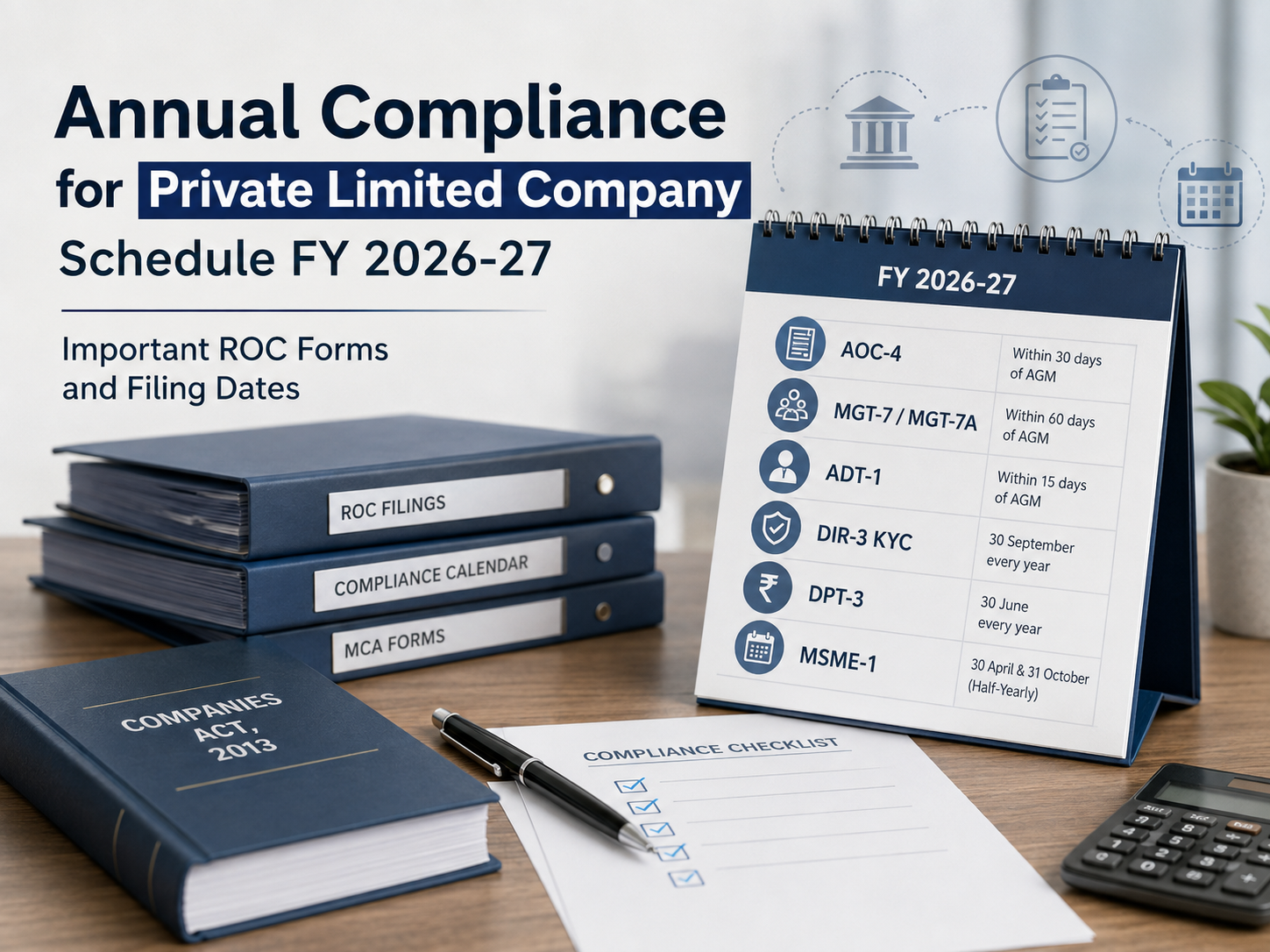
| Form | What It Reports | Filed By | Due Date (from AGM or FY end) |
| AOC-4 | Financial statements, Board’s Report, auditor’s report | Company | Within 30 days of AGM |
| MGT-7 / MGT-7A | Annual return: shareholding, directors, board meetings | Company | Within 60 days of AGM |
| ADT-1 | Appointment or reappointment of statutory auditor | Company | Within 15 days of AGM |
| DIR-3 KYC | Director identity and contact verification | Every DIN holder | 30 September every year |
| DPT-3 | Outstanding loans not treated as deposits | Company (where applicable) | 30 June every year |
| MSME-1 | Overdue payments to MSME suppliers beyond 45 days | Company (where applicable) | 30 April and 31 October (half-yearly) |
MGT-7A applies to One Person Companies and small companies as defined under the Companies Act. All other private limited companies file MGT-7.
The order matters. Most annual filings are calculated from the AGM date, not the financial year end directly, so getting the AGM date right sets every downstream deadline.
Step 1: Hold the AGM. Under Section 96 of the Companies Act, 2013, every private limited company other than an OPC must hold its AGM within six months of the financial year closing. For FY 2026-27, that places the outer deadline at 30 September 2027. Members need at least 21 clear days’ notice.
Step 2: File ADT-1 within 15 days of the AGM. This confirms the auditor’s appointment or reappointment to the Registrar. Skip this step and the audit engagement is not formally on record, even once the audit itself has begun.
Step 3: File AOC-4 within 30 days of the AGM. This carries the audited financial statements, the Board’s Report, and the auditor’s report as attachments. If the AGM is held on 30 September 2027, AOC-4 falls due by 30 October 2027.
Step 4: File MGT-7 or MGT-7A within 60 days of the AGM. This is the annual return: shareholding pattern, director details, board meeting frequency, and indebtedness. On the same AGM date, this lands around 29 November 2027.
Step 5: File DIR-3 KYC by 30 September. This runs on a fixed calendar date, not the AGM date. Every DIN holder must complete this annually, active director or not.
Step 6: File DPT-3 by 30 June, if the company carries outstanding loans or receipts not classified as deposits under the Companies (Acceptance of Deposits) Rules, 2014. Easy to overlook, since it sits outside the AGM cycle entirely. This is the one form our team sees skipped most, precisely because it does not depend on any meeting or transaction founders think to flag.
Step 7: File MSME-1, twice a year, if any payment to a micro or small enterprise supplier has stayed unpaid beyond 45 days from acceptance of goods or services. October to March dues go by 30 April, April to September dues by 31 October.
Delayed ROC filing carries a flat penalty structure that does not taper off. AOC-4 and MGT-7 attract a late fee of ₹100 per day of default, and this fee has no maximum cap, so a filing pushed back by several months can cost far more than the original government fee.
Director-level consequences follow a separate track:
A single missed deadline rarely ends in strike-off on its own. The exposure builds. One late AOC-4 is a fee. Two consecutive years of default starts touching director eligibility, and that risk extends beyond the one company to every other board a disqualified director sits on. This is the detail founders with multiple directorships miss most: a default in one company follows the director, not just the company.
Mandatory compliance for private limited company boards is not limited to Registrar forms. Two obligations run alongside the ROC calendar and get missed because they carry no portal reminder.
These surface only when an auditor, an investor, or the Registrar of Companies asks to see them, usually the worst possible time to discover a gap.
TMWala tracks every AGM, AOC-4, MGT-7, and DIN-linked deadline for your company from a single dashboard, so no form depends on you remembering a date months in advance. Book your free compliance consultation and get your entire FY 2026-27 filing calendar locked in before the AGM window opens.
What is the ROC filing due date for a private limited company in FY 2026-27?
AOC-4 falls due within 30 days of the AGM and MGT-7 within 60 days. Since the AGM must be held by 30 September 2027 at the latest, both deadlines follow from that date.
Is annual return filing mandatory even if the company had no business activity?
Yes. Annual return filing is mandatory for every registered private limited company regardless of turnover or activity. A dormant company must still file MGT-7 and AOC-4 each year.
What is the MCA filing due date for DIR-3 KYC?
DIR-3 KYC is due by 30 September every year for every individual holding a Director Identification Number, whether or not that person currently serves as an active director.
Does a private limited company need to file DPT-3 every year?
Only if it holds outstanding loans, deposits, or receipts of money falling within Rule 16A of the Companies (Acceptance of Deposits) Rules, 2014, as on 31 March. Otherwise, this filing does not apply.
What is the ROC forms for private limited companies checklist for a normal year?
AOC-4, MGT-7 or MGT-7A, ADT-1, and DIR-3 KYC apply every year without exception. DPT-3 and MSME-1 apply only where the underlying loan or overdue payment actually exists.
What happens if the AGM itself is delayed beyond 30 September?
Every downstream filing shifts later, but the statutory due dates for AOC-4 and MGT-7 stay tied to the actual AGM date, so late fees can still apply from the original deadline.
Is mandatory compliance for private limited company boards limited to ROC filings alone?
No. Boards must also hold at least four meetings a year and keep statutory registers current, obligations that exist independently of any Registrar filing.
Can a private limited company be struck off for missing annual filings?
Yes. Persistent non-filing over consecutive years can lead the Registrar to initiate strike-off proceedings, removing the company’s name from the register entirely.
Get started instantly
"*" indicates required fields
TMWala
Your one stop shop for all your business registration and compliance needs.
"*" indicates required fields
Choose your Entity Type
Non-MSME/ Large Entitie
Individual/ MSME/ Sole Proprietorships

₹9,000.00 Original price was: ₹9,000.00.₹3,999.00Current price is: ₹3,999.00.
Trademark Application @ ₹3999* (Premium Discounted Plan for MSME/Individual/Sole Proprietorships) Comprehensive
Government Fees
₹4500/-
₹9,000.00 Original price was: ₹9,000.00.₹3,999.00Current price is: ₹3,999.00.
Trademark Application @ ₹3999* (Premium Discounted Plan for Non-MSMEs/Large Entities) Comprehensive
Government Fees
₹9000/-
Choose your Entity Type
Individual/ MSME/ Sole Proprietorships
Non-MSME/ Large Entities

₹3,500.00 Original price was: ₹3,500.00.₹1,999.00Current price is: ₹1,999.00.
Government Fees
₹4500/-
₹3,500.00 Original price was: ₹3,500.00.₹1,999.00Current price is: ₹1,999.00.
Government Fees
₹9000/-
Choose your Entity Type
Individual/ MSME/ Sole Proprietorships
Non-MSME/ Large Entities
₹1,500.00 Original price was: ₹1,500.00.₹999.00Current price is: ₹999.00.
Trademark Application @ ₹999* (Basic Discounted Plan for MSME/Individual/Sole Proprietorships) Best-Selling, Economical & Easy
₹1,500.00 Original price was: ₹1,500.00.₹999.00Current price is: ₹999.00.
Trademark Application @ ₹999* (Basic Discounted Plan for Non-MSMEs/Large Entities) Best-Selling, Economical, Quick and Easy