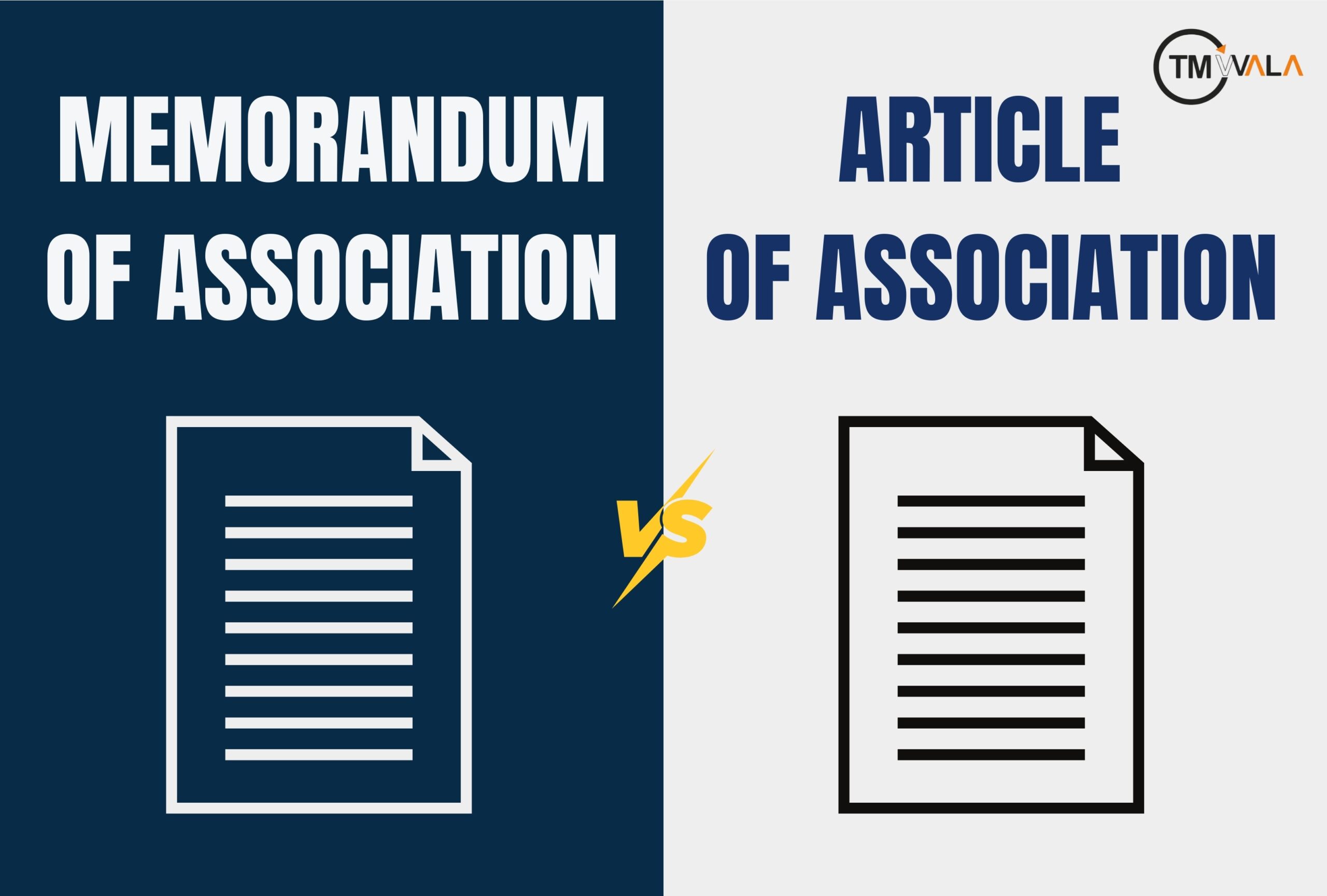
When you start a company, two documents act as its foundation, first one is the Memorandum of Association (MOA) and the second one is the Articles of Association (AOA). These are not just formal paperwork; they define how your company is created, what it can do, and how it will operate. In simple terms, if your company were a human being, the MOA would be its birth certificate and life purpose, while the AOA would be its personal rulebook.
This article explains what MOA and AOA are, the meaning, the contents of MOA and AOA, their importance under Indian company law, and a clear breakdown of the difference between MOA and AOA. If you plan to register a company in India, understanding these company incorporation documents is crucial.
MOA full form is the Memorandum of Association. In company terminology, it is a legal document that outlines the scope, limitations, and main objectives of a company. It is a permanent record that states what the company exists to do and what it cannot do.
Simple Definition: The MOA defines your company’s limits and communicates its objectives to the public. Any activity outside this scope is considered ultra vires, meaning “beyond the powers,” and such an act becomes invalid.
Every MOA must contain six mandatory clauses under the Companies Act, 2013. These clauses of the MOA include:
If you are unsure how to draft your MOA or need personalized guidance, TMWala can help you prepare compliant, professionally crafted documents.
Also read about and understand about Memorandum of Understanding (MOU).
The AOA refers to the rule book for a company’s internal management. While the MOA defines what the company can do, the AOA explains how it will be done.
Simple Definition: The AOA contains the rules and procedures for internal operations such as appointing directors, conducting meetings, issuing shares, and managing voting rights.
Although more flexible than the MOA, the AOA usually contains provisions related to:
The AOA can also include provisions like director retirement by rotation under Section 152(6), helping ensure transparency and good governance.
If drafting an AOA feels complicated, TMWala can help by preparing customised, legally compliant AOA documents tailored to your business needs.
The contents of MOA and AOA differ in structure and purpose:
| DOCUMENT | CONTENT FOCUS |
| MOA | External boundaries, objectives, scope of business |
| AOA | Internal rules, management guidelines, operational norms |
Understanding these contents is essential for complying with the MOA and AOA in company law.
This is one of the most important areas for entrepreneurs to understand. Below is a simple comparison that covers the essential distinction, also addressing the key phrase MOA vs AOA.
These points highlight the essential difference between MOA and AOA, helping founders understand how both documents work together.
The importance of MOA and AOA lies in the fact that they form the backbone of corporate governance. Without these documents, a company cannot be incorporated. They help:
If you are going through the registration process, TMWala can help streamline your paperwork and ensure both documents are perfectly in line with MCA standards.
To register a company in India, the government mandates several essential company incorporation documents, including:
These are the fundamental documents required for company registration in India. Missing or incorrectly drafted documents can delay your approval. TMWala ensures your documents are error-free and compliant.
Although not directly related to company incorporation in India, the phrase AOA insurance sometimes appears in financial contexts to refer to “Aggregate Limit of Liability” in insurance contracts. It is unrelated to the Articles of Association but is often searched due to the acronym AOA. It’s important not to confuse the two.
The MOA and AOA form the legal heart of your business. The MOA sets the direction, while the AOA ensures smooth internal functioning. Whether you’re an entrepreneur, investor, or law student, understanding MOA meaning, AOA, their clauses, and the difference between MOA and AOA is essential for navigating corporate governance in India.
If you want professional support in drafting these documents or registering your company smoothly, TMWala can help with expert guidance and end-to-end documentation support.
Get started instantly
"*" indicates required fields
TMWala
Your one stop shop for all your business registration and compliance needs.
"*" indicates required fields
Choose your Entity Type
Non-MSME/ Large Entitie
Individual/ MSME/ Sole Proprietorships

₹9,000.00 Original price was: ₹9,000.00.₹3,999.00Current price is: ₹3,999.00.
Trademark Application @ ₹3999* (Premium Discounted Plan for MSME/Individual/Sole Proprietorships) Comprehensive
Government Fees
₹4500/-
₹9,000.00 Original price was: ₹9,000.00.₹3,999.00Current price is: ₹3,999.00.
Trademark Application @ ₹3999* (Premium Discounted Plan for Non-MSMEs/Large Entities) Comprehensive
Government Fees
₹9000/-
Choose your Entity Type
Individual/ MSME/ Sole Proprietorships
Non-MSME/ Large Entities

₹3,500.00 Original price was: ₹3,500.00.₹1,999.00Current price is: ₹1,999.00.
Government Fees
₹4500/-
₹3,500.00 Original price was: ₹3,500.00.₹1,999.00Current price is: ₹1,999.00.
Government Fees
₹9000/-
Choose your Entity Type
Individual/ MSME/ Sole Proprietorships
Non-MSME/ Large Entities
₹1,500.00 Original price was: ₹1,500.00.₹999.00Current price is: ₹999.00.
Trademark Application @ ₹999* (Basic Discounted Plan for MSME/Individual/Sole Proprietorships) Best-Selling, Economical & Easy
₹1,500.00 Original price was: ₹1,500.00.₹999.00Current price is: ₹999.00.
Trademark Application @ ₹999* (Basic Discounted Plan for Non-MSMEs/Large Entities) Best-Selling, Economical, Quick and Easy