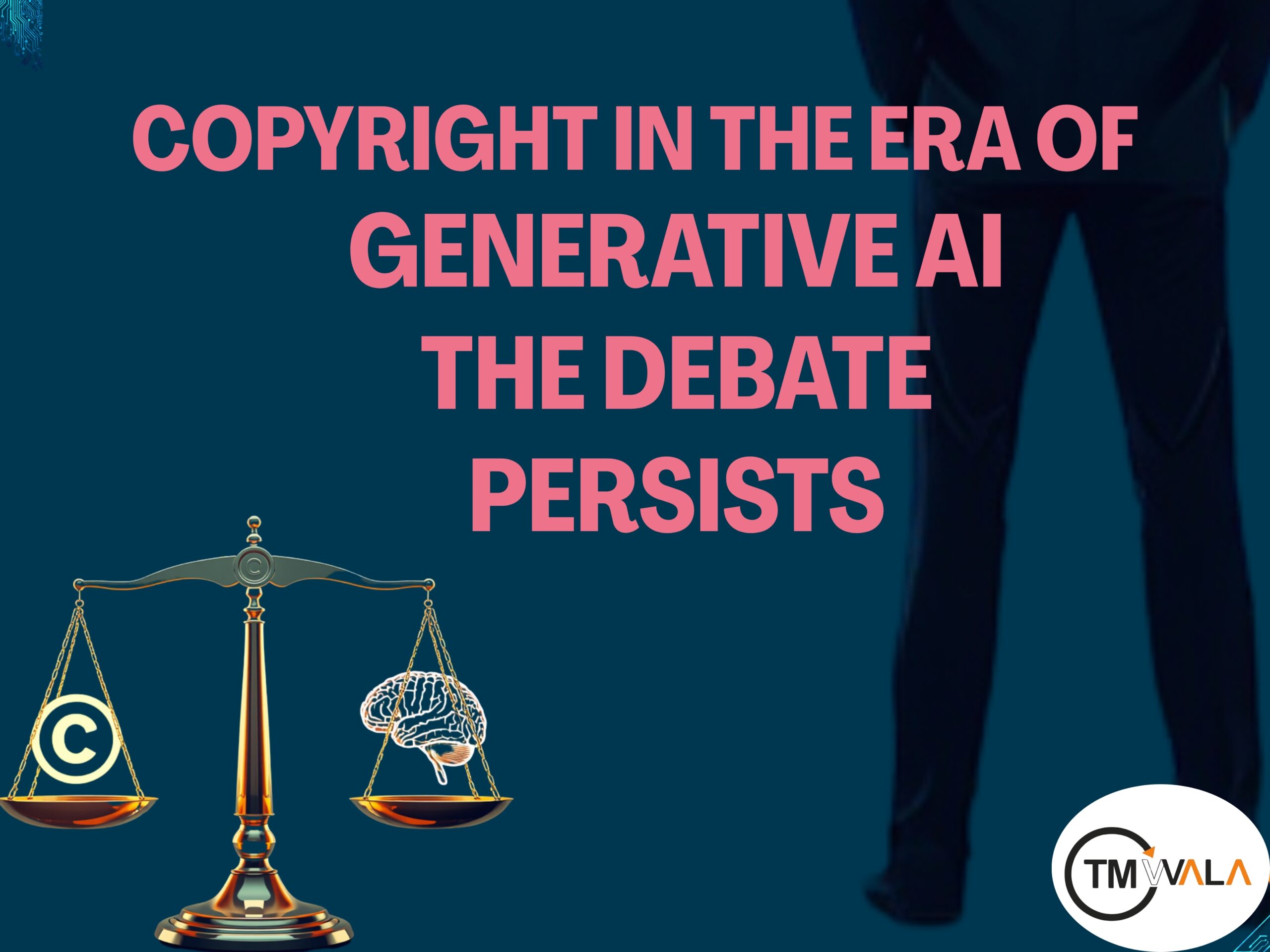
The fast pace of progress in generative artificial intelligence (AI) has revealed entirely new ways to create, disseminate, and use content in today’s time. Generative AI systems are now used for everything, for example like creation of visual images, musical compositions, articles, software code, and even poetry. Such AI systems have made their way into creative and commercial endeavours alike. While these technologies open endless avenues for creativity and productivity, they raise complicated legal and ethical issues, of which one of the most controversial and debated is generative AI copyright.
The copyright laws intend to safeguard creative works and drive innovation, but they must face tests imposed by new technologies capable of producing almost human-like creations in seconds. Lawmakers, technology firms, legal experts, artists, and consumers are concerned about who owns the creations of generative AI, whether it is appropriate to train AI systems with the use of copyrighted material, and whether rights must be given to those who create copyright-protected works in the manual way. Platforms such as TMWala can assist by simplifying the copyright registration process, helping creators protect and document ownership of original works, and providing guidance on broader intellectual property protection
Copyright refers to a system of laws that gives original creators exclusive rights over their artistic creations like novels, music, plays, and any other artistic work. These rights ordinarily involve reproduction, distribution, adaptation, and communication of the work in question. The main aim of copyright is to protect creativity while promoting diffusion of knowledge and culture. For official information on copyright registration, legal procedures, and applicable rules in India, creators can refer to the Copyright Office, Government of India.
Conventionally copyright has presumed that the creator of a work is human. However, with the growth of generative AI is challenging this notion by producing materials with little or no human involvement. Therefore, a crucial question arises whether a machine can be called an author or whether the creator of the AI should be regarded as an owner of the work.
In many jurisdictions copyright law does not provide any legal answers in this sense thus creating legal problems.
Generative AI models take in huge datasets consisting of texts, images, music, videos, and different kinds of content. While learning from the datasets, these systems are said to check for connections and patterns in data and not to memorize specific works. When generating outputs, these systems rely on their prompt from the users.
While producing unique-looking content, AI makes use of materials that are already out there. The training data is believed to involve copyrighted material from books, websites, artworks, photographs, news articles, and other forms of digital material used for free by the public.
Usage of copyrighted content for purposes of AI training is a controversial copyright issue. Business firms in the technological field argue that the process of AI training involves the use of data rather than the reproduction of any form of artistic expression. They argue that AI develops statistical associations instead of storing entire copies of works protected under copyright law, and therefore the learning of AI can be compared to that of humans.
At the same time, artists, musicians, journalists, photographers, and authors have a contrasting view on the problem. They maintain that AI uses creative work for commercial purposes without obtaining any licenses or paying any royalties, and many of creators believe that if their creative work is used in the process of making AI, they should get a credit for it as well as any other compensation that they are entitled to.
Due to the disagreement, there have been a lot of cases in different countries. Courts are often asked to adjudicate whether AI training is fair use, fair dealing, or copyright infringement provided the relevant national legislature.
Most copyright laws necessitate work to show originality owing to human creativity. Hence, AI-generated work may not enjoy copyright protection in various jurisdictions. With no human author, such works may instantly become part of the public domain.
Nevertheless, numerous AI products involve substantial human intervention. Users may craft their prompts, modify the output, and combine several outputs. Therefore, the issue of how much creativity was exercised by the user is of paramount importance.
Possible claims of ownership include the following:
The absence of international consensus has created problems in obtaining copyright for businesses and professionals relying on AI-generated works.
Copyright litigation over ownership of AI raises questions of fair use and fair dealing.
In those jurisdictions where fair use is recognized, courts typically analyse the following factors for consideration:
It is still unclear whether AI training is deemed as fair use. Different conclusions could be reached in court based on how AI models were created, whether the content is present in outputs, and the nature of the technology.
Countries implementing fair dealing mechanisms use exceptions that are narrower, which can potentially lead to different legal outcomes.
Governments worldwide are actively examining how copyright laws should respond to generative AI. Some policymakers advocate mandatory transparency regarding training datasets, allowing creators to determine whether their works have been used. Another is licensing systems through which AI developers would compensate copyright holders for access to protected content.
Several proposals also include:
International cooperation may become essential, as AI systems frequently operate across national borders.
Legal compliance alone may not resolve the broader ethical concerns surrounding copyright issues in generative AI.
Many creators argue that respect for artistic labour extends beyond copyright law. Even if AI training is legally permissible, questions remain about fairness, transparency, attribution, and consent.
AI developers increasingly recognise the importance of responsible innovation. Some organisations are exploring licensing agreements with publishers, artists, music companies, and stock image providers. Others have introduced safeguards to reduce the generation of content closely resembling copyrighted works. Building trust between technology developers and creative communities may prove just as important as legal reform.
Policymakers face the task of finding the right balance between two critical goals. On one side, strict copyright laws can stifle innovation in AI and exacerbate expenses in development and scientific breakthroughs.
On the second side, without adequate protection, human creativity may suffer since it would permit commercial exploitation of their original works without permission and compensation.
Hence, there is a need to have a legally balanced approach that would facilitate innovation and at the same time keep creators’ rights to their intellectual property intact.
The ongoing debate over copyright issues arising from generative AI technologies will continue to develop in accordance with advancements in technology, court decisions, and changes in legislation.
Future regulations may create a distinction among types of AI-generated content according to human involvement and AI training methods. There may also be a necessity for harmonization of copyright laws among countries to achieve a unified approach to cross-border digital technologies.
Enterprises implementing generative AI should respect regulations that change constantly and implement responsible AI regulation policies in accordance with copyright laws. At the same time, creators of generative AI technologies need to be aware of licensing and other legal protection possibilities.
Generative AI is one of the game changing and advent technologies of the 21st century, bringing unique new possibilities in the fields of creativity, efficiency and innovation. However, it also creates challenges to a few traditional assumptions on which copyright law is based. Issues related to ownership, authorship, licensing and copyrighted training data are still open to debate, which means that the legal and political disputes continue all around the world.
As numerous stakeholders, including governments, courts, technology firms and creative communities, are shaping the future of copyright legislation, it’s crucial to strike the right balance between protecting creator’s interests and promoting innovation. Good regulation should guarantee that creator’s interests are protected without putting any obstacles on the way of innovation. TMWala supports individuals, startups, and organisations by streamlining copyright registration and offering guidance on intellectual property matters, enabling creators to focus on innovation while taking practical measures to safeguard their creative works in the age of generative AI.
1. What is generative AI?
Ans. Generative AI creates text, images, music, code, and other content using machine learning.
2. Can AI-generated content be copyrighted?
Ans. It depends on the country’s copyright laws and the level of human involvement.
3. Is it legal to train AI on copyrighted content?
Ans. This remains a debated legal issue in many jurisdictions.
4. Who owns AI-generated content?
Ans. Ownership varies based on applicable laws and the extent of human contribution.
5. Can AI copy copyrighted works?
Ans. AI should not reproduce copyrighted content, but disputes can arise in some cases.
6. Why is copyright important for creators?
Ans. It protects original works and grants creator’s exclusive legal rights.
7. Should creators register their copyright?
Ans. Registration strengthens ownership claims and aids in legal enforcement.
8. How can businesses protect AI-assisted creations?
Ans. By documenting human contributions and securing intellectual property where applicable.
9. How does TMWala help creators?
Ans. TMWala assists with copyright registration and intellectual property guidance.
10. Will copyright laws change because of AI?
Ans. Many countries are considering updates to address AI-related copyright challenges.
Get started instantly
"*" indicates required fields
TMWala
Your one stop shop for all your business registration and compliance needs.
"*" indicates required fields
Choose your Entity Type
Non-MSME/ Large Entitie
Individual/ MSME/ Sole Proprietorships
₹9,000.00 Original price was: ₹9,000.00.₹3,999.00Current price is: ₹3,999.00.
Trademark Application @ ₹3999* (Premium Discounted Plan for MSME/Individual/Sole Proprietorships) Comprehensive
Government Fees
₹4500/-
₹9,000.00 Original price was: ₹9,000.00.₹3,999.00Current price is: ₹3,999.00.
Trademark Application @ ₹3999* (Premium Discounted Plan for Non-MSMEs/Large Entities) Comprehensive
Government Fees
₹9000/-
Choose your Entity Type
Individual/ MSME/ Sole Proprietorships
Non-MSME/ Large Entities
₹3,500.00 Original price was: ₹3,500.00.₹1,999.00Current price is: ₹1,999.00.
Government Fees
₹4500/-
₹3,500.00 Original price was: ₹3,500.00.₹1,999.00Current price is: ₹1,999.00.
Government Fees
₹9000/-
Choose your Entity Type
Individual/ MSME/ Sole Proprietorships
Non-MSME/ Large Entities
₹1,500.00 Original price was: ₹1,500.00.₹999.00Current price is: ₹999.00.
Trademark Application @ ₹999* (Basic Discounted Plan for MSME/Individual/Sole Proprietorships) Best-Selling, Economical & Easy
₹1,500.00 Original price was: ₹1,500.00.₹999.00Current price is: ₹999.00.
Trademark Application @ ₹999* (Basic Discounted Plan for Non-MSMEs/Large Entities) Best-Selling, Economical, Quick and Easy