
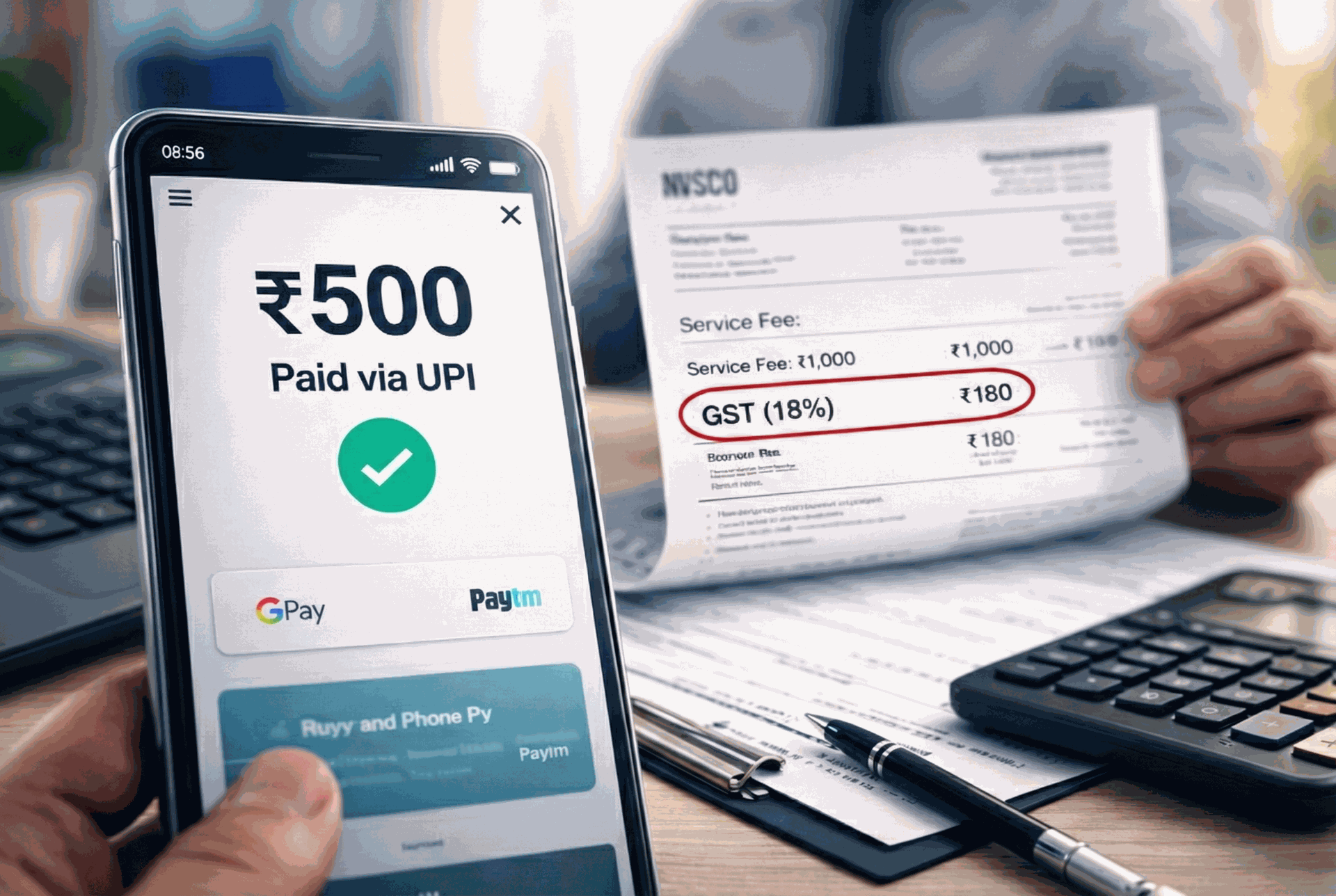
Your customer pays ₹500 via UPI. The money gets into your account. Simple. But then you open your payment gateway dashboard at the end of the month and find a line item asking, “Is there GST on UPI payment?” You were told UPI is free. So what exactly are you paying?
This confusion trips up thousands of merchants across India every month. The answer is not complicated once you understand where UPI ends and where your payment gateway begins. Let us walk through it clearly.
UPI charges for merchants on peer-to-merchant transactions are officially set at zero under government mandate. The National Payments Corporation of India (NPCI), which operates the UPI network, works under NPCI UPI guidelines that support zero-cost transactions for peer-to-merchant (P2M) payments. The government reinforced this by directing that Merchant Discount Rate (MDR) charges on UPI and RuPay debit card transactions be waived, with banks reimbursed through a separate government scheme.
That part is free. What is not free is the software layer sitting on top of it.
When you collect UPI payments through a third-party platform, a payment gateway, a payment aggregator, or an app-based checkout, that company charges you for its service. It is building and maintaining the infrastructure: the APIs, the dashboard, the reconciliation tools, and the support team. That service fee is where GST enters the picture.
GST on UPI payment does not apply to the transaction itself. It applies to the service fee a payment gateway charges you for facilitating that transaction, and that fee is a taxable service under the GST on financial services rules.
This is a critical distinction. And most merchant invoices do not explain it clearly.
MDR stands for Merchant Discount Rate. It is the percentage a bank historically charged a merchant every time a customer paid by card or UPI. For UPI and RuPay debit card transactions, the government mandated that MDR be set to zero. This means the acquiring bank cannot charge you a percentage of the transaction value.
Zero MDR is real. But it only eliminates one specific type of charge.
Payment gateways operate on a different commercial arrangement. They charge a platform fee or a service fee for providing the technology and compliance infrastructure that lets you accept digital payments. That fee is a taxable service under the GST framework. The applicable rate is 18%, classified under financial and IT-enabled services.
So the situation looks like this: the bank takes nothing from the transaction (zero MDR), but the gateway takes a small fee for its service, and GST on that fee is 18%. The GST on MDR charges is effectively zero because the MDR itself is zero. But the gateway service charge is a separate matter entirely.
Confusing these two is the most common mistake merchants make when reading their payment statements. When merchants ask about UPI charges for merchants, they are often conflating two different things: the free network transaction and the gateway service, which is not.
Most merchants notice the net amount debited and move on. Few actually open the tax invoice that their payment gateway is legally required to issue them.
Every GST-registered payment gateway or aggregator in India must issue a proper tax invoice. That invoice shows the base service charge and the 18% GST applied on top. This is exactly how GST on service charges in India works for B2B payment services. If your gateway charges you ₹1,000 in platform fees for the month, you are paying ₹1,180 total. The ₹180 is GST on payment gateway charges.
The rate of 18% comes from the GST classification of payment gateway and financial intermediary services. These fall under the standard taxable category for GST on financial services, not under any exemption. (The relevant exemption notification under GST, Notification No. 12/2017-Central Tax (Rate), covers specific financial services like interest income and insurance premium components. Payment technology and gateway services are not included.)
This matters for two reasons. First, you should know what you are paying. Second, if you are a GST-registered business, you may be able to recover it. More on that shortly.
Your bank statement carries several types of charges. Not all of them attract GST, and the distinction is worth understanding. Merchants often ask, “Is GST applicable to service charges?” The answer depends entirely on whether the charge is a discrete, itemized fee or falls under a protected financial activity.
GST on bank charges does not apply uniformly, and the same logic carries over to GST on banking services more broadly. The GST framework gives specific exemptions to certain core banking activities. Interest charged on loans is exempt from GST. Interest earned on savings and fixed deposits is also outside the GST net. Basic services related to credit extension and deposit acceptance generally fall under the exempted category, because charging GST on interest income would essentially be taxing a core financial product.
But the moment a bank charges you a discrete service fee, the picture changes. These itemized fees all attract GST at 18%:
Each of these is a fee-for-service, which is the trigger for GST on bank charges.
The underlying principle in GST on banking services is this: if the bank is acting as a lender or deposit-taker, the income is exempt. If the bank is providing a service, you can charge a fee-for-activity; GST applies.
For UPI-related charges specifically, GST on bank charges for API integration or platform access fees, common in enterprise-level UPI implementations, sits at 18%. If no discrete fee is charged, no GST applies
Yes. And most small merchants do not bother.
If your business is registered under GST and your payment gateway issues you a valid tax invoice, the 18% GST you pay on their service fee qualifies as Input Tax Credit (ITC). You can offset it against your GST output liability.
To claim ITC on GST on payment gateway charges, you need a valid GST invoice from the gateway with their GSTIN and yours, proof that the service was received, and that the charge appears correctly in your GSTR-2B (the auto-populated ITC statement).
The condition is standard: the supplier must have filed their GSTR-1, and the invoice must be reflected in your GSTR-2B before you can claim it. This is the same rule that applies to any business expense carrying GST.
For a merchant processing ₹50 lakh a month through a gateway at even a 0.5% platform fee, the annual GST outflow on those charges is not negligible. Claiming ITC on it reduces your net cost of accepting digital payments.
One practical note: if your business makes exempt supplies (for example, if you sell goods or services that are GST-exempt), your ITC eligibility may be proportional. Check with your tax advisor on the applicable ITC reversal rules before claiming.
GST on UPI payment does not mean you are being taxed on every transaction your customer makes. UPI charges for merchants at the network level are zero. UPI transactions are MDR-free by government mandate, and GST on MDR charges is effectively zero because the MDR itself is zero.
What you pay GST on is the service your payment gateway or aggregator provides: the technology, the platform, and the processing infrastructure. That service attracts 18% GST, and it shows up on a tax invoice that your provider is required to give you.
If your business is GST-registered, that 18% is not a sunk cost. It is recoverable through ITC, provided your invoicing details are correct and your supplier files on time.
Understanding this distinction does not require an accountant. It requires reading your invoice once.
TMWala helps merchants understand the real cost of every payment method, including what is recoverable and what is not. If you are reviewing your payment setup or comparing gateway options, start with a clear picture of what you are actually paying.
Get started instantly
"*" indicates required fields

TMWala
Your one stop shop for all your business registration and compliance needs.
"*" indicates required fields
Choose your Entity Type
Non-MSME/ Large Entitie
Individual/ MSME/ Sole Proprietorships

₹9,000.00 Original price was: ₹9,000.00.₹3,999.00Current price is: ₹3,999.00.
Trademark Application @ ₹3999* (Premium Discounted Plan for MSME/Individual/Sole Proprietorships) Comprehensive
Government Fees
₹4500/-
₹9,000.00 Original price was: ₹9,000.00.₹3,999.00Current price is: ₹3,999.00.
Trademark Application @ ₹3999* (Premium Discounted Plan for Non-MSMEs/Large Entities) Comprehensive
Government Fees
₹9000/-
Choose your Entity Type
Individual/ MSME/ Sole Proprietorships
Non-MSME/ Large Entities

₹3,500.00 Original price was: ₹3,500.00.₹1,999.00Current price is: ₹1,999.00.
Government Fees
₹4500/-
₹3,500.00 Original price was: ₹3,500.00.₹1,999.00Current price is: ₹1,999.00.
Government Fees
₹9000/-
Choose your Entity Type
Individual/ MSME/ Sole Proprietorships
Non-MSME/ Large Entities
₹1,500.00 Original price was: ₹1,500.00.₹999.00Current price is: ₹999.00.
Trademark Application @ ₹999* (Basic Discounted Plan for MSME/Individual/Sole Proprietorships) Best-Selling, Economical & Easy
₹1,500.00 Original price was: ₹1,500.00.₹999.00Current price is: ₹999.00.
Trademark Application @ ₹999* (Basic Discounted Plan for Non-MSMEs/Large Entities) Best-Selling, Economical, Quick and Easy