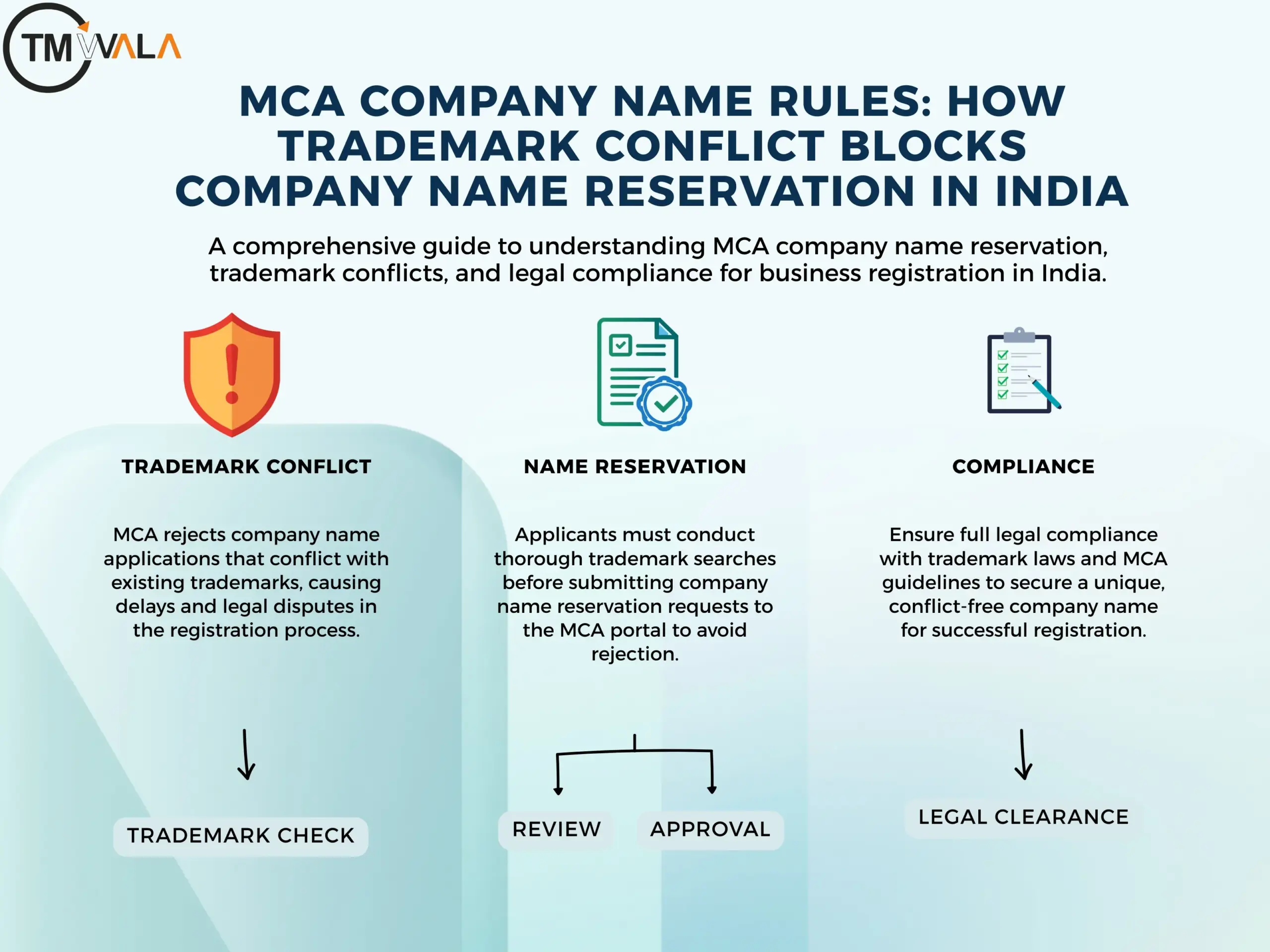
Choosing a company name is one of the most significant steps during the incorporation of a company. A company name is not a mere regulatory requirement under Indian company law; rather, it is a valuable business asset that embodies the company’s identity, reputation, goodwill, and brand value. As businesses use their corporate names to develop their market recognition, challenges and disputes frequently arise when a proposed company name resembles an existing company’s name or a registered trademark.
Such parallels can lead to confusion among customers, hamper the identities of already established brands, and lead businesses to costly legal disputes. To prevent these issues, the Companies Act, 2013, read with the Companies (Incorporation) Rules, 2014, provides a proper detailed MCA company name rules that govern company name approval and reservation. Simultaneously, the TradeMarks Act, 1999 protects the exclusive rights of trademark owners against unauthorized use of identical or deceptively similar marks.
Together, these laws ensure that businesses cannot obtain an unfair commercial advantage by adopting misleading corporate names. Therefore, compliance with the MCA name reservation rules, verifying company name availability in India, and conducting a proper trademark search are essential steps before filing for startup registration.
So, whether you are an entrepreneur, startup founder, or an established business that wants to obtain professional guidance and simplify the company name reservation process. Legal platforms such as TMWala assist businesses in conducting company name availability checks, trademark searches, and ensuring compliance with the MCA company name rules before filing for company incorporation.
The legal framework for company name approval is primarily contained in Section 4 of the Companies Act, 2013[1]. The provision requires that every proposed company name:
Although Section 4 empowers the Central Government to prescribe detailed rules regarding undesirable or conflicting names. Accordingly, Rules 8, 8A, and 9 of the Companies (Incorporation) Rules, 2014 regulate MCA name availability rules and the examination of proposed company names. These provisions give power to the Ministry of Corporate Affairs (MCA) to scrutinize proposed names before incorporation and reject names that conflict with existing corporate identities or trademarks.
One of the most important MCA company name rules is contained in Rule 8 of the Companies (Incorporation) Rules, 2014. The rule states that minute variations cannot distinguish two company names, such as: Punctuation marks, Spaces, Singular or plural forms, Abbreviations, Corporate suffixes like “Private”, “Limited”, “Company”, or “LLP”. Hence, they are generally ignored while assessing similarity. The objective of these rules is to prevent applicants from obtaining approval by making only superficial changes to an existing company name. Instead of examining spelling differences alone, the Registrar of Companies evaluates the overall commercial impression created by the proposed name. This approach minimizes public confusion and protects the goodwill associated with established businesses while supporting effective brand protection.
Among all the MCA name reservation rules, Rule 8A plays the most significant role in preventing trademark disputes.
A proposed company name is considered undesirable if it contains:
unless the applicant submits a written No Objection Certificate (NOC) or consent from the trademark owner.
Rule 8A also prohibits names that:
This provision creates a direct connection between the Companies Act and trademark law. Before approving a company name, the Registrar of Companies must examine both existing company names and records maintained in the Trademark Registry.
Therefore, businesses must conduct a complete trademark availability search before applying for company incorporation to prevent rejection and future litigation.
For more information, visit: https://www.mca.gov.in/content/mca/global/en/acts-rules/ebooks/rules.html
The procedure for reserving a company name is governed by Rule 9 of the Companies (Incorporation) Rules, 2014.
Applications are submitted electronically through the Ministry of Corporate Affairs using:
Once an application is filed, it is examined by the Central Registration Centre (CRC) in accordance with:
The Registrar verifies whether the proposed name:
If the proposed name of the company complies with the law, it is reserved for the prescribed period. Otherwise, the application may be rejected or returned for resubmission with modifications.
The induction of SPICe+ has substantially streamlined startup registration by incorporating varied regulatory approvals into a single online application. The RUN service streamlines name reservation and company name changes by enabling early identification of trademark conflicts.
There are many entrepreneurs who mistakenly assume that a company name is approved by the MCA automatically guarantees the legal right to use that name in business. In reality, MCA approval does not override trademark rights.
Before applying for incorporation, businesses should conduct:
The trademark availability search significantly reduces the risk of rejection during name reservation and helps businesses avoid infringement claims after incorporation.
Even after incorporation, conflicts may arise if a misleading company name is approved. To deal with such situations, Section 16 of the Companies Act, 2013[2] empowers the Central Government to direct a company to change its name. Under Section 16(1)(a), a company may be required to change its name if it is identical with or too similar to an existing company’s name. Under Section 16(1)(b), the registered proprietor of a trademark may seek rectification where a company’s name is identical or deceptively similar to a registered trademark.
If the company fails to comply with the Government’s direction, the Central Government may allocate a new name, and the Registrar of Companies will issue a fresh Certificate of Incorporation.
Businesses running a smooth company incorporation should implement the following precautions:
The legal framework regulating company name reservation in India seeks to balance ease of incorporation while protecting existing commercial identities. Section 4 of the Companies Act, 2013, together with Rules 8, 8A, and 9 of the Companies (Incorporation) Rules, 2014, empowers the Ministry of Corporate Affairs to reject names that are identical, deceptively similar, or otherwise undesirable. Section 16 further offers an efficient remedy where a disputing company name has already been registered.
Digital platforms such as SPICe+ and RUN have strengthened the incorporation process by enabling systematic examination of proposed names before registration. However, MCA approval does not automatically grant the legal right to use a company name that infringes trademark rights or misleads consumers.
For entrepreneurs and businesses, verifying the availability of a company name in India, conducting an extensive trademark search, and understanding the MCA name availability rules are important steps toward successful startup registration, long-term brand safety, and legally compliant company incorporation.
Platforms such as TMWala support entrepreneurs by assisting with the company’s incorporation process in compliance with MCA Rules.
[1]The Companies Act, 2013, section 4, Act No. 18, Acts of Parliament, 2013 (India).
[2]The Companies Act, 2013, section 16, Act No. 18, Acts of Parliament, 2013 (India).
Get started instantly
"*" indicates required fields
TMWala
Your one stop shop for all your business registration and compliance needs.
"*" indicates required fields
Choose your Entity Type
Non-MSME/ Large Entitie
Individual/ MSME/ Sole Proprietorships
₹9,000.00 Original price was: ₹9,000.00.₹3,999.00Current price is: ₹3,999.00.
Trademark Application @ ₹3999* (Premium Discounted Plan for MSME/Individual/Sole Proprietorships) Comprehensive
Government Fees
₹4500/-
₹9,000.00 Original price was: ₹9,000.00.₹3,999.00Current price is: ₹3,999.00.
Trademark Application @ ₹3999* (Premium Discounted Plan for Non-MSMEs/Large Entities) Comprehensive
Government Fees
₹9000/-
Choose your Entity Type
Individual/ MSME/ Sole Proprietorships
Non-MSME/ Large Entities
₹3,500.00 Original price was: ₹3,500.00.₹1,999.00Current price is: ₹1,999.00.
Government Fees
₹4500/-
₹3,500.00 Original price was: ₹3,500.00.₹1,999.00Current price is: ₹1,999.00.
Government Fees
₹9000/-
Choose your Entity Type
Individual/ MSME/ Sole Proprietorships
Non-MSME/ Large Entities
₹1,500.00 Original price was: ₹1,500.00.₹999.00Current price is: ₹999.00.
Trademark Application @ ₹999* (Basic Discounted Plan for MSME/Individual/Sole Proprietorships) Best-Selling, Economical & Easy
₹1,500.00 Original price was: ₹1,500.00.₹999.00Current price is: ₹999.00.
Trademark Application @ ₹999* (Basic Discounted Plan for Non-MSMEs/Large Entities) Best-Selling, Economical, Quick and Easy