Non-Conventional Trademarks in India: Law & Process

Non-Conventional Trademarks and Their Registration

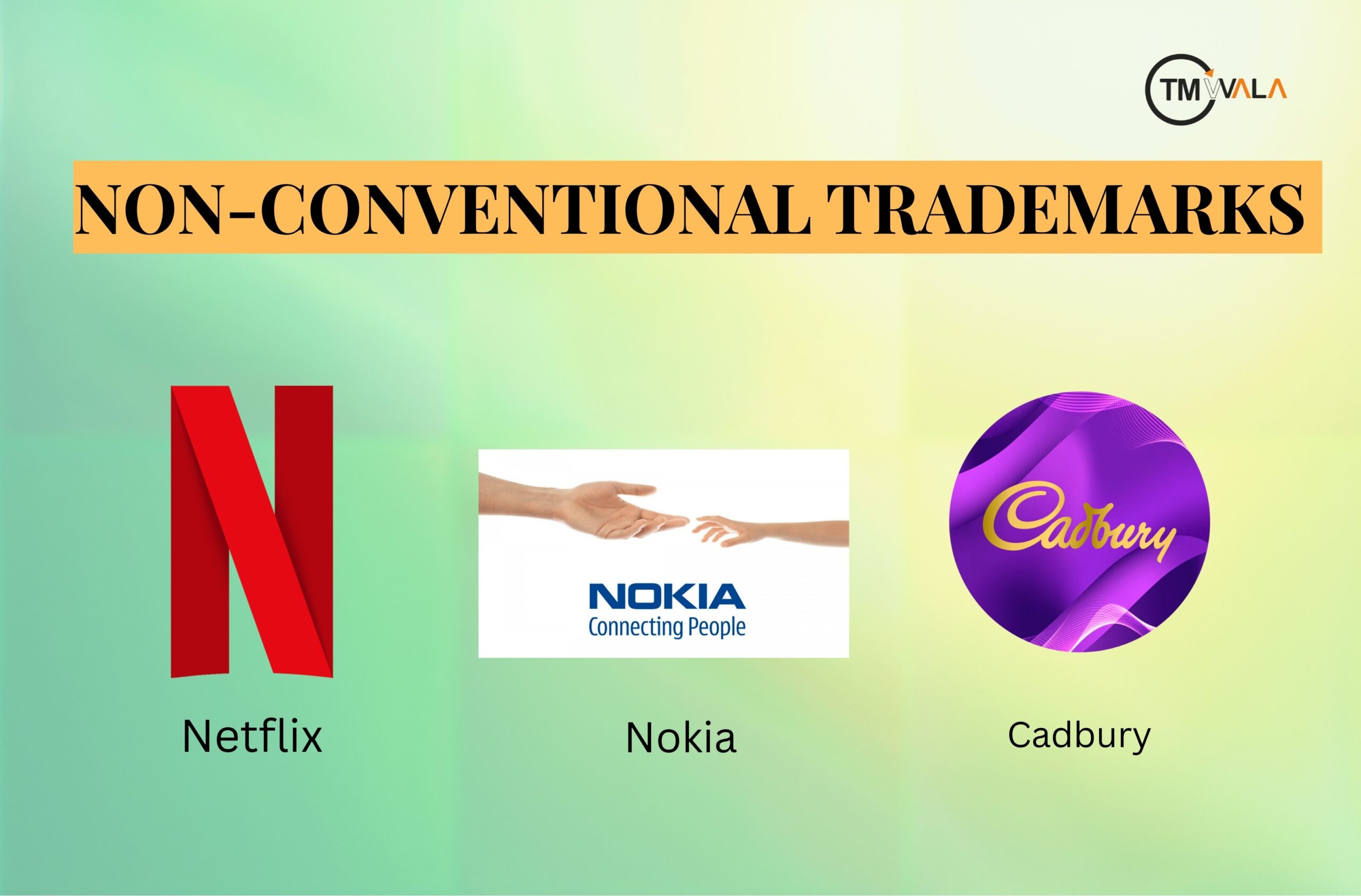
non-conventional trademarks with Netflix, Nokia, and Cadbury logos on a gradient background.

In today’s highly competitive business environment, trademarks have evolved far beyond traditional word and logo marks. Modern brands are increasingly leveraging distinctive sounds, colors, shapes, motions, smells, and even textures to create a unique identity and deepen consumer engagement. These non-conventional trademarks are emerging as powerful tools for brand differentiation, enabling companies to communicate their values and personality in ways that transcend conventional visual branding.

Globally, intellectual property frameworks have adapted to recognize and protect these innovative forms of branding. Organizations such as the World Intellectual Property Organization (WIPO) and its Standing Committee on Trademarks, Industrial Designs, and Geographical Indications (SCT) have acknowledged the significance of non-traditional trademarks and the need for their legal protection. By protecting these unconventional brand assets, companies can enhance consumer recognition and loyalty while safeguarding their market reputation from imitators.

While jurisdictions like the United States and the European Union have developed more comprehensive procedures and legal frameworks for non-traditional trademarks, India’s legal landscape remains in a relatively nascent stage. The country has taken initial steps to accommodate these innovative trademarks, particularly sound and shape marks, but the legal and administrative processes remain complex and underdeveloped. Nonetheless, recent landmark registrations and judicial pronouncements indicate a growing recognition of the importance of non-conventional trademarks in India.

Types of Non-Conventional Trademarks

Non-conventional trademarks are marks that extend beyond the traditional textual or visual logo marks. Some common types include:

TYPE OF TRADEMARKEXAMPLE
Motion MarksNokia’s “Hands Connecting” Motion Mark
Sound MarksNetflix’s “Ta-Da” Notification Sound
Smell MarksSumitomo Rubber Industries’ “Rose-Scented” Tyres
Colour MarksCadbury’s Purple Colour Packaging
Shape MarksCoca-Cola’s Contoured Bottle Shape

These marks are often highly distinctive and capable of signaling the source of goods or services without relying on traditional textual or logo representations. Their adoption by leading global brands highlights their commercial and strategic value. For example, Nokia’s motion mark and Netflix’s introduction sound have become instantly recognizable to consumers, creating strong brand associations that go beyond conventional logos. Similarly, Sumitomo Rubber Industries’ olfactory (smell) mark for tyres represents a breakthrough in sensory branding, demonstrating the potential for trademarks to engage multiple senses.

Registration Process for Non-Conventional Trademark in India

Registering a non-conventional trademark in India is a detailed process requiring careful preparation, given the novelty and complexity of such marks. The process typically involves the following steps:

  1. Conduct a Trademark Search: Before applying, it is essential to conduct a comprehensive search to ensure that the proposed mark does not conflict with any existing registrations. For non-conventional trademarks, this search can be particularly challenging, as traditional trademark search methods primarily focus on word and logo marks. A thorough search can prevent future disputes and objections, saving time and resources.
  2. Filing the Trademark Application: Once a clear search confirms the uniqueness of the mark, the application must be submitted to the Controller General of Patents, Designs, and Trademarks. The application should include detailed descriptions of the trademark, along with graphical, scientific, or technical representations, where applicable, to accurately convey the mark. Non-conventional trademarks often require specialized documentation, such as audio files for sound marks, 3D models for shape marks, or chemical descriptions for smell marks.
  3. Examination Process: The trademark office examines the application to determine whether the mark meets the statutory requirements, including distinctiveness and non-deceptiveness. For unconventional trademarks, examiners carefully evaluate whether the mark can clearly distinguish the applicant’s goods or services from those of others and whether it can be represented in a manner that is intelligible, durable, and objective.
  4. Publication in the Trademark Journal: If the application meets the examination requirements, it is published in the Trademark Journal to invite opposition. Third parties can file objections within a stipulated period if they believe the mark conflicts with their rights. This stage is particularly critical for non-conventional trademarks, as objections often arise regarding graphical representation or distinctiveness.
  5. Registration and Certification: If no opposition is filed or any opposition is successfully resolved, the trademark is registered, and the applicant receives a certificate of registration. The registered non-conventional trademark then enjoys the same legal protection as traditional trademarks under the Trade Marks Act, 1999, including the right to prevent unauthorized use and to seek damages for infringement.

Notable Examples of Non-Conventional Trademarks

Several prominent non-conventional trademarks have successfully been registered in India, reflecting the growing acceptance of innovative branding:

  • Nokia’s “Hands Connecting” Motion Mark – Application No. 2008135, Trade Marks Act, 1999.
  • Sound of Human Yodelling “YAHOO!” – Application No. 1270406, registered in 2008.
  • Cadbury’s Purple Packaging – Société des Produits Nestlé SA v. Cadbury UK Ltd [2017] EWCA Civ 358.
  • Sumitomo Rubber Industries’ Rose-Scented Tyres – Application No. TMR/DEL/SCH/2025/16.

These examples illustrate the diversity of non-conventional marks and the innovative strategies employed by companies to strengthen brand identity.

Challenges in Registering Non-Convention Trademarks in India

Despite the potential benefits, registering non-conventional trademarks in India involves unique challenges:

  1. Trademark Search: Due to the unconventional nature of these marks, conducting an exhaustive search to detect conflicts is more complicated than for standard word or logo marks.
  2. Graphical Representation: One of the most critical hurdles is providing a precise and objective representation of the mark. This is especially challenging for sensory marks such as scents or textures. Recent registrations, like Sumitomo Rubber’s rose-scented tyres, illustrate how scientific graphical representation can meet these requirements.
  3. Establishing Uniqueness: The applicant must demonstrate that the mark is distinctive and capable of identifying the source of goods or services. Arbitrary or non-functional characteristics often strengthen the argument for distinctiveness.
  4. Demonstrating Consumer Recognition: It is necessary to show that the mark can effectively distinguish the goods or services of one entity from those of others, particularly in competitive markets.

Conclusion

Non-conventional trademarks are transforming the way businesses build and protect their brand identities. From motion and sound marks to scents, colours, and shapes, these marks enable companies to engage consumers in novel ways and create lasting impressions. While India’s legal framework for non-traditional trademarks is still evolving, recent registrations and landmark cases indicate a growing recognition of their significance.

The registration process, though challenging, can be navigated effectively with the right guidance. Companies must focus on distinctiveness, graphical representation, and thorough legal compliance to ensure robust protection.

Service providers like TMWala play a pivotal role in helping businesses secure, monitor, and enforce non-conventional trademarks in India and internationally. By leveraging their expertise, companies can maximize the commercial value of their innovative brand assets while safeguarding them against infringement.

FAQs

  1. What are non-conventional trademarks?
    Trademarks that go beyond words or logos, such as sounds, colours, shapes, motions, smells, or textures.
  2. Why are non-conventional trademarks important?
    They help brands stand out, create unique identities, and strengthen consumer recognition.
  3. Can non-conventional trademarks be registered in India?
    Yes, India allows registration of marks like sound, shape, color, motion, and smell marks.
  4. What is an example of a sound trademark?
    Netflix’s “Ta-Da” notification sound.
  5. What is a key challenge in registering these trademarks?
    Providing clear and objective representation, especially for scents or textures.
  6. What is the first step in registration?
    Conduct a thorough trademark search to ensure the mark is unique.
  7. What documents are needed for filing?
    Audio files, 3D models, chemical descriptions, or technical representations, depending on the mark type.
  8. How is the trademark examined?
    The office checks distinctiveness, non-deceptiveness, and the mark’s ability to identify goods or services.
  9. Can third parties oppose registration?
    Yes, after publication in the Trademark Journal, objections can be filed.
  10. Do registered non-conventional trademarks have legal protection?
    Yes, they enjoy the same rights as traditional trademarks under the Trademarks Act, 1999.

Get started instantly

Hero enquiry form

"*" indicates required fields

Name*
This field is for validation purposes and should be left unchanged.

Leave a Reply

Your email address will not be published. Required fields are marked *


The reCAPTCHA verification period has expired. Please reload the page.

"Protect Your Brand with Our Legal Expertise!"

Get an Instant Call Back from Our Legal Experts

Hero enquiry form

"*" indicates required fields

Name*
This field is for validation purposes and should be left unchanged.

Choose your Entity Type

Non-MSME/ Large Entitie

Individual/ MSME/ Sole Proprietorships
File a Trademark, Trademark application logo of TMWala

Original price was: ₹9,000.00.Current price is: ₹3,999.00.

Trademark Application @ ₹3999* (Premium Discounted Plan for MSME/Individual/Sole Proprietorships) Comprehensive

Government Fees

₹4500/-

Add to cart
File a Trademark, Trademark application logo of TMWala

Original price was: ₹9,000.00.Current price is: ₹3,999.00.

Trademark Application @ ₹3999* (Premium Discounted Plan for Non-MSMEs/Large Entities) Comprehensive

Government Fees

₹9000/-

Add to cart

Choose your Entity Type

Individual/ MSME/ Sole Proprietorships

Non-MSME/ Large Entities
Original price was: ₹3,500.00.Current price is: ₹1,999.00.

Government Fees

₹4500/-

Add to cart

Original price was: ₹3,500.00.Current price is: ₹1,999.00.

Government Fees

₹9000/-

Add to cart

Choose your Entity Type

Individual/ MSME/ Sole Proprietorships

Non-MSME/ Large Entities

Trademark Application by TMWala

Original price was: ₹1,500.00.Current price is: ₹999.00.

Trademark Application @ ₹999* (Basic Discounted Plan for MSME/Individual/Sole Proprietorships) Best-Selling, Economical & Easy

Government Fees

₹4500/-

Add to cart
Trademark Application by TMWala

Original price was: ₹1,500.00.Current price is: ₹999.00.

Trademark Application @ ₹999* (Basic Discounted Plan for Non-MSMEs/Large Entities) Best-Selling, Economical, Quick and Easy

Government Fees

₹9000/-

Add to cart