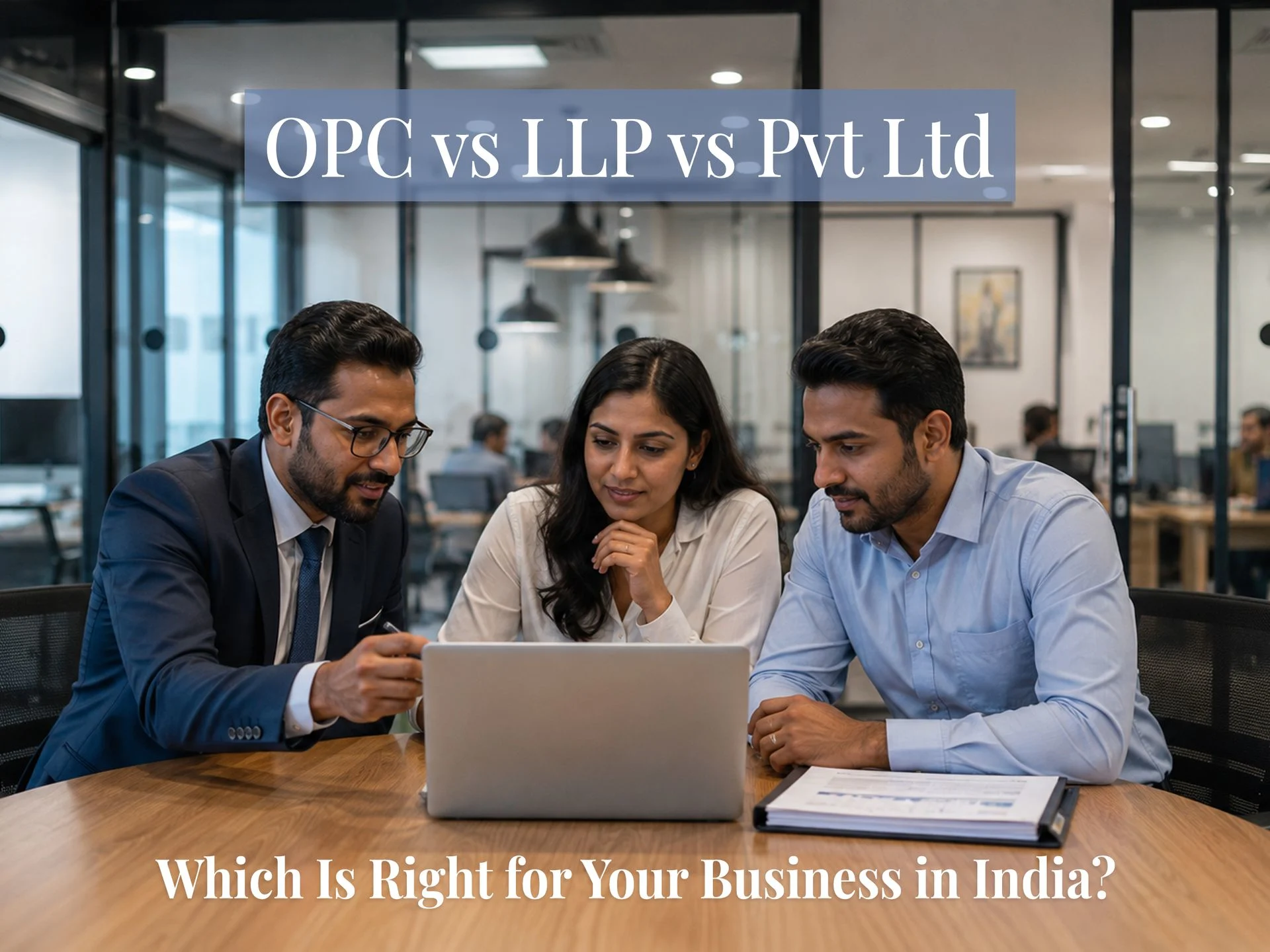
You have a business idea. Maybe you already have revenue. Now comes the question most founders delay longer than they should: which legal structure do you register under?
OPC, LLP, or Private Limited Company, each has a distinct legal identity, compliance load, and growth ceiling. Choosing the wrong one does not just create paperwork problems. It can limit your ability to raise funding, bring in partners, or protect your personal assets when things go sideways.
This guide walks you through the real differences between the three structures, what each one suits, and how to decide without second-guessing yourself for six months.
OPC meaning in company law: A One Person Company (OPC) is a registered company with a single shareholder and a single director. Introduced under the Companies Act 2013, it gives a solo entrepreneur the benefits of a corporate structure, limited liability, legal identity, and credibility, without needing a co-founder or partner.
OPC company meaning in practical terms: you own it entirely, you run it entirely, and your personal assets are protected from business liabilities. The company is a separate legal entity from you.
Key characteristics of OPC:
One Person Company registration in India is handled through the MCA (Ministry of Corporate Affairs) portal, and the entire process can be completed online. TMWala’s One Person Company registration service manages this end to end, from documentation to the Certificate of Incorporation.
A Limited Liability Partnership (LLP) combines the flexibility of a partnership with limited liability protection. It is governed by the LLP Act 2008 and requires a minimum of two designated partners.
LLP registration in India is popular among professionals, chartered accountants, lawyers, architects, consultants, and small businesses that want a formal structure without the heavier compliance of a Private Limited Company.
Key characteristics of LLP:
One important distinction: in an LLP, you cannot issue shares. This matters significantly if you plan to seek venture capital or angel investment.
A Private Limited Company (Pvt Ltd) is the most commonly chosen structure for startups and growth-oriented businesses in India. It is governed by the Companies Act 2013 and allows between 2 and 200 shareholders.
Private Limited Company registration in India is the default choice for founders seeking investment, building large teams, or operating in sectors where institutional credibility matters.
Key characteristics of a Pvt Ltd:
| Feature | OPC | LLP | Pvt Ltd |
| Minimum founders | 1 | 2 | 2 |
| Liability protection | Yes | Yes | Yes |
| Can raise equity investment | No | No | Yes |
| Audit requirement | Mandatory | Conditional | Mandatory |
| Taxation | 22% (domestic) | 30% flat | 22% (domestic) |
| Compliance burden | Moderate | Low–Moderate | High |
| Perpetual succession | Yes | Yes | Yes |
| Foreign ownership allowed | No | Yes (with conditions) | Yes |
| Ideal for | Solo founders | Professionals, small firms | Startups, scalable businesses |
This is one of the most searched comparisons, and the answer is simpler than most articles make it seem. The core difference between OPC and Private Limited Company is ownership structure and scalability.
An OPC is built for one person. It cannot have more than one shareholder, cannot issue equity to investors, and must be converted into a Pvt Ltd once it crosses revenue or capital thresholds. If you start a business alone and want the legal protection of a company without the complexity of managing multiple stakeholders, OPC registration works well.
A Private Limited Company is built for growth with others. It supports multiple shareholders, allows equity fundraising, and has no mandatory conversion trigger. The compliance cost is higher, but the structural capacity is significantly greater.
Choose OPC if:
Choose Pvt Ltd if:
The LLP vs Private Limited Company debate usually comes down to two things: funding ambition and compliance appetite. If you want to raise money from venture capital, angel networks, or even equity-based crowdfunding, LLP is not the answer. Investors take equity stakes, and LLPs do not have share capital. Full stop.
If you are running a services business, consulting, legal practice, accounting, or architecture, and your growth model does not depend on equity investment, an LLP offers meaningful advantages. Compliance costs are lower, audit requirements are conditional, and the partnership structure is easier to manage between professionals.
Where the comparison actually matters:
The tax treatment differs as well. LLPs are taxed at a flat 30% rate on their profits, whereas a domestic Private Limited Company is taxed at 22% (plus surcharge and cess). For a profitable business, this gap has real consequences over time.
Another often-overlooked point: OPC vs LLP for a solo professional. If you are a consultant or freelancer wanting a formal structure, OPC gives you corporate credibility and limited liability. LLP requires a second partner. If bringing someone in purely for compliance purposes is not appealing, OPC is the cleaner option.
If you are registering a startup with the intention of raising funds, the structure matters before the pitch deck does. DPIIT (Department for Promotion of Industry and Internal Trade) recognises startups under all three structures for Startup India benefits. However, equity-based investors, angel funds, venture capital firms, and accelerators universally expect a Private Limited Company.
Startup company registration as a Pvt Ltd is standard practice because:
If your startup plan involves raising even a single rupee of external equity within the first three years, register as a Private Limited Company from day one. Later restructuring is possible, but it incurs additional costs and complexities.
All three structures can be registered entirely online. The timelines vary, typically 7 to 15 working days for OPC and LLP and 10 to 20 working days for a Pvt Ltd, subject to MCA processing and government approvals. To register a company online with TMWala, the entire process is handled end-to-end by our experts, with document collection, filing, and follow-up all managed on your behalf.
Regardless of which structure you choose, the process for company registration in India follows a similar sequence:
For OPC registration:
For LLP registration in India:
For Private Limited Company registration in India:
This section gets skipped in most comparison guides. It should not. The structure you choose today determines the compliance cost you pay every year going forward. For an early-stage solo business with modest revenue, the lower compliance load of an LLP (with a co-founder) or the manageable structure of an OPC can mean meaningful savings annually. For a funded startup, the Pvt Ltd structure is non-negotiable regardless of compliance cost.
OPC annual compliance:
LLP annual compliance:
Pvt Ltd annual compliance:
Choosing the right structure is one decision. Executing the registration without errors, delays, or rejected filings is another.
At TMWala, we handle company registration in India end-to-end: from document preparation and DSC procurement to MCA filing and certificate of incorporation delivery. Every registration is managed by qualified professionals, and our process is 100% online so you do not need to visit a government office.
What you get with TMWala:
Whether you are pursuing OPC registration, LLP registration in India, or Private Limited Company registration, we tailor our support to your specific situation.
Begin with a free consultation. Share your business plan, and our team will recommend the right structure before you commit to anything.
Get started instantly
"*" indicates required fields
TMWala
Your one stop shop for all your business registration and compliance needs.
"*" indicates required fields
Choose your Entity Type
Non-MSME/ Large Entitie
Individual/ MSME/ Sole Proprietorships

₹9,000.00 Original price was: ₹9,000.00.₹3,999.00Current price is: ₹3,999.00.
Trademark Application @ ₹3999* (Premium Discounted Plan for MSME/Individual/Sole Proprietorships) Comprehensive
Government Fees
₹4500/-
₹9,000.00 Original price was: ₹9,000.00.₹3,999.00Current price is: ₹3,999.00.
Trademark Application @ ₹3999* (Premium Discounted Plan for Non-MSMEs/Large Entities) Comprehensive
Government Fees
₹9000/-
Choose your Entity Type
Individual/ MSME/ Sole Proprietorships
Non-MSME/ Large Entities

₹3,500.00 Original price was: ₹3,500.00.₹1,999.00Current price is: ₹1,999.00.
Government Fees
₹4500/-
₹3,500.00 Original price was: ₹3,500.00.₹1,999.00Current price is: ₹1,999.00.
Government Fees
₹9000/-
Choose your Entity Type
Individual/ MSME/ Sole Proprietorships
Non-MSME/ Large Entities
₹1,500.00 Original price was: ₹1,500.00.₹999.00Current price is: ₹999.00.
Trademark Application @ ₹999* (Basic Discounted Plan for MSME/Individual/Sole Proprietorships) Best-Selling, Economical & Easy
₹1,500.00 Original price was: ₹1,500.00.₹999.00Current price is: ₹999.00.
Trademark Application @ ₹999* (Basic Discounted Plan for Non-MSMEs/Large Entities) Best-Selling, Economical, Quick and Easy