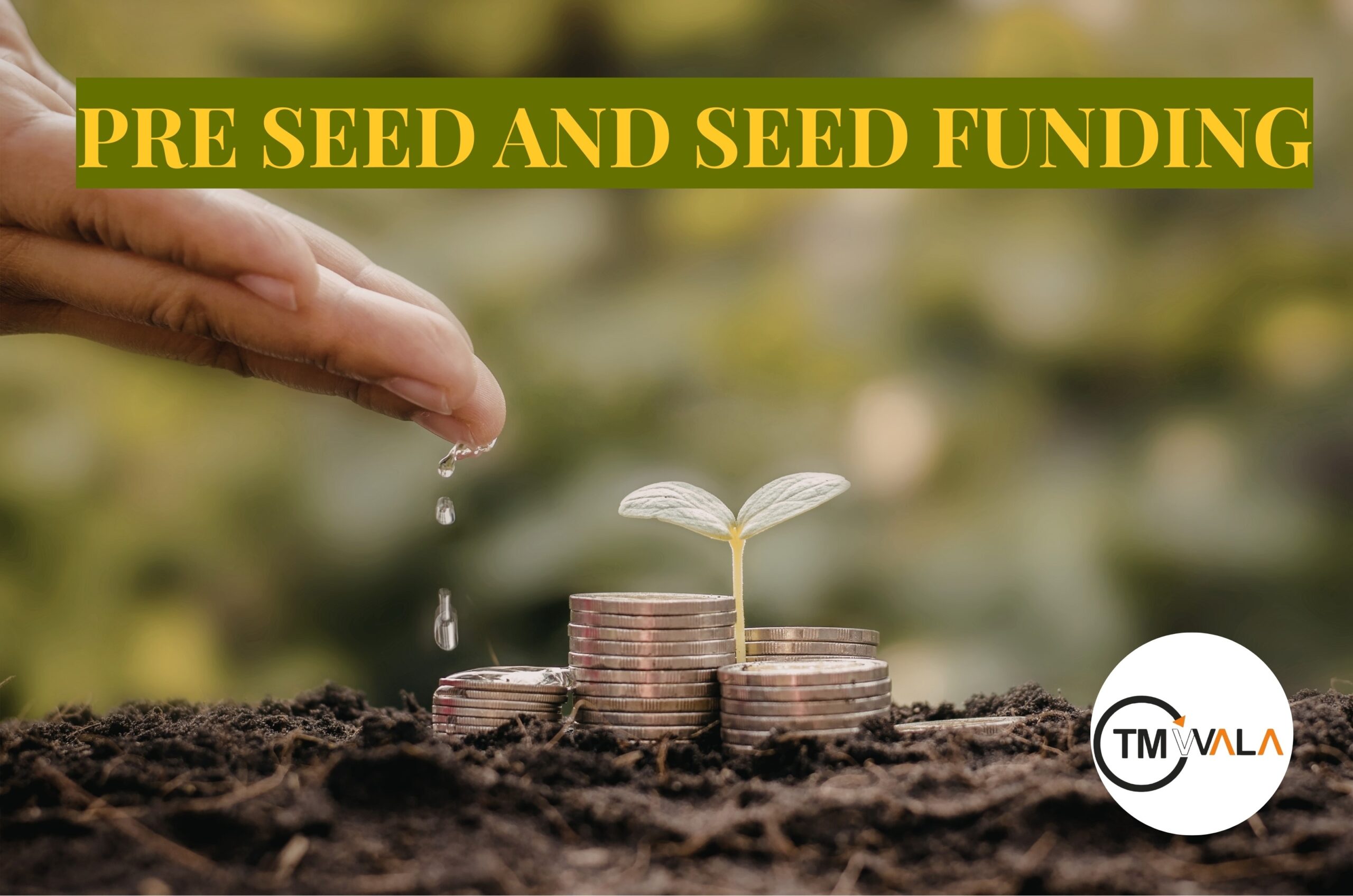
Pre-Seed and Seed Funding for Early-Stage Startups

Pre-Seed and Seed Funding: A Complete Guide for Startups

pre-seed and seed funding for startups.

For entrepreneurs, navigating the financial landscape of a startup can feel like learning a new language. Terms like pre-seed funding, seed funding, SAFE, or convertible note often appear daunting, but understanding them is crucial for the growth and success of your venture. In this article, we break down the essentials of early-stage startup financing, explore the funding stages of a startup, and explain how platforms like TMWala can help startups in India secure capital efficiently.

Pre-Seed Funding for Startups

Pre-seed funding for startups is the earliest stage of investment, designed to help entrepreneurs transform their initial idea into something tangible. Think of it as the fuel that allows the startup car to roll out of the garage and start its journey. Preseed capital is usually raised before a formal seed round and is typically used for foundational tasks that prepare the company for further growth. Key expenditures include:

  • Market research to understand the potential audience and competitors.
  • Product development, including prototypes and minimum viable products (MVPs).
  • Hiring early team members to help execute the vision.
  • Legal compliance and incorporation costs.
  • Initial marketing to test demand and awareness.

At this stage, startups are not expected to generate profits. The goal is to turn ideas into reality, providing a proof of concept that validates the potential of the business. Early funding also serves as a signal to future investors, demonstrating the startup team’s seriousness and commitment.

| Also, know how to get funding for your business in 2026

Why Pre-Seed Funding Matters

  1. Turns Ideas into Reality– A promising concept only gains value when it becomes a functional product or service. Preseed funding makes this transformation possible.
  2. Validates Your Startup Idea– Financial backing from investors or friends indicates that your idea has merit.
  3. Attracts Future Investors– Raising initial capital is often essential before moving to seed or Series A funding.
  4. Provides Early Validation for the Founder Team– Startups with funding are perceived as more credible, which helps attract talent, partners, and subsequent investors.

In India, initiatives like the Startup India Seed Fund Scheme have made preseed support more accessible, providing financial assistance to help founders cross the crucial earlystage hurdle. Moreover, platforms like TMWala can help startups identify suitable preseed investors and streamline the funding process, making it easier to secure initial capital without losing valuable time.

Seed Funding for Startups

What is seed funding? Seed funding, or seed round funding, is the first formal round of investment that comes after initial bootstrapping or pre-seed support. At this stage, startups usually have a prototype, an early product, or a founding team ready to expand operations. Seed funding is critical for transforming a promising concept into a scalable venture.

Typical uses of seed funding include:

  • Product development and refinement – Hiring engineers or developers, building a minimum viable product (MVP), or iterating based on customer feedback.
  • Building the team and operations – Funding salaries for founders and initial employees, setting up tools, and covering office or operational costs.
  • Validating the market – Testing the product with early users, gathering data, and refining the business model.
  • Enhancing credibility – Early investors signal trustworthiness, making it easier to attract future funding and talent.
  • Unlocking further funding – Demonstrating traction at the seed stage is often required to attract a series of venture capital investors.

Without seed funding, many startups stall at the concept stage. For instance, in India, investors like Info Edge provided as little as ₹4.7 crore to Zomato at the seed stage, ultimately yielding enormous returns. Platforms like TMWala support startups in India by connecting them with investors and guiding founders through documentation and pitching processes, increasing the chances of successful fundraising.

How Startups Secure Early-Stage Startup Funding in India

Raising funds requires both strategy and persistence. Entrepreneurs typically leverage multiple channels to secure investment:

  • Networking and Warm Introductions– Attend startup events, demo days, pitch competitions, and industry meetups. Warm referrals from mentors or peers often open doors faster than cold outreach.
  • Angel Investors for Startups– Reach out to individual angels or networks such as Mumbai Angels, Indian Angel Network, or online platforms like AngelList and LetsVenture. Superangels, including figures like Ratan Tata or Anand Mahindra, may also invest if your traction is promising.
  • Startup Accelerators/Incubators– Programs like Y Combinator, 500 Startups, Axilor, GSF, and T-Hub provide mentorship, seed funding (typically ₹10–50 lakh in India), and access to a network of investors.
  • Crowdfunding and Competitions– Platforms or contests can generate funds and visibility for your product.
  • Corporate and University Programs– Corporate VC arms and university incubators (IITs, IIMs, BITS) provide funding for alumni or student startups.
  • Direct Pitching– Target seed-stage investors with a concise pitch deck. Institutional VCs usually prefer startups with some traction.
  • Government Grants/LoansSchemes such as SISFS via incubators provide equity-free grants for eligible startups.
  • Investor Events & Demo Days– VC-hosted pitch events provide exposure and opportunities to meet multiple investors at once.

TMWala can be instrumental in this process by offering curated introductions to angel investors, accelerators, and seed-stage VCs, ensuring startups are matched with investors aligned to their vision and stage of growth.

Seed Funding vs Venture Capital

Many founders confuse seed funding with later-stage venture capital. Key distinctions include:

  • Stage of Company– Seed funding occurs at the idea or validation stage. Venture capital usually comes at Series A/B, when the startup has proven traction.
  • Amount Raised– Seed rounds are smaller, often ₹2–10 crore in India, while Series A investments can reach tens or hundreds of crores.
  • Valuation & Dilution– Seed stage valuations are lower, meaning investors get more equity for less money. VCs invest at higher valuations with higher amounts.
  • Investor Profile– Seed investors are often angels or accelerators, while VCs are institutional funds with formal processes and larger capital pools.
  • Risk and Expectations– Seed investors accept higher risk; VCs expect evidence of a viable business model and market traction.
  • Terms and Control– VC deals often include board seats and stricter terms, while seed-stage agreements are usually more founder-friendly.

Most startups begin with seed funding to validate their product-market fit. Only after demonstrating traction should founders pursue seed-stage venture capital or larger VC funding. Trying to skip the seed stage may result in rejections from institutional VCs, while starting too small may limit growth potential.

SAFE vs Convertible Note

Understanding the difference between SAFE and convertible notes is crucial for early-stage startup financing. Both are instruments to raise capital without setting a full valuation upfront, but they operate differently:

SAFE (Simple Agreement for Future Equity)

  • Not a debt instrument; no maturity date or interest.
  • Converts into equity during a subsequent priced round, often at a discount or with a valuation cap.
  • Ideal for startups seeking fast, uncomplicated earlystage funding.

Convertible Note

  • A shortterm debt instrument that converts to equity later.
  • Includes interest and a maturity date.
  • Converts into equity under agreed terms, often with a discount or valuation cap.
  • Suitable for founders and investors comfortable with a debt structure that defers valuation.

Both options allow founders to delay complex negotiations while securing capital, making them popular choices in earlystage startup funding in India.

Conclusion

Navigating startup investment stages is a critical part of building a successful business. Preseed and seed funding are foundational, helping entrepreneurs turn ideas into reality, validate concepts, attract investors, and scale operations. Earlystage startup funding in India is increasingly accessible through angel investors, government schemes like the Startup India Seed Fund Scheme, accelerators, and platforms like TMWala, which simplifies the fundraising journey.

By understanding the funding stages of a startup, leveraging the right mix of investors, and choosing appropriate financial instruments like SAFE or convertible notes, founders can maximize their chances of success while preserving equity and control. Seed funding serves as a launching pad, while subsequent venture capital rounds allow startups to scale aggressively, capturing market opportunities and becoming industry leaders.

For founders aiming to navigate this complex ecosystem efficiently, TMWala offers guidance, connections, and resources to secure the right type of funding at the right stage, ensuring that your startup not only survives but thrives in India’s dynamic startup landscape.

FAQs

  1. What is pre-seed funding?
    Pre-seed funding is the earliest stage of startup investment used to turn an idea into a prototype, conduct market research, and build an initial team.
  2. How is pre-seed funding different from seed funding?
    Pre-seed funding focuses on idea validation and groundwork, while seed funding helps startups scale operations after developing a prototype or early product.
  3. What is seed funding?
    Seed funding is the first formal investment round raised after preseed or bootstrapping, aimed at building a viable and scalable business.
  4. What are the common uses of seed round funding?
    Seed funds are typically used for product development, hiring, market validation, operations, and achieving early traction.
  5. Who invests at the pre-seed and seed stages?
    Angel investors for startups, accelerators, incubators, earlystage venture capital funds, and government schemes commonly invest at these stages.
  6. What is the Startup India Seed Fund Scheme?
    The Startup India Seed Fund Scheme is a government initiative that provides financial assistance to earlystage startups through approved incubators.
  7. How can startups raise early-stage startup funding in India?
    Startups can raise funds through networking, angel investors, accelerators, government grants, demo days, and direct pitching to investors.
  8. What is the difference between SAFE and a convertible note?
    A SAFE is not debt and has no interest or maturity date, while a convertible note is a debt instrument with interest that converts into equity later.
  9. How is seed funding different from venture capital?
    Seed funding supports early validation, while venture capital typically comes at Series A or later stages when the startup shows traction and growth.
  10. How can TMWala help startups with funding?
    TMWala helps startups by connecting them with relevant investors, accelerators, and seed-stage VCs while guiding them through the fundraising process.

Get started instantly

Hero enquiry form

"*" indicates required fields

Name*
This field is for validation purposes and should be left unchanged.

Leave a Reply

Your email address will not be published. Required fields are marked *


The reCAPTCHA verification period has expired. Please reload the page.

"Protect Your Brand with Our Legal Expertise!"

Get an Instant Call Back from Our Legal Experts

Hero enquiry form

"*" indicates required fields

Name*
This field is for validation purposes and should be left unchanged.

Choose your Entity Type

Non-MSME/ Large Entitie

Individual/ MSME/ Sole Proprietorships
File a Trademark, Trademark application logo of TMWala

Original price was: ₹9,000.00.Current price is: ₹3,999.00.

Trademark Application @ ₹3999* (Premium Discounted Plan for MSME/Individual/Sole Proprietorships) Comprehensive

Government Fees

₹4500/-

Add to cart
File a Trademark, Trademark application logo of TMWala

Original price was: ₹9,000.00.Current price is: ₹3,999.00.

Trademark Application @ ₹3999* (Premium Discounted Plan for Non-MSMEs/Large Entities) Comprehensive

Government Fees

₹9000/-

Add to cart

Choose your Entity Type

Individual/ MSME/ Sole Proprietorships

Non-MSME/ Large Entities
Original price was: ₹3,500.00.Current price is: ₹1,999.00.

Government Fees

₹4500/-

Add to cart

Original price was: ₹3,500.00.Current price is: ₹1,999.00.

Government Fees

₹9000/-

Add to cart

Choose your Entity Type

Individual/ MSME/ Sole Proprietorships

Non-MSME/ Large Entities

Trademark Application by TMWala

Original price was: ₹1,500.00.Current price is: ₹999.00.

Trademark Application @ ₹999* (Basic Discounted Plan for MSME/Individual/Sole Proprietorships) Best-Selling, Economical & Easy

Government Fees

₹4500/-

Add to cart
Trademark Application by TMWala

Original price was: ₹1,500.00.Current price is: ₹999.00.

Trademark Application @ ₹999* (Basic Discounted Plan for Non-MSMEs/Large Entities) Best-Selling, Economical, Quick and Easy

Government Fees

₹9000/-

Add to cart