
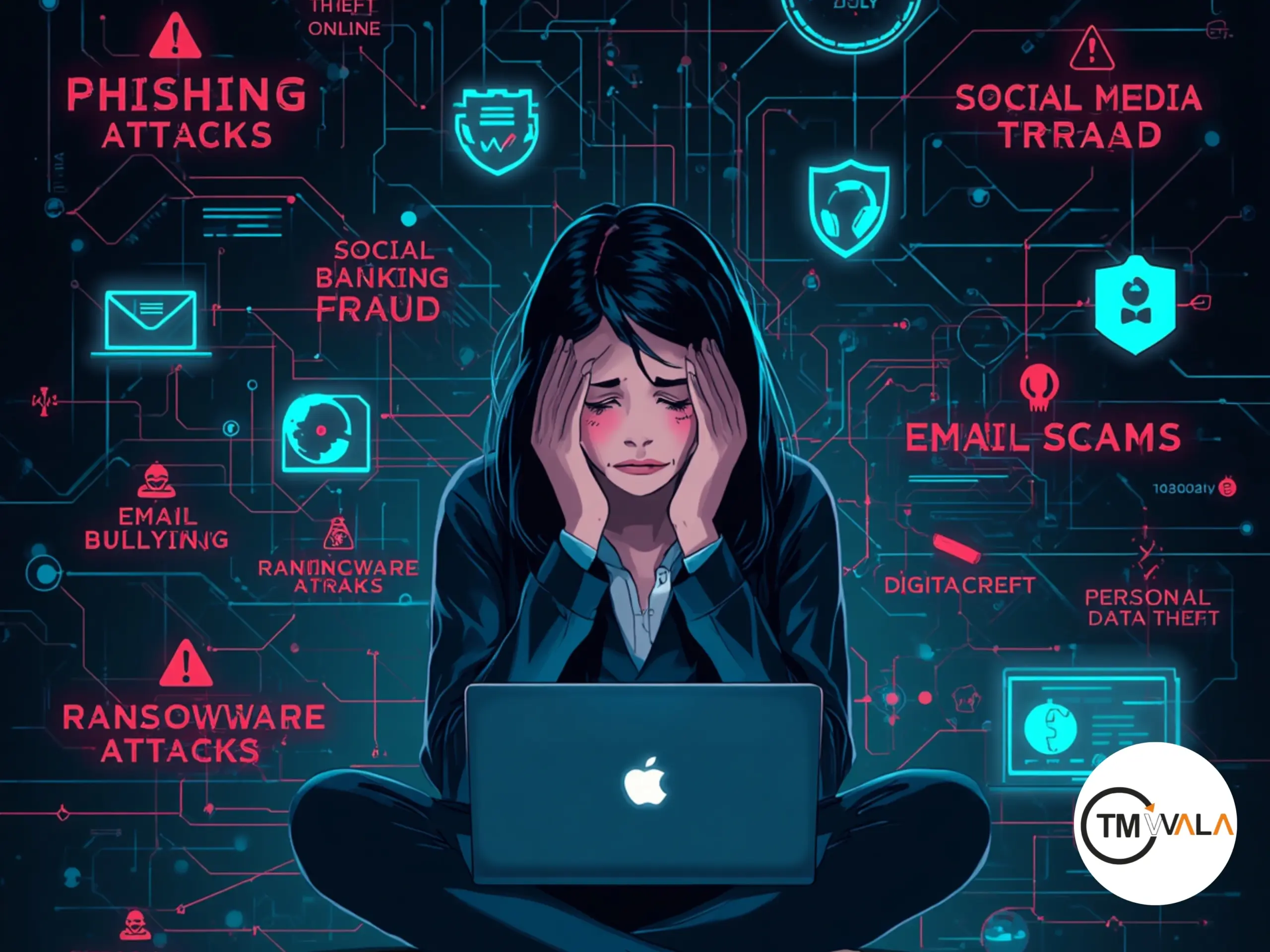
The rapid expansion of digital technology has transformed how individuals communicate, work, and manage financial activities. While this digital shift has created convenience and efficiency, it has also opened doors to various forms of cyber threats targeting individuals. Cybercrime today is not limited to large organizations or governments; individuals are equally vulnerable to attacks that can result in financial loss, identity theft, and emotional distress.
Understanding these threats is essential for building a safer digital environment. Awareness of cybercrime patterns, prevention techniques, and reporting mechanisms can significantly reduce risks. Platforms like TMWala play an important role in educating users, spreading awareness, and helping individuals stay protected through reliable guidance and cybersecurity resources. By learning about different types of cyber threats, individuals can take informed steps to safeguard their personal and financial data.
Cybercrime can be broadly categorized based on the target and nature of the offense. These categories help explain how cybercriminals operate and which areas are most vulnerable in the digital ecosystem.
Cybercrimes are generally classified into crimes against individuals, property, organizations, and society. Each category includes different methods and intentions, ranging from financial fraud to data destruction and psychological harassment. Among these, crimes against individuals are the most common, as personal users are often less protected and more likely to fall victim to deception techniques.
TMWala helps users understand these classifications in simple terms, making it easier to recognize threats and take preventive action.
Cybercrime against individuals refers to illegal activities carried out using digital platforms that directly harm a person’s privacy, identity, or financial security. These crimes are increasing rapidly due to the widespread use of smartphones, social media, and online banking systems.
Such crimes often include manipulation, deception, and unauthorized access to personal information. Awareness and early detection are key to reducing their impact.
| File a complaint on the National Cyber Crime Reporting Portal
There are several examples of cybercrimes that individuals commonly encounter in their daily digital interactions. These include online scams, identity theft, hacking, and harassment through digital platforms. Cybercriminals often use psychological manipulation and fake identities to gain trust before exploiting victims.
TMWala provides educational content that helps users identify these crimes and respond appropriately before damage occurs.
Personal cyber-attacks refer to targeted attempts to harm individuals by stealing data, accessing accounts without permission, or spreading malicious software. These attacks can lead to financial fraud, privacy violations, and emotional stress. Attackers often exploit weak passwords or unsecured networks to gain access to personal systems.
Phishing attacks are one of the most common cyber threats faced by individuals. In these attacks, criminals send fake emails, messages, or websites that appear legitimate in order to trick users into sharing sensitive information such as passwords or banking details. These attacks rely heavily on deception and urgency to manipulate victims.
Online identity theft occurs when someone illegally obtains and uses another person’s personal information, such as Aadhaar details, bank information, or login credentials, to commit fraud. This can result in unauthorized transactions, fake accounts, and severe financial losses for the victim.
Online banking fraud involves unauthorized access to bank accounts or manipulation of digital payment systems. Fraudsters may use fake apps, phishing links, or OTP interception techniques to steal money. The increasing use of digital banking has made it easier for criminals to target unsuspecting users.
Social media hacking refers to unauthorized access to personal accounts on platforms such as Facebook, Instagram, or X. Hackers may misuse these accounts to scam friends, spread misinformation, or demand money. Weak passwords and a lack of two-factor authentication are common causes of such attacks.
Email scams involve fraudulent messages designed to deceive users into sharing personal data or making payments. These emails often imitate trusted organizations and create urgency to trick recipients into quick action. Common examples include fake job offers, lottery winnings, and bank verification requests.
Ransomware attacks involve malicious software that locks or encrypts a user’s data and demands payment for its release. These attacks can affect personal devices and lead to permanent data loss if proper backups are not maintained. Criminals often demand payment in untraceable digital currencies.
OTP fraud in India occurs when criminals trick individuals into sharing one-time passwords sent by banks or service providers. Once the OTP is obtained, fraudsters can complete unauthorized transactions. These scams often involve fake customer care calls or phishing messages.
SIM swap fraud is a technique where criminals take control of a victim’s mobile number by convincing telecom providers to issue a duplicate SIM. Once successful, they can intercept OTPs and gain access to financial accounts, leading to major financial damage.
Cyberbullying examples include sending abusive messages, spreading false rumours online, exclusion from digital groups, and posting humiliating content about someone. Such behaviour can cause emotional distress and long-term psychological impact on victims.
Financial fraud cybercrime includes any online activity aimed at illegally obtaining money or financial benefits. This may involve fake investment schemes, UPI scams, or credit card fraud. The increasing dependency on digital transactions has made financial fraud one of the fastest-growing cyber threats.
Digital fraud refers to a wide range of cyber scams conducted through online platforms. These include impersonation scams, fake loan offers, and fraudulent investment schemes. Awareness and verification of digital communications are essential to prevent such fraud.
Cybersecurity awareness is the foundation of protection against cyber threats. It involves understanding risks, using strong passwords, enabling two-factor authentication, and regularly updating software. Educated users are less likely to fall victim to cybercrime. TMWala actively promotes cybersecurity awareness by simplifying complex digital safety concepts for everyday users.
Personal data theft involves stealing sensitive information such as passwords, bank details, or identification documents. This stolen data is often used for identity fraud or sold on the dark web. Protecting personal information is essential for maintaining digital security.
One of the most common cybercrimes today is phishing, as it targets a large number of users and requires minimal technical skill from attackers. It relies on deception rather than technical hacking, making it highly effective against unaware individuals.
Examples of cybercrimes include phishing, identity theft, online banking fraud, ransomware attacks, SIM swap fraud, social media hacking, and email scams. These crimes affect individuals in different ways but often result in financial loss or privacy breaches.
Preventing cybercrime requires a combination of awareness, technology, and responsible online behaviour. Individuals should use strong and unique passwords, enable two-factor authentication, avoid suspicious links, and keep software updated. Regular monitoring of financial accounts and reporting suspicious activity is also essential. Platforms like TMWala assist users by providing guidance on safe digital practices and helping them stay informed about emerging threats.
Cybercrime against individuals continues to evolve as technology advances. From phishing attacks to identity theft and financial fraud, the risks are diverse and constantly changing. However, with proper awareness, education, and preventive measures, individuals can significantly reduce their vulnerability.
TMWala plays an important role in this ecosystem by helping users understand cyber threats in a simplified manner and encouraging safe digital behaviour. By staying informed, adopting cybersecurity best practices, and using trusted guidance platforms, individuals can confidently navigate the digital world while minimizing risks associated with cybercrime.
Get started instantly
"*" indicates required fields

TMWala
Your one stop shop for all your business registration and compliance needs.
"*" indicates required fields
Choose your Entity Type
Non-MSME/ Large Entitie
Individual/ MSME/ Sole Proprietorships

₹9,000.00 Original price was: ₹9,000.00.₹3,999.00Current price is: ₹3,999.00.
Trademark Application @ ₹3999* (Premium Discounted Plan for MSME/Individual/Sole Proprietorships) Comprehensive
Government Fees
₹4500/-
₹9,000.00 Original price was: ₹9,000.00.₹3,999.00Current price is: ₹3,999.00.
Trademark Application @ ₹3999* (Premium Discounted Plan for Non-MSMEs/Large Entities) Comprehensive
Government Fees
₹9000/-
Choose your Entity Type
Individual/ MSME/ Sole Proprietorships
Non-MSME/ Large Entities

₹3,500.00 Original price was: ₹3,500.00.₹1,999.00Current price is: ₹1,999.00.
Government Fees
₹4500/-
₹3,500.00 Original price was: ₹3,500.00.₹1,999.00Current price is: ₹1,999.00.
Government Fees
₹9000/-
Choose your Entity Type
Individual/ MSME/ Sole Proprietorships
Non-MSME/ Large Entities
₹1,500.00 Original price was: ₹1,500.00.₹999.00Current price is: ₹999.00.
Trademark Application @ ₹999* (Basic Discounted Plan for MSME/Individual/Sole Proprietorships) Best-Selling, Economical & Easy
₹1,500.00 Original price was: ₹1,500.00.₹999.00Current price is: ₹999.00.
Trademark Application @ ₹999* (Basic Discounted Plan for Non-MSMEs/Large Entities) Best-Selling, Economical, Quick and Easy