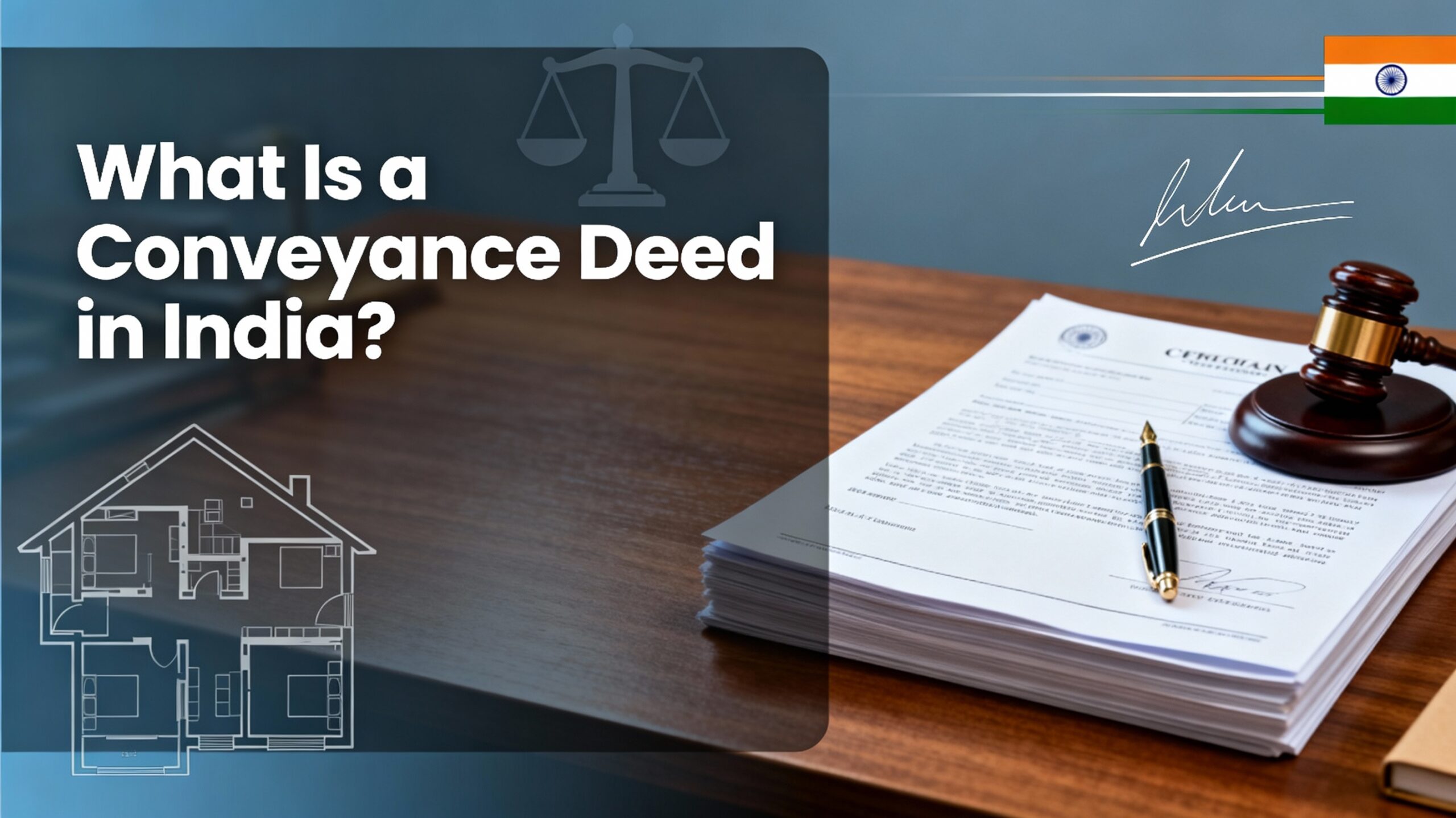
A conveyance deed is one of the most important legal documents in Indian real estate transactions because it establishes the lawful transfer of property ownership from one party to another. Many homebuyers hear terms like sale deed, conveyance deed, and property transfer during the buying process, but do not fully understand how each functions. This often leads to confusion and delays in registration.
This article explains what is conveyance deed in India is in simple terms. It covers the types of conveyance deeds, the complete documents list, the conveyance deed format, and a clear comparison of conveyance deed vs sale deed to help buyers, housing societies, and property owners make informed decisions.
A conveyance deed is a legal document that officially transfers the title of a property from the seller or owner to the buyer. It is executed after all terms of the property transaction are agreed upon. Once signed and registered, it becomes proof of lawful ownership.
In Indian property law, every transfer of immovable property requires a registered document that legally records the change of ownership. This is why a conveyance deed is essential in most real estate transactions, including freehold sales, leasehold transfers, gifts, mortgages, and assignments. It is also widely used in conveyancing in India, particularly when housing societies acquire land and building rights from developers after project completion.
A conveyance deed must be registered at the local Sub-Registrar’s Office. Registration involves payment of stamp duty on the conveyance deed, which varies by state.
A buyer becomes the legal owner of a property only when the conveyance deed is executed and registered. Without it, ownership remains incomplete, and the buyer may face issues such as:
A registered conveyance deed provides clear evidence of ownership and is legally enforceable in any court of law.
There are different types of conveyance deeds, depending on the nature of the transaction. The main categories include:
This is used when a property is sold for a financial consideration. It is similar to a sale deed, but the term “conveyance deed” is broader and covers all forms of property transfer. A sale conveyance deed is executed only after the full payment is made and both parties agree to the terms of the sale.
A gift deed is a type of conveyance deed in which property is transferred voluntarily without any monetary consideration. It must be executed by the donor and accepted by the donee. Registration and stamp duty are mandatory, although some states offer concessional rates for family transfers.
Read the relevant article: Will Deed in India.
This deed transfers the leasehold rights of a property for a specific period. It is common in government-allotted properties, industrial plots, and properties built on leased land.
A mortgage deed is used when a property is given as security in exchange for a loan. The ownership remains with the borrower, but certain rights stay with the lender until the loan is repaid.
Once a building is completed, the developer must transfer land and building rights to the cooperative housing society. This process requires a conveyance deed that legally transfers ownership from the builder to the society.
Each type serves the same core purpose: formal transfer of property ownership with legal validity.
The documents required for a conveyance deed depend on the type of transfer, but the standard set includes:
A clear list of documents required for a conveyance deed ensures faster verification and registration at the Sub-Registrar’s Office.
There is no single universal conveyance deed format, but all valid deeds include certain essential components. A typical conveyance deed format for property includes:
Once drafted, the deed is printed on stamp paper and registered.
Many property buyers confuse a sale deed with a conveyance deed, but the two are not identical. A sale deed is one type of conveyance deed.
Below is a clear comparison explaining the difference between a sale deed and a conveyance deed.
| Aspect | Conveyance Deed | Sale Deed |
| Definition | A specific type of conveyance deed is used only when property is sold. | Used in sales, gifts, mortgages, lease, and society conveyance. |
| Scope | Broader term covering all property transfers. | Narrower term limited to sale transactions. |
| Consideration | May or may not involve monetary payment. | Always involves financial payment. |
| Usage | Used only in the sale of property. | Used in sales, gifts, mortgages, leases, and society conveyance. |
| Legal Requirement | Used in sales, gifts, mortgages, leases, and society conveyance. | Registration is mandatory under the Registration Act, 1908. |
| Outcome | Transfer of rights, title, and interest. | A general document used to transfer ownership of property through sale, gift, lease, or assignment. |
In simple terms, a sale deed is always a conveyance deed. However, a conveyance deed is not always a sale deed.
Understanding the sale deed helps clarify this difference. A sale deed is a contractual document that confirms the sale of a property for a price. A conveyance deed is the broader document that executes the legal transfer of ownership.
Consider a housing society in Mumbai that wants legal ownership of the land and building from the developer. Even though all flats are sold, the society cannot claim ownership until the builder executes a conveyance deed in their favour. Without this document, the society cannot redevelop the building, update property records, or apply for municipal permissions.
This example shows why conveyance deeds are significant in property ownership transfer and are not limited to individual sale transactions.
Stamp duty must be paid before registration of a conveyance deed. The stamp duty on a conveyance deed varies from state to state and is usually calculated on the market value or the agreement value of the property.
Some states charge different stamp duty rates depending on whether the transfer is through sale, gift, or lease. For example, several states offer lower stamp duty for gift deeds between family members. However, buyers should always check the latest notifications issued by the respective state governments.
Registration strengthens the legality of the deed and is mandatory under the Registration Act, 1908. The typical process includes:
Once registered, the deed becomes part of the public records.
A conveyance deed is a vital document that ensures the lawful and undisputed transfer of property ownership in India. Understanding what is conveyance deed is, its types, and the documents required helps buyers and housing societies navigate the legal process smoothly. It also clarifies the commonly misunderstood difference between a conveyance deed and vs sale deed, improving decision-making in property transactions.
Whether you are buying a flat, receiving property as a gift, or forming a society that needs ownership rights, the conveyance deed protects your legal interests and provides long-term security.
Get started instantly
"*" indicates required fields

TMWala
Your one stop shop for all your business registration and compliance needs.
"*" indicates required fields
Choose your Entity Type
Non-MSME/ Large Entitie
Individual/ MSME/ Sole Proprietorships
₹9,000.00 Original price was: ₹9,000.00.₹3,999.00Current price is: ₹3,999.00.
Trademark Application @ ₹3999* (Premium Discounted Plan for MSME/Individual/Sole Proprietorships) Comprehensive
Government Fees
₹4500/-
₹9,000.00 Original price was: ₹9,000.00.₹3,999.00Current price is: ₹3,999.00.
Trademark Application @ ₹3999* (Premium Discounted Plan for Non-MSMEs/Large Entities) Comprehensive
Government Fees
₹9000/-
Choose your Entity Type
Individual/ MSME/ Sole Proprietorships
Non-MSME/ Large Entities
₹3,500.00 Original price was: ₹3,500.00.₹1,999.00Current price is: ₹1,999.00.
Government Fees
₹4500/-
₹3,500.00 Original price was: ₹3,500.00.₹1,999.00Current price is: ₹1,999.00.
Government Fees
₹9000/-
Choose your Entity Type
Individual/ MSME/ Sole Proprietorships
Non-MSME/ Large Entities
₹1,500.00 Original price was: ₹1,500.00.₹999.00Current price is: ₹999.00.
Trademark Application @ ₹999* (Basic Discounted Plan for MSME/Individual/Sole Proprietorships) Best-Selling, Economical & Easy
₹1,500.00 Original price was: ₹1,500.00.₹999.00Current price is: ₹999.00.
Trademark Application @ ₹999* (Basic Discounted Plan for Non-MSMEs/Large Entities) Best-Selling, Economical, Quick and Easy