In the evolving world of business, scaling up often brings complexity. You might find yourself managing multiple ventures, assets, and liabilities all under one roof. This is where a holding company comes into play. It is a powerful strategy used by the world’s most successful corporate groups to organize their empires, protect their assets, and manage risk.
But what is a holding company exactly? Is it just for billionaires, or can it benefit your growing business too?
In this article, I will break down the holding company’s meaning, explore the holding company’s business model, and look at how a holding company in India operates under the latest regulations. Whether you are an entrepreneur looking to restructure or an investor seeking clarity, this post is your roadmap.
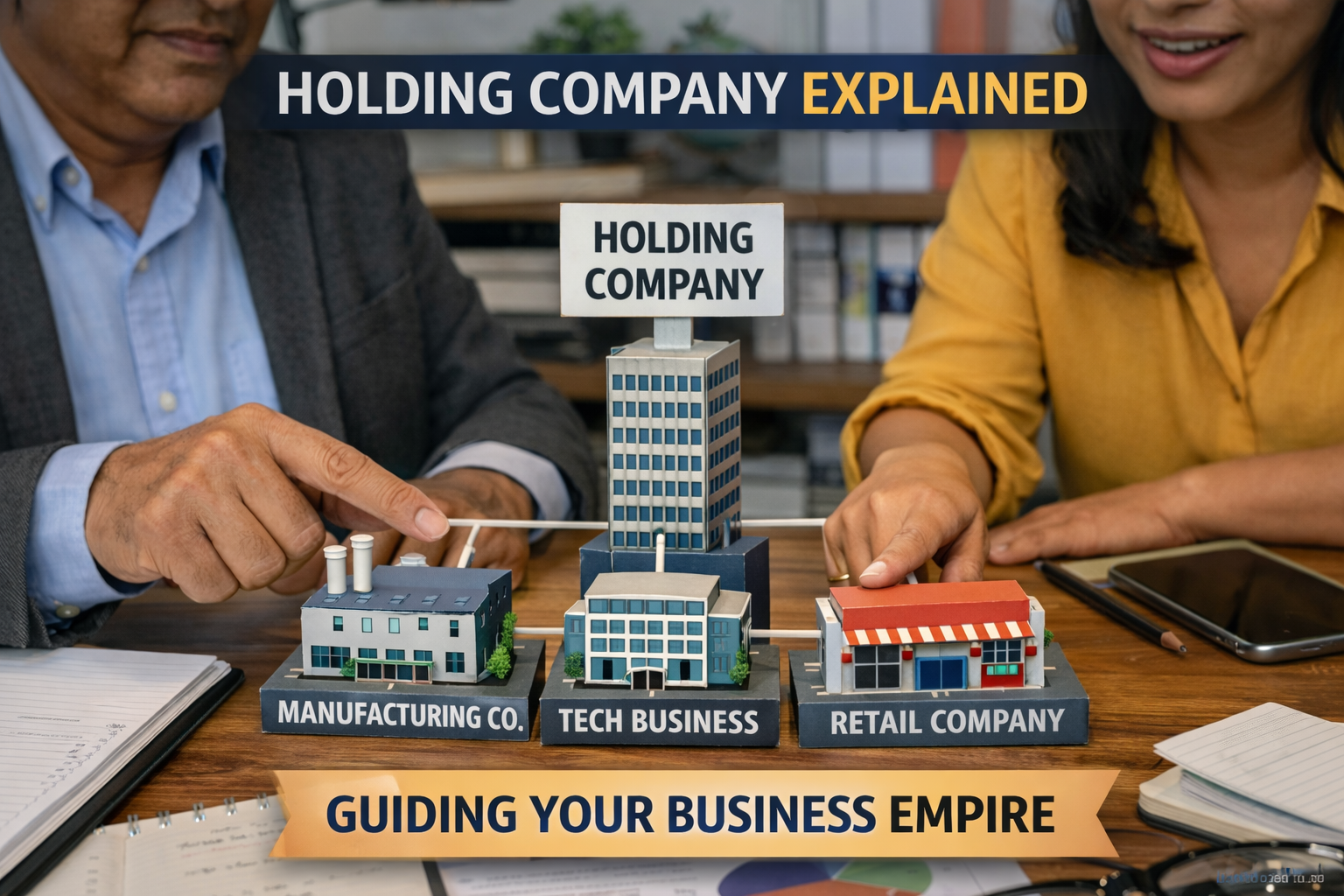
At its core, a holding company is a parent entity that exists primarily to own and control other companies. Think of it as a protective umbrella. Unlike a standard business that interacts with customers and sells products, a holding company typically doesn’t manufacture goods or offer services itself. Instead, its main job is to hold the controlling stock or membership interests in other companies, known as subsidiary companies.
According to the holding company definition in the Companies Act 2013 (Section 2(46)), a holding company is defined in relation to one or more other companies, meaning it is a company of which such companies are subsidiary companies.
In simpler terms, if Company A buys enough shares in Company B to control its decisions, Company A becomes the parent company (holding), and Company B becomes the subsidiary company.
The holding company business model is built on ownership and oversight rather than day-to-day operations.
This holding company structure allows the parent to oversee a vast empire without getting bogged down in the daily grind of running a factory or a retail store. The relationship between a holding and a subsidiary company is one of strategic guidance versus operational execution.
Not all holding companies look the same. Depending on their purpose, we can classify types of holding companies into a few categories:
It is crucial to understand the distinction between the holding company and operating company dynamics.
By separating these two, you create a firewall. If the operating company faces a lawsuit, the valuable assets owned by the holding company are usually safe from creditors.
Why do businesses go through the trouble of setting up this structure? The benefits of holding company structures are significant:
To visualize this, let’s look at some famous holding company examples:
Setting up a holding company in India follows the standard incorporation procedures under the Companies Act, 2013.
A holding company is not just a fancy term for big corporations. It is a strategic tool for asset protection, growth, and efficient management. Whether you are looking to protect your intellectual property, manage diverse business lines, or plan for future investment, understanding the holding company’s meaning and structure is your first step toward building a resilient business empire.
At TMWala, we understand that navigating the legalities of a holding company’s relationship with its subsidiary can be daunting. From registration to compliance, we are here to simplify the process so you can focus on building your legacy.
Get started instantly
"*" indicates required fields

TMWala
Your one stop shop for all your business registration and compliance needs.
"*" indicates required fields
Choose your Entity Type
Non-MSME/ Large Entitie
Individual/ MSME/ Sole Proprietorships

₹9,000.00 Original price was: ₹9,000.00.₹3,999.00Current price is: ₹3,999.00.
Trademark Application @ ₹3999* (Premium Discounted Plan for MSME/Individual/Sole Proprietorships) Comprehensive
Government Fees
₹4500/-
₹9,000.00 Original price was: ₹9,000.00.₹3,999.00Current price is: ₹3,999.00.
Trademark Application @ ₹3999* (Premium Discounted Plan for Non-MSMEs/Large Entities) Comprehensive
Government Fees
₹9000/-
Choose your Entity Type
Individual/ MSME/ Sole Proprietorships
Non-MSME/ Large Entities

₹3,500.00 Original price was: ₹3,500.00.₹1,999.00Current price is: ₹1,999.00.
Government Fees
₹4500/-
₹3,500.00 Original price was: ₹3,500.00.₹1,999.00Current price is: ₹1,999.00.
Government Fees
₹9000/-
Choose your Entity Type
Individual/ MSME/ Sole Proprietorships
Non-MSME/ Large Entities
₹1,500.00 Original price was: ₹1,500.00.₹999.00Current price is: ₹999.00.
Trademark Application @ ₹999* (Basic Discounted Plan for MSME/Individual/Sole Proprietorships) Best-Selling, Economical & Easy
₹1,500.00 Original price was: ₹1,500.00.₹999.00Current price is: ₹999.00.
Trademark Application @ ₹999* (Basic Discounted Plan for Non-MSMEs/Large Entities) Best-Selling, Economical, Quick and Easy