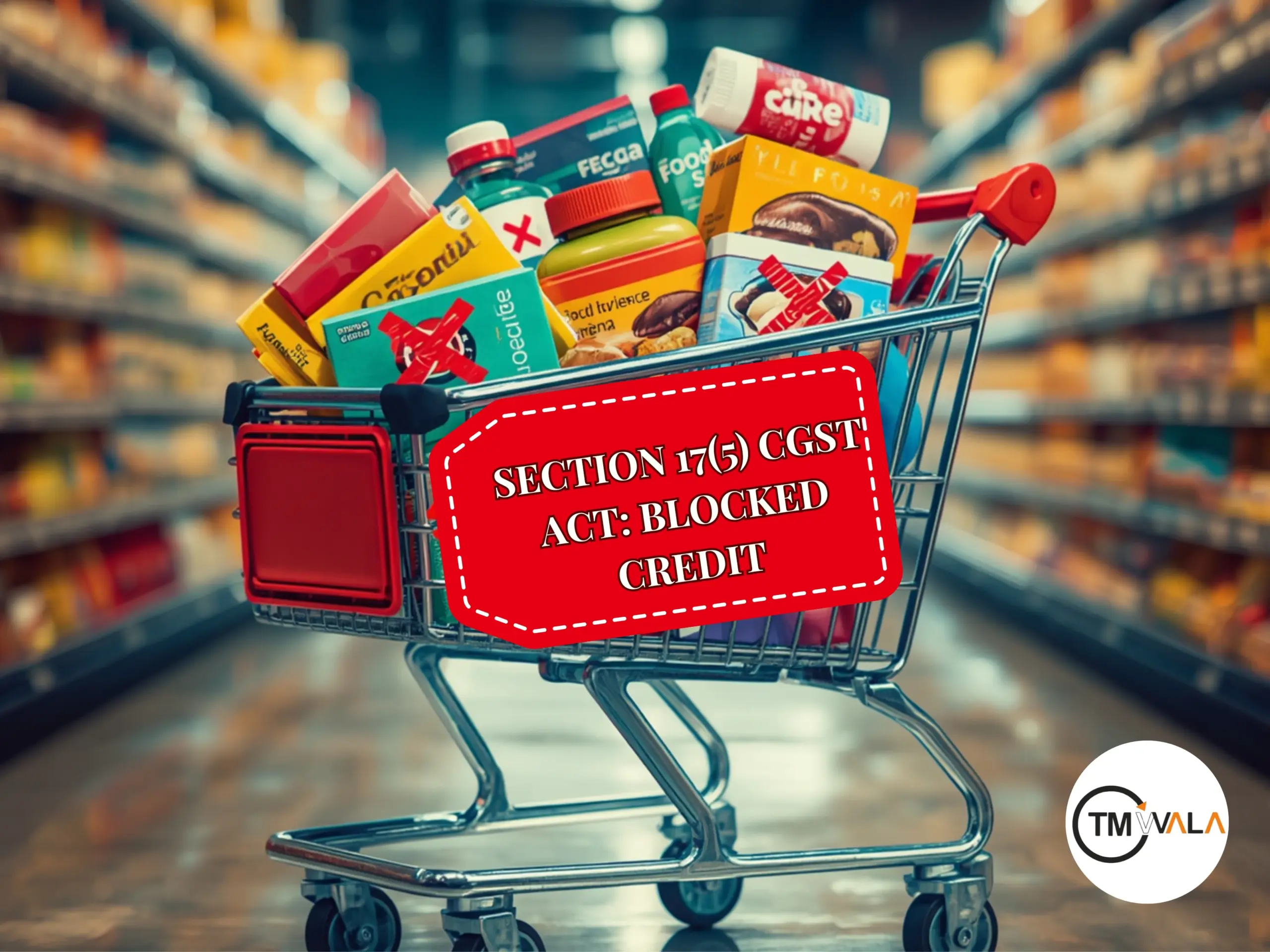
The introduction of Goods and Services Tax (GST) in India was aimed at creating a seamless credit chain, allowing businesses to claim input tax credit (ITC) on taxes paid on purchases. However, this benefit is not unrestricted. One of the most critical provisions that businesses must understand is section 17(5) of the CGST Act, which lays down specific cases where ITC is not allowed. These restrictions are commonly referred to as blocked credit under GST.
For businesses, this provision directly impacts cash flow, compliance accuracy, and tax planning. Misinterpretation or incorrect claims under this section can lead to reversals, interest, and penalties. Given the complexity involved in interpreting section 17(5) of the CGST Act, professional assistance becomes valuable. TMWala can support businesses in navigating these provisions effectively.
To begin with, it is important to understand what block credit is in GST. Blocked credit refers to those input tax credits that are expressly disallowed under GST law, even if the goods or services are used in the course or furtherance of business.
Under normal circumstances, ITC can be claimed when purchases are used for taxable supplies. However, section 17(5) of the CGST Act overrides this principle by specifying certain expenses where credit is not permitted. In such cases, the GST paid becomes a cost to the business rather than a recoverable credit.
The concept of ineligible input tax credit under GST arises from statutory restrictions rather than business usage. Even if an expense is legitimate and business-related, ITC may still be denied if it falls under blocked categories.
This provision ensures that ITC is not claimed on:
The law aims to prevent misuse of credit and maintain the integrity of the GST system.
TMWala helps in identifying ineligible input tax credit under GST and ensures that businesses do not claim ITC on restricted expenses. This reduces the risk of future disputes and penalties.
A proper understanding of the list of blocked credits under GST is essential for compliance. The major categories can be simplified as follows:
TMWala assists in the proper classification and reporting of blocked credit under GST, ensuring that GST returns are accurate and compliant with the latest regulations.
Understanding the law becomes easier through practical examples of blocked credit under GST.
Consider a company purchasing a car for its senior management. Even though the vehicle is used for business purposes, ITC cannot be claimed because it falls under the restricted category of motor vehicles.
Similarly, if a business provides free samples to promote its products, the GST paid on such goods cannot be claimed as ITC. In fact, if the credit was already claimed, it must be reversed.
Another example is the construction of an office building. Even though the building is used for business operations, ITC on construction-related expenses is not allowed, making it a significant cost component.
Employer-related expenses also provide common examples. GST paid on canteen services or health insurance is generally not eligible for ITC unless the employer is legally required to provide these benefits.
While blocked credits define what is not allowed, the broader input tax credit rules under GST define the eligibility conditions for claiming ITC.
To claim ITC, a registered person must:
These conditions must be satisfied, along with ensuring that the credit does not fall under section 17(5) of the CGST Act. Therefore, ITC eligibility is a combination of general conditions and specific restrictions.
Visit Goods & Service Tax, CBIC, Government of India: Input Tax Credit to understand the rules.
The concept of reversal of input tax credit is closely linked with blocked credit provisions. If ITC has been claimed incorrectly or if conditions are not met, the credit must be reversed.
Reversal essentially means adding the previously claimed ITC back to the output tax liability. This can arise in several situations, such as non-payment to suppliers within 180 days or when goods are used for exempt supplies.
In cases involving blocked credits, reversal becomes necessary when ITC was mistakenly claimed on ineligible items like free samples or personal consumption goods. Depending on the timing, interest may also be applicable.
GST compliance requires accurate reporting of ITC, including blocked credits. As per recent updates in return formats, ineligible ITC must be disclosed separately in GSTR-3B. (NOTIFICATION No. 14/2022 – Central Tax)
Businesses must ensure that:
Failure to comply with these requirements can result in notices, audits, and financial penalties.
Despite clear provisions, businesses often struggle with identifying blocked credits correctly. The complexity arises due to detailed clauses, exceptions, and frequent amendments in the GST law.
For example, determining whether an expense qualifies as personal consumption or business use can sometimes be subjective. Similarly, distinguishing between plant and machinery and immovable property requires careful analysis.
Errors in classification can lead to wrongful ITC claims, which may later require reversal along with interest. This not only affects profitability but also increases compliance burden.
The restrictions imposed under section 17(5) of the CGST Act form a crucial part of the GST framework. While the system aims to provide seamless credit, it also ensures that certain expenses do not qualify for ITC.
A clear understanding of:
is essential for every taxpayer.
By carefully evaluating each expense and aligning with input tax credit rules under GST, businesses can avoid errors and ensure accurate compliance. Additionally, proper handling of the reversal of input tax credit helps in maintaining financial discipline.
In an evolving regulatory environment, staying updated and seeking expert guidance from platforms like TMWala can make a significant difference in managing GST effectively and avoiding unnecessary tax costs.
Get started instantly
"*" indicates required fields
TMWala
Your one stop shop for all your business registration and compliance needs.
"*" indicates required fields
Choose your Entity Type
Non-MSME/ Large Entitie
Individual/ MSME/ Sole Proprietorships
₹9,000.00 Original price was: ₹9,000.00.₹3,999.00Current price is: ₹3,999.00.
Trademark Application @ ₹3999* (Premium Discounted Plan for MSME/Individual/Sole Proprietorships) Comprehensive
Government Fees
₹4500/-
₹9,000.00 Original price was: ₹9,000.00.₹3,999.00Current price is: ₹3,999.00.
Trademark Application @ ₹3999* (Premium Discounted Plan for Non-MSMEs/Large Entities) Comprehensive
Government Fees
₹9000/-
Choose your Entity Type
Individual/ MSME/ Sole Proprietorships
Non-MSME/ Large Entities
₹3,500.00 Original price was: ₹3,500.00.₹1,999.00Current price is: ₹1,999.00.
Government Fees
₹4500/-
₹3,500.00 Original price was: ₹3,500.00.₹1,999.00Current price is: ₹1,999.00.
Government Fees
₹9000/-
Choose your Entity Type
Individual/ MSME/ Sole Proprietorships
Non-MSME/ Large Entities
₹1,500.00 Original price was: ₹1,500.00.₹999.00Current price is: ₹999.00.
Trademark Application @ ₹999* (Basic Discounted Plan for MSME/Individual/Sole Proprietorships) Best-Selling, Economical & Easy
₹1,500.00 Original price was: ₹1,500.00.₹999.00Current price is: ₹999.00.
Trademark Application @ ₹999* (Basic Discounted Plan for Non-MSMEs/Large Entities) Best-Selling, Economical, Quick and Easy