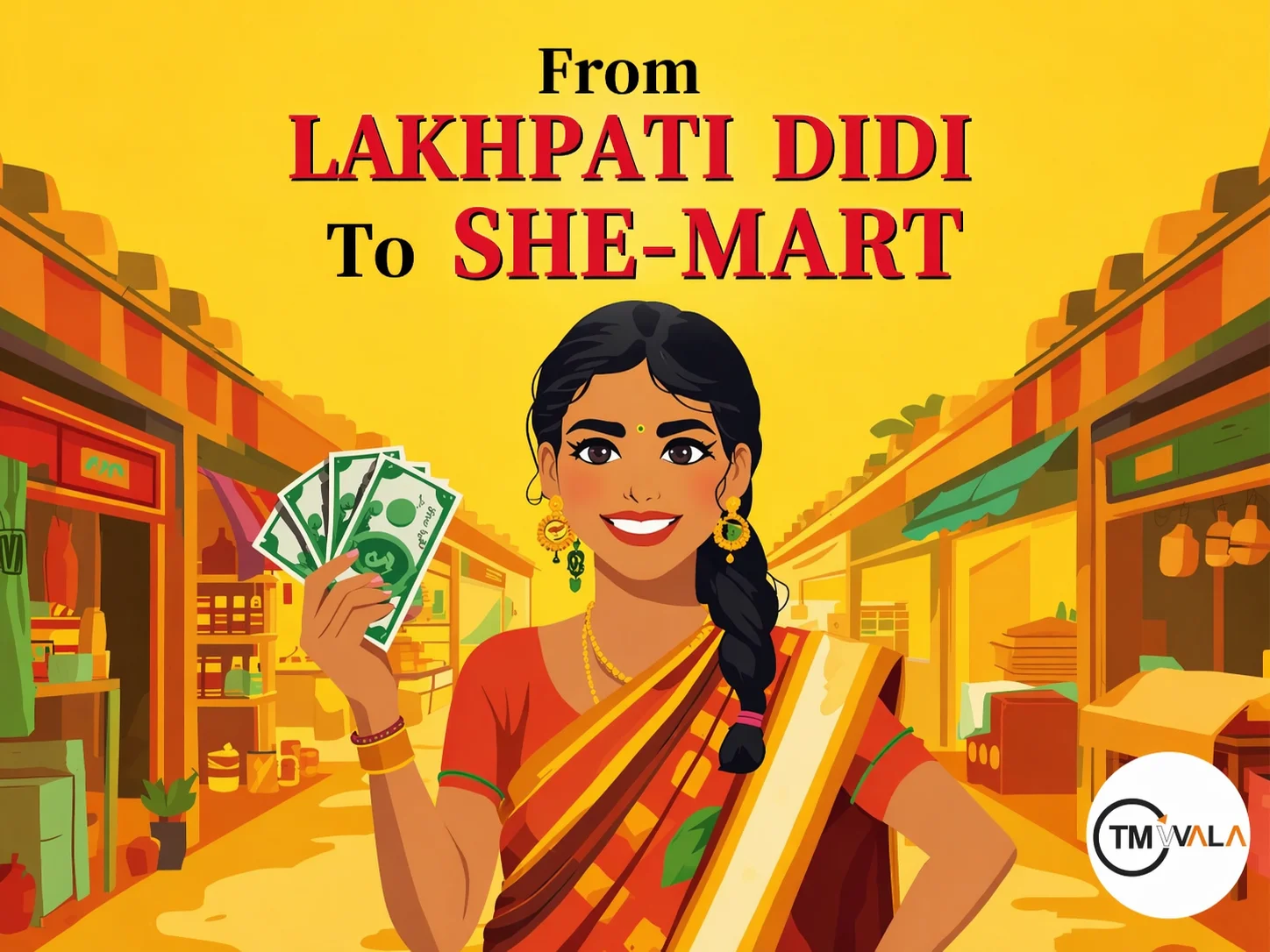
Rural women in India are increasingly becoming key drivers of economic transformation through self-help groups (SHGS) and initiatives like the Lakhpati Didi scheme, which focus on income generation and skill development. However, limited market access remains a major challenge for sustaining and scaling their enterprises.
In this context, SHE-MART emerges as the next step, aiming to bridge the gap between production and markets by enabling direct sales, branding, and business expansion for small enterprises. This shift marks a transition from basic livelihood support to women-led enterprise development.
The Lakhpati Didi scheme is all about laying a strong, practical foundation for women’s financial independence at the grassroots level and focuses on the supply side (training and production). The Lakhpati Didi initiative is a strategic outcome of the Deendayal Antyodaya Yojana-National Rural Livelihoods Mission(DAY-NRLM), designed to lift rural households out of poverty by fostering social and financial inclusion.
Its primary goal is to empower women within Self-Help Groups (SHGs) to earn a sustainable income of at least ₹1 lakh per year (Approx), which translates to a steady monthly earning of around ₹10,000 maintained over at least four agricultural or business cycles. To date, the mission has successfully organized over 10 crore households into 90.90 lakh SHGs, with nearly 1.48 crore women already achieving the “LAKHPATI” milestone.
Beyond financial success, they inspire through adopting sustainable livelihood practices and achieving a decent standard of living. SHGs support this journey with collective action, financial literacy, and skill development, empowering members for entrepreneurial ventures. The government actively backs this initiative, promoting diversified livelihood activities and fostering collaboration across sectors for strategic planning and implementation.
SHE-MART (Self Help Entrepreneur Marts) is a Government of India initiative announced in the Union Budget 2026-27. It is designed to empower women entrepreneurs by creating community-owned retail outlets within cluster-level federations of self-help groups and focuses on the demand side (sales and marketing).
Once a woman becomes a successful Lakhpati Didi and creates high-quality products, her biggest challenge is finding a profitable market without losing a large portion of her hard-earned income to middlemen. This is a revolutionary scheme that aims to transform the way women entrepreneurs access markets and sell their products. This scheme helps in creating permanent, community-owned retail stores managed directly by the women’s federations themselves.
Instead of selling their product at a low price to temporary agents, this scheme offers direct access to consumers. It is a strong shift that transforms a rural producer into a formal business owner, giving her a rightful place in the retail market.
It works in a simple step-by-step manner from joining an SHG to becoming a successful entrepreneur. It provides a structured pathway for women to enter into formal retail markets and build sustainable businesses.
STEP 1 – Join SHG, become a member of a Self-Help Group in your area.
STEP 2 – Create quality products with SHG support and training.
STEP 3 – Access organized SHE- MART retail platforms for direct sales.
STEP 4 – Develop your own product brand value with professional support.
STEP 5 – Achieve sustainable growth and financial independence.
SHE-MART provides a complete lifecycle for the rural women’s economic empowerment. While the Lakhpati Didi provides the “seeds” of financial stability by focusing on individual skills and earning capacity, SHE-MART acts as the “soil and sunlight,” it establishes permanent retail infrastructure that allows those efforts to flourish into professional enterprises.
By shifting rural producers into formal business owners, this two-step model ensures that women are not just living, but are actively leading the transformation of the Indian economy from the grassroots level.
The SHE-MART program has an economic impact that extends beyond sales, as it brings formal retail engagement directly to the community. It is a strong engine for economic growth that includes everyone. The program turns local production into a professional industry by supporting SHGs led by women all over the country. This has a big impact on household income.
This financial stability is quickly put back into the community, which means that people spend more on good healthcare and education for the next generation instead of keeping it in a bank account. This cycle of making money and reinvesting it ultimately leads to more community development. This shows that the benefits of including rural women in the formal economy are felt all over the country.
| Feature | Lakhpati Didi | SHE-MART |
| Primary Goal | Increase annual income to rupees 1 lakh + | Provide a retail platform for sales |
| Focus Area | Income Generation | Business Expansion |
| Support Type | Livelihood & skill support | Retail infrastructure access |
| Target Outcome | Earning capacity building | Enterprise ownership |
| Market Focus | Local Livelihood | Formal retail market integration |
| Stage | Early Stage: Empowerment & Survival. | Advanced Stage: Scale & Industrialization. |
Get started instantly
"*" indicates required fields
TMWala
Your one stop shop for all your business registration and compliance needs.
"*" indicates required fields
Choose your Entity Type
Non-MSME/ Large Entitie
Individual/ MSME/ Sole Proprietorships
₹9,000.00 Original price was: ₹9,000.00.₹3,999.00Current price is: ₹3,999.00.
Trademark Application @ ₹3999* (Premium Discounted Plan for MSME/Individual/Sole Proprietorships) Comprehensive
Government Fees
₹4500/-
₹9,000.00 Original price was: ₹9,000.00.₹3,999.00Current price is: ₹3,999.00.
Trademark Application @ ₹3999* (Premium Discounted Plan for Non-MSMEs/Large Entities) Comprehensive
Government Fees
₹9000/-
Choose your Entity Type
Individual/ MSME/ Sole Proprietorships
Non-MSME/ Large Entities
₹3,500.00 Original price was: ₹3,500.00.₹1,999.00Current price is: ₹1,999.00.
Government Fees
₹4500/-
₹3,500.00 Original price was: ₹3,500.00.₹1,999.00Current price is: ₹1,999.00.
Government Fees
₹9000/-
Choose your Entity Type
Individual/ MSME/ Sole Proprietorships
Non-MSME/ Large Entities
₹1,500.00 Original price was: ₹1,500.00.₹999.00Current price is: ₹999.00.
Trademark Application @ ₹999* (Basic Discounted Plan for MSME/Individual/Sole Proprietorships) Best-Selling, Economical & Easy
₹1,500.00 Original price was: ₹1,500.00.₹999.00Current price is: ₹999.00.
Trademark Application @ ₹999* (Basic Discounted Plan for Non-MSMEs/Large Entities) Best-Selling, Economical, Quick and Easy