
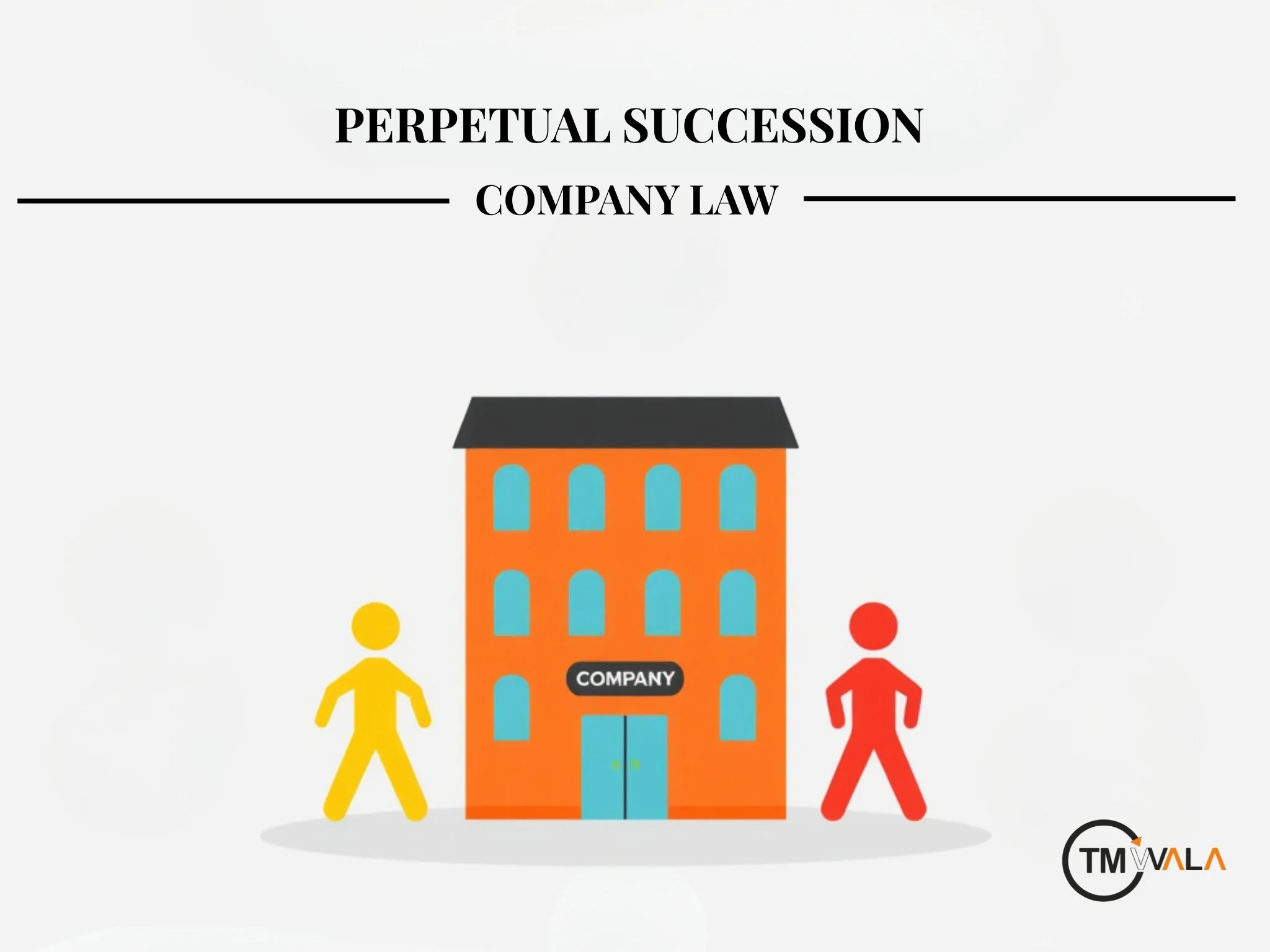
Modern corporate law rests on a few core principles that distinguish companies from other business structures, such as partnerships and sole proprietorships. One of the most fundamental among these is perpetual succession. This concept ensures that a company continues to exist regardless of changes in its ownership or management. In practical terms, it provides stability, continuity, and confidence to investors, creditors, and other stakeholders.
Understanding perpetual succession in company law is essential for anyone dealing with corporate structures, compliance, or business strategy. This article explains what perpetual succession is, its legal basis under Indian law, its features, and how it interacts with other essential doctrines such as separate legal entity and corporate personality.
TMWala can help businesses practically interpret such legal principles, ensuring compliance with the Companies Act, 2013, while supporting long-term growth strategies.
To understand what perpetual succession is, it is important to recognize that a company is treated as a distinct legal person. Once incorporated under the Companies Act, 2013, it gains an identity separate from its members.
Perpetual succession refers to the uninterrupted existence of a company despite any changes in its shareholders, directors, or management. Members may come and go due to resignation, transfer of shares, insolvency, or even death, but the company continues to operate as the same legal entity.
The Companies Act, 2013, recognizes this principle as it is inferred from the concept of incorporation and a separate legal entity. This means that even if all original members leave, the company does not cease to exist.
The idea of perpetual succession of a company ensures continuity in contracts, ownership of assets, and legal obligations, making companies a preferred structure for long-term ventures.
The principle of perpetual succession is closely tied to two foundational doctrines:
A company is a separate legal entity, meaning it is distinct from its shareholders and directors. It can own property, enter into contracts, and initiate or defend legal proceedings in its own name.
This principle was firmly established in the landmark case of Salomon v. Salomon & Co. Ltd., where the court held that a company is independent of its members, even if one person holds the majority of shares.
The concept of corporate personality gives a company its legal identity. Though it is not a natural person, the law treats it as an artificial person capable of exercising rights and bearing obligations.
These doctrines collectively support perpetual succession by ensuring that the company’s existence is not tied to the lifespan or involvement of its members.
To fully appreciate perpetual succession, it is useful to understand the broader characteristics of company law. These include:
Among these, perpetual succession acts as a stabilizing force, ensuring that all other features remain effective over time.
The features of perpetual succession highlight why it is a cornerstone of corporate law:
These features make companies more reliable than other business forms, especially for long-term investments and large-scale operations.
The concept of perpetual succession of a company has several practical advantages:
For startups and established businesses alike, this principle ensures that the enterprise is not dependent on individual stakeholders.
TMWala can assist companies in structuring their incorporation and governance frameworks in a way that fully leverages these benefits while remaining compliant with statutory requirements.
Although perpetual succession allows indefinite existence, a company can still come to an end through legal procedures. Understanding winding up vs dissolution is essential:
Winding Up
Winding up is the process of closing down a company. A liquidator is appointed to sell assets, pay liabilities, and settle claims. During this stage, the company continues to exist legally.
Dissolution
Dissolution is the final stage where the company’s name is removed from the register of companies, and its legal existence ends permanently.
Key Differences
This distinction shows that perpetual succession continues until the company is formally dissolved under the law.
Perpetual succession does not operate in isolation. It is supported by:
Together, these principles create a robust legal framework that allows companies to function efficiently and sustainably.
While perpetual succession offers numerous advantages, it also comes with certain challenges:
Courts may “lift the corporate veil” in such situations to hold individuals accountable.
The doctrine of perpetual succession is one of the defining features of corporate law. It ensures that a company remains unaffected by changes in its membership, allowing it to operate continuously and maintain its legal identity over time. When combined with the principles of separate legal entity and corporate personality, it creates a stable and reliable structure for conducting business.
Understanding perpetual succession in company law is essential for entrepreneurs, investors, and legal professionals alike. It not only provides continuity but also enhances trust, facilitates investment, and supports long-term growth.
As businesses evolve in an increasingly complex regulatory environment, professional guidance becomes crucial. TMWala can help organizations navigate incorporation, compliance, and corporate governance while ensuring that key principles like perpetual succession are effectively implemented and protected.
In essence, while individuals may come and go, a company once formed can endure, grow, and adapt across generations, making perpetual succession a cornerstone of modern corporate law.
Ans. Perpetual succession refers to the continuous existence of a company despite changes in its members, directors, or shareholders.
Ans. Perpetual succession in company law means a company remains legally active until it is formally wound up, regardless of changes in ownership.
Ans. It ensures business continuity, builds investor confidence, and allows companies to operate without interruption.
Ans. No, a company continues to exist even if all original shareholders leave, provided legal requirements are maintained.
Ans. A separate legal entity allows a company to exist independently, which supports its perpetual succession.
Ans. Corporate personality gives a company legal identity, enabling it to continue regardless of changes in membership.
Ans. Yes, a company can exist indefinitely unless it is legally dissolved through proper procedures.
Ans. Key features include continuous existence, stability in ownership, protection of assets, and uninterrupted business operations.
Ans. Winding up is the process of closing a company, while dissolution is the final stage where the company ceases to exist.
Ans. Yes, in some cases it can be misused, but courts may lift the corporate veil to hold individuals accountable.
Get started instantly
"*" indicates required fields

TMWala
Your one stop shop for all your business registration and compliance needs.
"*" indicates required fields
Choose your Entity Type
Non-MSME/ Large Entitie
Individual/ MSME/ Sole Proprietorships

₹9,000.00 Original price was: ₹9,000.00.₹3,999.00Current price is: ₹3,999.00.
Trademark Application @ ₹3999* (Premium Discounted Plan for MSME/Individual/Sole Proprietorships) Comprehensive
Government Fees
₹4500/-
₹9,000.00 Original price was: ₹9,000.00.₹3,999.00Current price is: ₹3,999.00.
Trademark Application @ ₹3999* (Premium Discounted Plan for Non-MSMEs/Large Entities) Comprehensive
Government Fees
₹9000/-
Choose your Entity Type
Individual/ MSME/ Sole Proprietorships
Non-MSME/ Large Entities

₹3,500.00 Original price was: ₹3,500.00.₹1,999.00Current price is: ₹1,999.00.
Government Fees
₹4500/-
₹3,500.00 Original price was: ₹3,500.00.₹1,999.00Current price is: ₹1,999.00.
Government Fees
₹9000/-
Choose your Entity Type
Individual/ MSME/ Sole Proprietorships
Non-MSME/ Large Entities
₹1,500.00 Original price was: ₹1,500.00.₹999.00Current price is: ₹999.00.
Trademark Application @ ₹999* (Basic Discounted Plan for MSME/Individual/Sole Proprietorships) Best-Selling, Economical & Easy
₹1,500.00 Original price was: ₹1,500.00.₹999.00Current price is: ₹999.00.
Trademark Application @ ₹999* (Basic Discounted Plan for Non-MSMEs/Large Entities) Best-Selling, Economical, Quick and Easy