
In India, trademark law has evolved significantly over the years, expanding beyond the protection of conventional marks such as logos, brand names, and symbols. Today, businesses can also seek protection for non-conventional trademarks, including colours, sounds, shapes, and even smells. These unconventional marks play a crucial role in helping brands create a distinct identity and a lasting impression in the minds of consumers.
In this article, we will focus on one of the most unique and relatively unexplored forms of non-traditional trademarks, i.e., smell trademarks in India, also known as olfactory trademarks in India. Despite their potential to serve as powerful brand identifiers, registering a smell trademark poses several legal and practical challenges. From difficulties in representing a scent in a clear and precise manner to meeting the requirements set by trademark authorities, the process is far from straightforward.
We will examine why it is particularly difficult to register a smell trademark in India, the legal framework and requirements involved in the registration process, and the evolving approach of Indian authorities toward such marks. The article will also highlight the case of India’s first registered smell trademark, providing insight into how these challenges have been addressed in practice.
Finally, we will discuss how TMWala can assist individuals and businesses in navigating the complexities of registering a smell trademark, ensuring a smoother and more efficient application process.
A smell mark as a trademark in India falls under the category of non-traditional or unconventional trademarks. Unlike traditional marks that can be visually perceived, smell marks rely on sensory perception, making them inherently more complex in terms of legal recognition and registration.
Under Section 2(1)(zb) of the Trade Marks Act, 1999, a trademark is defined as a mark capable of being represented graphically and capable of distinguishing the goods or services of one person from those of others. This definition historically restricted trademarks to visual elements. However, with evolving business practices and branding strategies, the scope has gradually expanded to include non-visual identifiers such as sounds and, in rare cases, smells.
However, the inclusion of smells within the trademark regime is not straightforward. The key issue lies in the requirement of graphical representation, which becomes difficult when dealing with something intangible like a scent. Unlike a logo or a word, a smell cannot be easily depicted or described in a universally accepted format.
The concept of distinctiveness in trademark law is central to determining whether any mark, including a smell, can be registered. Distinctiveness refers to the ability of a trademark to uniquely identify the source of goods or services and distinguish them from others in the market.
Trademarks are generally categorized along a spectrum of distinctiveness from inherently distinctive marks (such as arbitrary or fanciful marks) to descriptive and generic marks. For a smell to qualify as a trademark, it must function as a source identifier rather than merely serving a functional or descriptive purpose.
In the case of smell marks, this requirement becomes even more stringent. Many products naturally have a smell, especially in industries such as perfumes, food, or cosmetics. Therefore, the smell must not be functional or inherent to the product. Instead, it must be unique and capable of indicating the commercial origin of the goods.
For example, a floral fragrance applied to tyres does not serve any functional purpose related to the product itself. This increases the chances of such a scent being considered distinctive. However, proving this distinctiveness to the satisfaction of authorities remains a significant challenge.
The registration of olfactory trademarks in India is fraught with legal and practical challenges. One of the primary hurdles is the requirement for a graphical representation. The law mandates that a trademark must be represented in a manner that is clear, precise, self-contained, easily accessible, intelligible, durable, and objective.
Smells, by their very nature, do not easily meet these criteria. Descriptions of scents are often subjective and can vary from person to person. Chemical formulas, on the other hand, may not accurately convey the sensory experience of the smell. Similarly, samples of scents cannot be stored permanently in a way that satisfies legal requirements.
Another major challenge is dealing with a trademark objection in India. Applications for smell trademarks are more likely to face objections due to a lack of clarity, difficulty in representation, or failure to establish distinctiveness. Overcoming such objections requires a combination of legal expertise, technical evidence, and strong documentation.
This is where professional assistance becomes crucial. TMWala can help applicants prepare robust applications, respond effectively to objections, and ensure that all legal requirements are met, thereby increasing the chances of successful registration.
A significant development in this area came with a unique application filed before the trademark registry of India. Trademark Application No. 5860303 was filed by Sumitomo Rubber Industries Ltd., Japan, seeking registration of a smell described as a “floral fragrance/smell reminiscent of roses” for tyres under Class 12, on a proposed-to-be-used basis.
This application is considered one of the rarest in India, as it attempts to secure legal protection for a scent, something not traditionally recognized under trademark law. The case brought into focus the practical difficulties involved in registering a smell trademark.
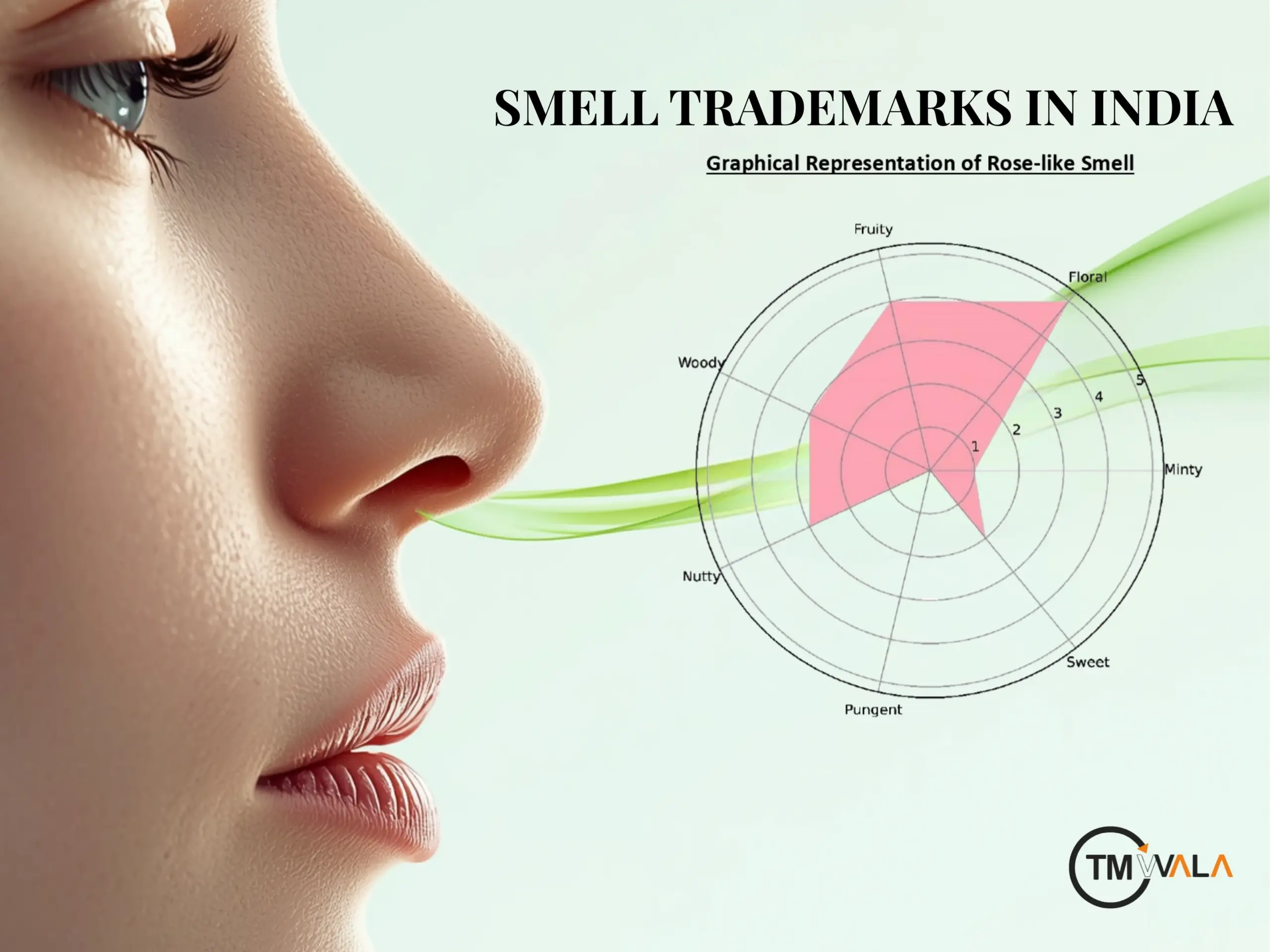
One of the biggest challenges faced by the applicant was fulfilling the requirement of a graphical representation. Since smells cannot be visually depicted, the applicant adopted an innovative scientific approach developed by experts from the Indian Institute of Information Technology (IIIT), Allahabad.
The experts created a graphical representation of the scent by mapping it as a vector in a seven-dimensional space. Each dimension corresponded to a fundamental category of smell: floral, fruity, woody, nutty, pungent, sweet, and minty. This method provided a structured and objective way to represent the fragrance.
After reviewing the application and the scientific representation, the authorities found that the trademark satisfied all legal requirements. It was considered clear, precise, self-contained, intelligible, and capable of graphical representation. As a result, the application was accepted and directed to be advertised as an olfactory mark under the Trade Marks Act, 1999.
Read The Case Judgement Here: ORDER.pdf
The Sumitomo case marks a turning point in the recognition of smell trademarks in India. It demonstrates that with the integration of science and law, even non-traditional marks can meet the stringent requirements of trademark registration.
This decision also reflects the evolving nature of intellectual property law in India. As branding strategies become more innovative, the law must adapt to accommodate new forms of expression. The acceptance of a smell trademark opens the door for businesses to explore sensory branding in a more structured and legally protected manner.
At the same time, the case highlights that such registrations will remain rare and highly scrutinized. Applicants must be prepared to provide detailed evidence, scientific backing, and strong legal arguments to support their claims.
The recognition of olfactory trademarks in India represents a significant step forward in the evolution of trademark law. While the challenges associated with registering a smell trademark are considerable, the Sumitomo case proves that they are not insurmountable.
From meeting the requirement of graphical representation to establishing distinctiveness and overcoming a potential trademark objection in India, the process demands both legal and technical expertise. Businesses looking to protect such unique brand elements must approach the process strategically.
This is where TMWala can play a vital role. By offering expert guidance, handling documentation, and assisting in responding to objections, TMWala helps simplify the otherwise complex process of registering non-traditional trademarks. As the landscape of branding continues to evolve, having the right support can make all the difference in securing and protecting innovative intellectual property.
In conclusion, while smell trademarks remain an emerging area in India, they hold immense potential for businesses willing to innovate. With the right approach and professional assistance, even something as intangible as a scent can become a legally protected brand asset.
Get started instantly
"*" indicates required fields

TMWala
Your one stop shop for all your business registration and compliance needs.
"*" indicates required fields
Choose your Entity Type
Non-MSME/ Large Entitie
Individual/ MSME/ Sole Proprietorships

₹9,000.00 Original price was: ₹9,000.00.₹3,999.00Current price is: ₹3,999.00.
Trademark Application @ ₹3999* (Premium Discounted Plan for MSME/Individual/Sole Proprietorships) Comprehensive
Government Fees
₹4500/-
₹9,000.00 Original price was: ₹9,000.00.₹3,999.00Current price is: ₹3,999.00.
Trademark Application @ ₹3999* (Premium Discounted Plan for Non-MSMEs/Large Entities) Comprehensive
Government Fees
₹9000/-
Choose your Entity Type
Individual/ MSME/ Sole Proprietorships
Non-MSME/ Large Entities

₹3,500.00 Original price was: ₹3,500.00.₹1,999.00Current price is: ₹1,999.00.
Government Fees
₹4500/-
₹3,500.00 Original price was: ₹3,500.00.₹1,999.00Current price is: ₹1,999.00.
Government Fees
₹9000/-
Choose your Entity Type
Individual/ MSME/ Sole Proprietorships
Non-MSME/ Large Entities
₹1,500.00 Original price was: ₹1,500.00.₹999.00Current price is: ₹999.00.
Trademark Application @ ₹999* (Basic Discounted Plan for MSME/Individual/Sole Proprietorships) Best-Selling, Economical & Easy
₹1,500.00 Original price was: ₹1,500.00.₹999.00Current price is: ₹999.00.
Trademark Application @ ₹999* (Basic Discounted Plan for Non-MSMEs/Large Entities) Best-Selling, Economical, Quick and Easy