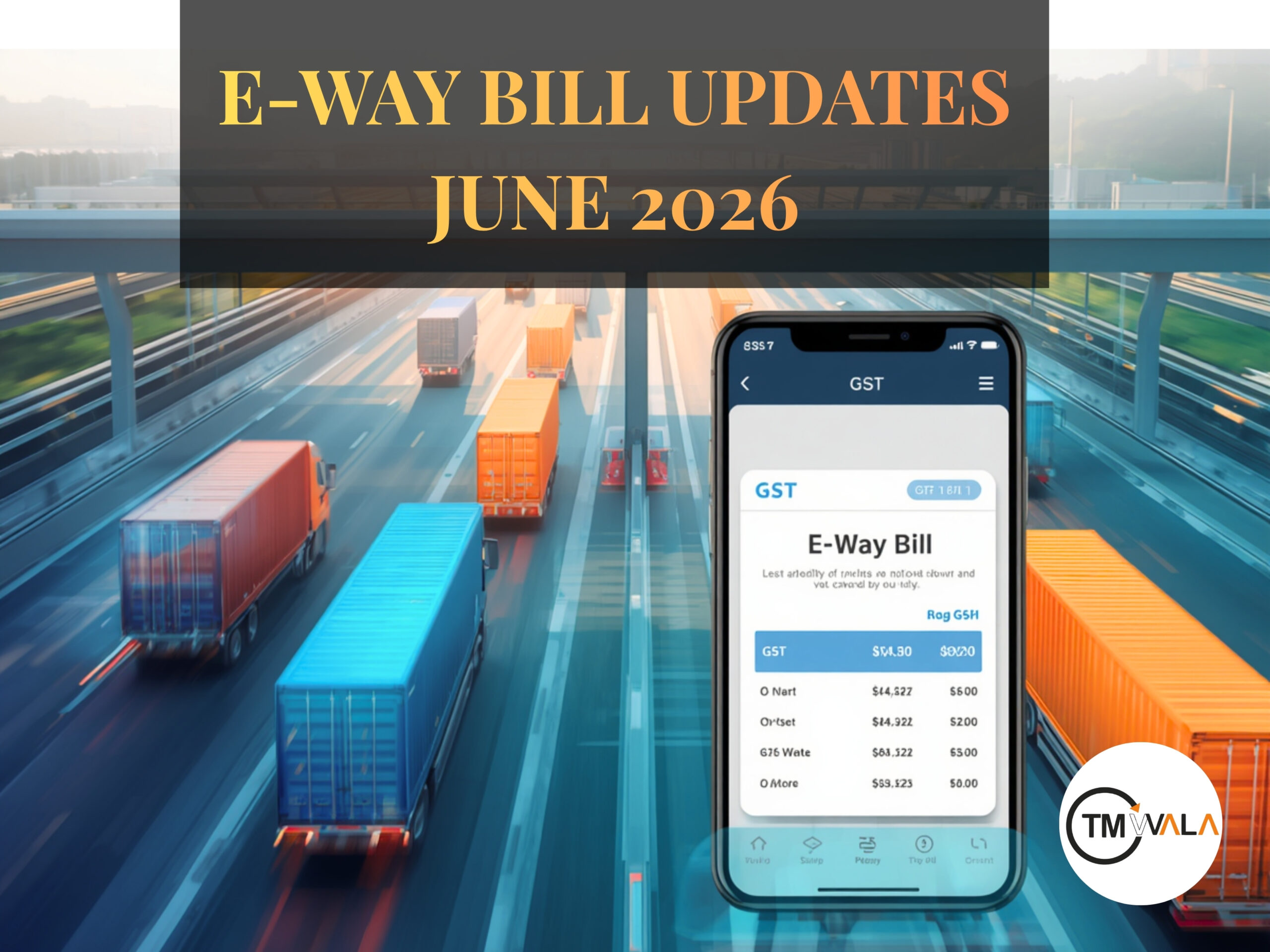
The GST compliance framework in India continues to evolve with regular technological and procedural enhancements. One of the most significant developments in recent months is the latest e–way bill update introduced by GSTN in May 2026. These changes are expected to improve transparency, strengthen tracking of goods movement, and simplify transport-related compliance for businesses and transporters.
With the implementation of the latest GST e-way bill updates, every taxpayer, transporter, ERP provider, and logistics operator must understand the revised system requirements. The newly introduced e–way bill rules include mandatory data fields, voluntary closure facilities, API enhancements, and updated compliance procedures.
The GST e–way bill system is governed under Section 68 of the CGST Act, read with Rule 138 of the CGST Rules, 2017. It applies to the movement of goods where the consignment value exceeds the prescribed threshold limit.
For businesses struggling to stay updated with changing GST regulations, TMwala can assist with GST compliance management, e–way bill handling, registration amendments, and transport documentation support. Their professional assistance can help businesses avoid penalties and maintain smooth logistics operations.
On 20 May 2026, GSTN issued a major e–way bill notification introducing several functional enhancements in the system. These updates are aimed at improving data integrity and enabling better monitoring of transportation activities under GST. Read the Advisory Here: gstn_advisory_ewb_approved.pdf
One of the key changes under the e–way bill latest update is the mandatory requirement to capture the “Ship To GSTIN” in Bill–To/Ship–To transactions. Earlier, this field was optional in some cases, but now it has become compulsory during e–way bill generation. If the consignee is unregistered, taxpayers must enter “URP” in the Ship to GSTIN field.
Another important feature introduced is the voluntary e–way bill closure facility. This enhancement allows suppliers, recipients, transporters, or authorized drivers to close an e–waybill once the delivery is completed. The system also allows closure through mobile numbers linked during e–way bill generation.
GSTN has further announced that API changes for ERP systems and GST software providers will become effective from 15 June 2026. Businesses using automated billing or logistics software must ensure timely updates to avoid disruptions.
The e–way bill requirement under GST applies whenever goods worth more than ₹50,000 are transported. The requirement generally applies in the following situations:
The system generates a unique e–way Bill Number (EBN), which must accompany the goods during transportation.
Businesses must understand that e–way bills are mandatory not only for sales transactions but also for stock transfers, branch transfers, exhibitions, and goods sent for repairs or processing.
The e–way bill generation process is entirely online and can be completed through the official portal. The process involves entering transaction details, invoice information, transporter details, and vehicle information.
The steps involved are as follows:
Once generated, the document contains a QR code and a unique number for verification purposes.
Businesses should note that Part A details cannot be edited after generation, while Part B allows updates related to transportation details.
The e–way bill validity rules are based on the travel distance between the source and destination locations. The system calculates the validity period automatically based on PIN codes.
The validity generally starts from midnight following the time of generation. If goods are not delivered within the prescribed validity period, movement becomes non–compliant unless the validity is extended.
The transporter can extend validity within eight hours before or after expiry in situations such as:
Failure to extend the validity within the permitted window may require the generation of a fresh e–way bill.
In the year 2026, this threshold value will remain generally at ₹50,000 throughout many portions of India, but there are exceptions for certain states and/or types of goods. Certain states and categories may prescribe different threshold limits through notifications. Businesses should verify the latest applicable limits before transportation.
Businesses must therefore verify product-specific applicability before transportation.
For intrastate movement, threshold limits continue to differ from state to state depending on local notifications issued by respective state governments.
The e–way bill rules for interstate movement remain uniform across India. Whenever goods valued above the prescribed threshold cross state borders, generating an e–way bill becomes mandatory.
The e–way bill rules for intrastate differ depending on state–specific relaxations. Several states have increased threshold limits for local transportation to reduce compliance burdens for small businesses.
Taxpayers engaged in both interstate and intrastate transportation should regularly review notifications issued by their state GST departments to remain compliant.
The requirement of the e–way bill for job work is particularly important under GST compliance. Even if the value of goods is below ₹50,000, an e–way bill becomes mandatory in case of interstate movement for job work purposes.
Goods sent for:
Must generally be accompanied by a delivery challan and a valid e–way bill.
Failure to comply may result in detention of goods during transit inspections.
The e–way bill vehicle number update facility allows taxpayers and transporters to modify vehicle details in case of transshipment or vehicle replacement during transit.
This feature becomes useful when:
The consolidated e–way bill facility enables transporters to club multiple e–way bills into a single consolidated document for easier movement and verification.
This significantly simplifies logistics operations for bulk transportation businesses.
The GST e–way bill cancellation rules permit cancellation under specific circumstances.
The generator can cancel the e–way bill within 24 hours if:
Once 24 hours pass, cancellation by the generator is not permitted.
Recipients can reject an e–way bill within 72 hours of generation. If no rejection is made within this period, the e–way bill is treated as accepted automatically.
Businesses should therefore verify all transportation details carefully before generation.
Penalties may include tax and penalty under Section 129 of the CGST Act, detention or seizure of goods and vehicles, and additional compliance scrutiny.
Maintaining accurate documentation and valid transportation records is therefore critical for every business.
The documents required for the transportation of goods under GST generally include:
In certain notified cases, RFID mapping may also become mandatory for conveyances transporting goods.
Transporters and drivers must ensure these documents remain available during transit verification by GST officers.
Many taxpayers continue to face e–way bill login issues due to technical or browser-related reasons.
Common solutions include:
GSTN also provides support through designated helpdesk channels for persistent technical issues.
Businesses often need to update their mobile numbers or email IDs linked to the GST portal. The amendment in the GST registration procedure for non–core fields can be completed online.
The process involves:
Usually, the updated details are approved within a few hours if validations are successful.
Businesses frequently ask how to update their mobile numbers in the e–way bill portal after changing their registered contact details.
The process is straightforward:
Once synchronized, the new mobile number becomes available for e–way bill operations and closure functionalities.
The movement of goods under GST requires careful coordination between suppliers, transporters, and recipients. Businesses should adopt proper compliance practices, such as:
Automating GST and transport workflows through professional service providers can significantly reduce compliance risks.
TMwala can support businesses with GST advisory, e–way bill compliance, registration amendments, transporter documentation, and ERP-related guidance. Their expertise can help organizations maintain smooth transportation operations while ensuring complete GST compliance.
The June 2026 e–way bill update represents another important step toward digitized GST compliance and enhanced transportation monitoring. With the introduction of mandatory Ship to GSTIN requirements, voluntary closure functionality, API upgrades, and revised compliance workflows, businesses must upgrade their internal systems immediately.
Understanding the e–way bill latest update is essential not only for avoiding penalties but also for ensuring uninterrupted logistics operations. Companies engaged in transportation, manufacturing, trading, and job work activities should train their teams and update ERP systems in line with the latest GSTN advisories.
As GST compliance becomes increasingly technology-driven, professional support from experts like TMwala can help businesses stay compliant, reduce operational risks, and simplify GST-related procedures effectively.
Get started instantly
"*" indicates required fields
TMWala
Your one stop shop for all your business registration and compliance needs.
"*" indicates required fields
Choose your Entity Type
Non-MSME/ Large Entitie
Individual/ MSME/ Sole Proprietorships
₹9,000.00 Original price was: ₹9,000.00.₹3,999.00Current price is: ₹3,999.00.
Trademark Application @ ₹3999* (Premium Discounted Plan for MSME/Individual/Sole Proprietorships) Comprehensive
Government Fees
₹4500/-
₹9,000.00 Original price was: ₹9,000.00.₹3,999.00Current price is: ₹3,999.00.
Trademark Application @ ₹3999* (Premium Discounted Plan for Non-MSMEs/Large Entities) Comprehensive
Government Fees
₹9000/-
Choose your Entity Type
Individual/ MSME/ Sole Proprietorships
Non-MSME/ Large Entities
₹3,500.00 Original price was: ₹3,500.00.₹1,999.00Current price is: ₹1,999.00.
Government Fees
₹4500/-
₹3,500.00 Original price was: ₹3,500.00.₹1,999.00Current price is: ₹1,999.00.
Government Fees
₹9000/-
Choose your Entity Type
Individual/ MSME/ Sole Proprietorships
Non-MSME/ Large Entities
₹1,500.00 Original price was: ₹1,500.00.₹999.00Current price is: ₹999.00.
Trademark Application @ ₹999* (Basic Discounted Plan for MSME/Individual/Sole Proprietorships) Best-Selling, Economical & Easy
₹1,500.00 Original price was: ₹1,500.00.₹999.00Current price is: ₹999.00.
Trademark Application @ ₹999* (Basic Discounted Plan for Non-MSMEs/Large Entities) Best-Selling, Economical, Quick and Easy