Today’s market hardly acknowledges businesses through their names, logos, or catchphrases. In fact, the growth of the non-traditional trademark is determined by the increasing use of original perception and vision elements such as sounds, colours, shapes, movements, as well as the scent of a product.
Non-traditional trademarks let brands enjoy success in such an area as branding, making it possible to create striking ads and elaborate on new and unique brand identity features. Nevertheless, the process of registering trademarks and the process of protecting them involves substantial knowledge in the field of trademark legislative provisions.
TMWALA, a novel intellectual property and trademark service provider, helps businesses provide their trademark strategies and achieve the maximum protection of their brand.
Traditionally, a trademark is an emblem, sign, word, or combination of signs that separates products or services of one business from another. However, the more modern meaning of branding goes beyond just visual signs.
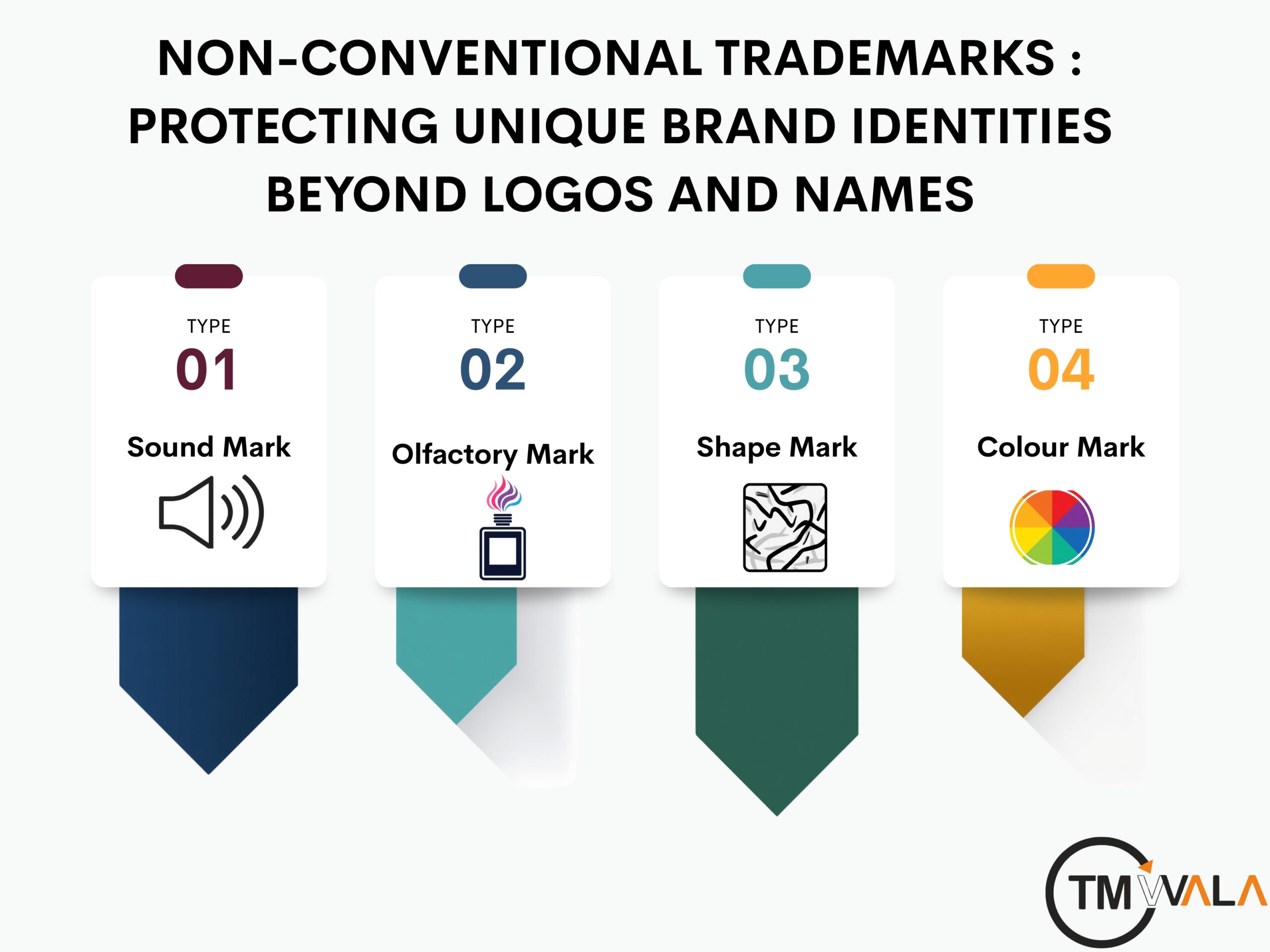
Unconventional trademarks are considered trademarks that do not belong to traditional categories of signs, logos, or words. They are identified thanks to their sensory elements and may be as follows:
Despite taking different shapes and formats, these trademarks still serve to perform the main functions of differentiating goods/services and establishing the link between consumers and the brand.
Traditionally, trademark laws were concerned primarily with material and tangible signs, like logos or brand names. But with advancements in marketing strategies, technology, and consumer behaviour, today people can easily identify brands based on different forms of experience.
Today, brands emphasize on overall experience of consumers when marketing their products. For instance, a consumer may recognize a brand by:
With this change, many countries have amended their trademark legislations in way to adapt to the new forms of brand identification.
WIPO recognizes that trademarks can be formed by non-traditional marks, too, subject to distinctiveness and representation requirements that must be met.
1. Sound Trademarks
A sound trademark is something that protects a sound that people think of when they hear it, they know which brand it is. Sounds are really tools for marketing because people can recognise certain sounds right away even if they do not see a logo or the product. Examples of sound trademarks are brand jingles, application notification sound, advertising tunes, audio signatures
To register a sound, trademark the sound must be distinct and unique. People must be able to tell that it is from a particular company that sells goods or services. It has to be able to identify the source of goods or services.
People who want to register a trademark can send in sound recordings and other things that show what the sound is when they apply for registration. The Government of India’s Trademarks Registry has rules and steps that people must follow to register a trademark, including what’s needed for different kinds of marks.
2. Colour Trademarks
Colour trademarks are important because colours can affect what people think of a brand and people often think of a brand when they see a colour. A colour trademark is when a brand gets to own a colour or colours that people think of when they see that colour.
It can be hard to get a colour trademark because:
If a company uses a bunch of colours in a way that might be easier to trademark than just one colour.
3. Shape Trademarks
Shape trademarks are when a company gets to own the shape of a product or its packaging.
Examples of shape trademarks are special bottle designs, unique packaging structures, distinctive product shapes
A shape trademark cannot be registered if the shape is just because of what the product is.
A shape trademark also cannot be registered if the shape is needed for the product to work.
The shape has to be special, not just any shape.
Companies have to show that people think of their brand when they see the shape.
The shape has to be distinctive. People have to think of the company when they see it.
4. Motion Trademarks
Motion trademarks are when a company gets to own moving images or animations that people think of when they see them. Examples of motion trademarks are brand logos, digital application opening animations, product demonstration sequences
These trademarks are valuable for technology companies and entertainment businesses and online platforms. Motion trademarks are a deal for these companies because they use a lot of digital stuff.
5. Hologram and Multimedia Trademarks
Digital technology is getting better companies that can use new kinds of trademarks like holograms and multimedia. These trademarks can have images, sounds, animation, elements.
These kinds of trademarks are becoming more important in industries, like technology, entertainment, gaming. As the internet and virtual reality get bigger these kinds of trademarks might become more common. Hologram and multimedia trademarks are the future of branding.
Legal Requirements for Non-Conventional Trademark Registration
Although non-conventional trademarks are different in form, they must satisfy the fundamental requirements of trademark law.
One of the primary requirements of registration is that the mark must be distinctive. A company name or symbol should be able to help people know where a product or service comes from. If a lot of people use the name or symbol it is probably not going to get protected.
When people want to trademark something, they have to clearly represents that what it looks like. What they have to send in depends on what kind of trademark it’s. They might have to send in a file if it is a sound, pictures or descriptions if it is a shape or Computer files if it is a moving image or a video. This helps figure out what is protected by the trademark.
A trademark that is applied for registration should not be descriptive of goods or services it is applied for. For example, if a lot of companies use the shape, for a product or if a colour is used by a lot of businesses, it is probably not going to be protected just for one company.
Challenges in Protecting Non-Conventional Trademarks
Despite their advantages, non-conventional trademarks present several challenges.
Difficulty in Proving Distinctiveness
Businesses often need to demonstrate that consumers recognise the mark as belonging to a particular company. They can prove the same by their advertising campaigns, sales records market research, brand recognition studies.
Enforcement Challenges
Monitoring infringement of non-conventional trademarks can be more complex than traditional trademarks. For example, like similar sounds may require detailed comparison, colour infringement may involve evaluating consumer confusion, shape disputes may require technical analysis.
Changing Technology
Technology continues to create new branding opportunities. Virtual reality, artificial intelligence, and digital platforms are introducing new ways for businesses to interact with consumers. Trademark laws must continue adapting to protect emerging forms of brand identity.
Non-conventional trademarks offer several benefits:
1. Stronger Brand Recognition
Unique brand elements help consumers remember businesses more easily.
2. Competitive Advantage
Protection prevents competitors from copying distinctive brand features.
3. Increased Business Value
Strong intellectual property portfolios can increase the overall value of a company.
4. Better Customer Experience
Unique sounds, visuals, and designs create stronger emotional connections with customers.
Businesses should take a strategic approach when protecting innovative brand elements.
Important steps include:
Professional trademark assistance can help businesses avoid registration errors and strengthen their protection strategy.
The term “non-conventional trademarks” embodies the evolution of the field of trademark protection. With the advancement of technologies, companies have moved away from logos and names. Therefore, they are now beginning to protect new intellectual property assets including sounds, colours, shapes, and digital experiences.
In the international competition, the exclusive sign enables firms to strengthen brand awareness, minimize the risk of infringement, and increase commercial value. However, effective protection is only available to those who carry out thorough preparatory work, collect evidence of secondary meaning, and fulfil all requirements of trademark laws.
Assistance of experts like TMWala allows businesses to get an insight into using non-traditional trademarks in their activities. By choosing both conventional and non-conventional trademarks, companies strengthen their positions in the sphere of business.
Get started instantly
"*" indicates required fields

TMWala
Your one stop shop for all your business registration and compliance needs.
"*" indicates required fields
Choose your Entity Type
Non-MSME/ Large Entitie
Individual/ MSME/ Sole Proprietorships
₹9,000.00 Original price was: ₹9,000.00.₹3,999.00Current price is: ₹3,999.00.
Trademark Application @ ₹3999* (Premium Discounted Plan for MSME/Individual/Sole Proprietorships) Comprehensive
Government Fees
₹4500/-
₹9,000.00 Original price was: ₹9,000.00.₹3,999.00Current price is: ₹3,999.00.
Trademark Application @ ₹3999* (Premium Discounted Plan for Non-MSMEs/Large Entities) Comprehensive
Government Fees
₹9000/-
Choose your Entity Type
Individual/ MSME/ Sole Proprietorships
Non-MSME/ Large Entities
₹3,500.00 Original price was: ₹3,500.00.₹1,999.00Current price is: ₹1,999.00.
Government Fees
₹4500/-
₹3,500.00 Original price was: ₹3,500.00.₹1,999.00Current price is: ₹1,999.00.
Government Fees
₹9000/-
Choose your Entity Type
Individual/ MSME/ Sole Proprietorships
Non-MSME/ Large Entities
₹1,500.00 Original price was: ₹1,500.00.₹999.00Current price is: ₹999.00.
Trademark Application @ ₹999* (Basic Discounted Plan for MSME/Individual/Sole Proprietorships) Best-Selling, Economical & Easy
₹1,500.00 Original price was: ₹1,500.00.₹999.00Current price is: ₹999.00.
Trademark Application @ ₹999* (Basic Discounted Plan for Non-MSMEs/Large Entities) Best-Selling, Economical, Quick and Easy