On February 1, 2026, Finance Minister Nirmala Sitharaman presented the Union Budget for the fiscal year 2026-27. If you are wondering how this financial roadmap affects your daily life, you are in the right place.
This year’s budget focuses heavily on three pillars: strengthening healthcare, boosting domestic manufacturing, and maintaining fiscal discipline. While income tax slabs for 2026 remain unchanged, the announcement of the new Income Tax Act 2025 (effective April 1, 2026) promises to simplify the tax code significantly in the coming months.
Whether you are planning international travel, trading in the stock market, or managing household expenses, understanding these tax changes in India is crucial for your financial planning. Let’s dive into the specifics of what got cheaper in the Indian budget and where you might see price increases in the 2026 Union budget.
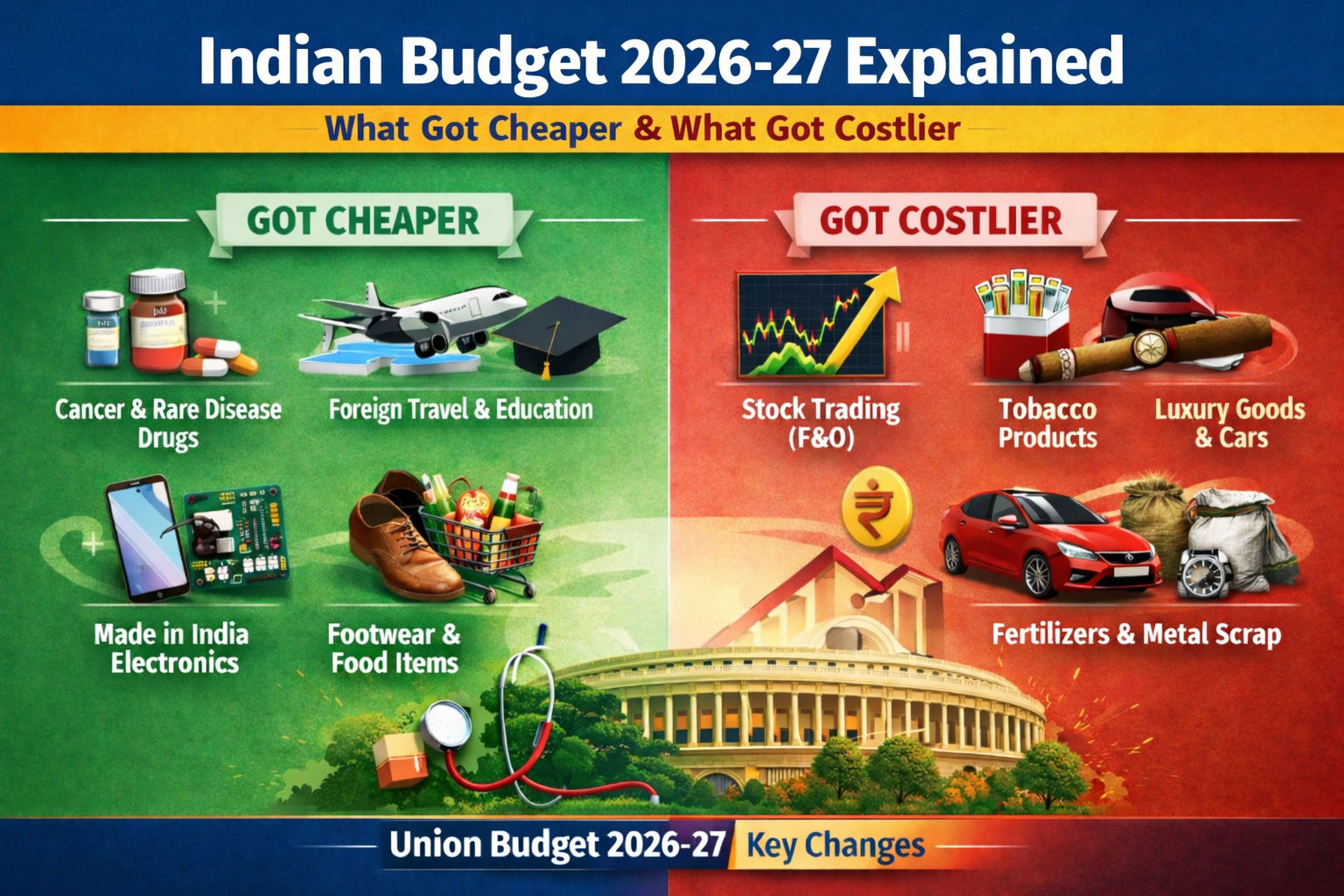
Top 5 Things That Got Cheaper in the Indian Union Budget
The government has strategically lowered customs duties to provide relief to the common man and boost specific sectors like healthcare and electronics. Here is how you save money this year.
1. Cancer Treatment & Rare Disease Medicines
In a compassionate move, the government has fully exempted three additional cancer medicines and drugs for rare diseases from customs duties.
- The Benefit: This leads to a direct price reduction, making life-saving treatments more accessible to thousands of families.
- Why It Matters: With healthcare budget allocation seeing a massive boost, this exemption ensures that financial barriers do not stand in the way of critical medical care.
2. International Travel & Education
Planning a holiday or sending a child abroad for studies? The Tax Collected at Source (TCS) on foreign remittances has been rationalized.
- The Benefit: Lower upfront costs when booking international tour packages or remitting fees for overseas education.
- Why It Matters: This eases cash flow for middle-class families and encourages global exposure for students and travelers alike.
3. Mobile Phones & Electronics Made in India
To further the “Make in India” initiative, customs duties on mobile phone components, chargers, and printed circuit board assemblies (PCBA) have been reduced by nearly 5-10%.
- The Benefit: Expect a price drop in smartphones, especially mid-range models assembled domestically.
- Why It Matters: This aligns with manufacturing initiatives in India, ensuring you get better technology at lower prices while supporting local jobs.
4. Personal Imports
The duty-free allowance for personal items imported via courier or postal services has been revised upwards.
- The Benefit: You can now order small gadgets, fashion accessories, or books from international websites with reduced fear of heavy customs levies.
- Why It Matters: It simplifies cross-border commerce for individual consumers and reduces the friction of global shopping.
5. Leather Footwear & Food Items
Customs duties on raw materials for leather goods and specific imported food items (like certain nuts and processed protein foods) have been slashed.
- The Benefit: Lower retail prices for quality leather shoes and bags, as well as reduced costs for premium grocery items.
- Why It Matters: This boosts the leather export sector by lowering input costs and keeps household grocery bills manageable.
| Also, read more about how the Union Budget 2026 will impact startups, MSMEs, and Compliance
Top 5 Things That Got More Expensive
While many items saw relief, the government has tightened the purse strings on luxury consumption and speculative trading to balance the fiscal deficit in India.
1. Stock Market Derivatives Trading
The Securities Transaction Tax (STT) on futures and options (F&O) has been hiked significantly.
- The Impact: The fees for dealing in derivatives will surge, hitting high-speed dealers and individual buyers wagering on F&O.
- The Reasoning: This move aims to curb excessive speculation in the market and encourage long-term investment over short-term betting.
2. Tobacco Products
Excise duties and the National Calamity Contingent Duty (NCCD) on cigarettes and tobacco products have been increased by 10-15%.
- The Impact: Smokers will see an immediate rise in the price of cigarettes and other tobacco derivatives.
- The Reasoning: A standard measure to discourage consumption of harmful goods while generating revenue for public health initiatives.
3. Fertilizers
While subsidies continue, the government has rationalized the pricing structure for imported fertilizers to promote the use of alternative, organic options.
- The Impact: A slight increase in input costs for farmers relying heavily on imported chemical fertilizers.
- The Reasoning: To encourage the shift toward sustainable agriculture and reduce the massive chemical fertilizer subsidy burden.
4. Luxury Items & Umbrellas
In a move to shield domestic industries, the government has raised duties on finished luxury goods and specific everyday items.
- The Nuance on Cars: While recent trade deals (with the EU and UK) have lowered prices for specific European vehicles, the standard customs duty on luxury cars from other nations (like Japan or the USA) has been hiked. This creates a two-tier market where “Treaty Cars” are cheaper, but others are costlier.
- The Umbrella Tax: Surprisingly, umbrellas see a steep duty hike (up to 20% or ₹60/piece). This is a protectionist measure to curb cheap, low-quality imports and boost India’s local MSME umbrella manufacturers.
- Other Luxuries: Imported smartwatches, high-end cameras, and premium headphones see a duty rise to encourage buying their “Made in India” counterparts.
5. Minerals & Scrap
Duties on specific mineral ores and metal scrap have been tweaked to protect domestic mining interests.
- The Impact: Industries relying on imported scrap aluminum or copper may see a marginal increase in raw material costs.
- The Reasoning: To incentivize the domestic recycling industry and mining sector.
Key Context Information
To truly understand the Indian Union Budget 2026, we must look at the macroeconomic data. These numbers dictate the health of our economy and the government’s ability to spend on your welfare.
- Total Capital Expenditure (CapEx): The government has committed ₹12.2 lakh crore to infrastructure, marking a 9% increase over the previous year. This ensures that road, rail, and digital connectivity projects continue at a rapid pace, creating jobs and improving logistics.
- Fiscal Deficit Target: The government remains committed to fiscal prudence, targeting a deficit of 4.4% of GDP. This signals to global investors that India is managing its debt responsibly.
- Healthcare Allocation: A historic allocation of ₹1,06,530.42 crore has been made to the Ministry of Health and Family Welfare. This marks almost a 10% boost, highlighting the drive toward bolstering civic medical capabilities.
- Income Tax Stability: There were no changes to slabs this year. However, the finance minister confirmed that the new Income Tax Act 2025 will come into effect on April 1, 2026. This act is expected to rewrite the rules of taxation, aiming for simplicity and transparency.
- Major Initiatives:
- Biopharma SHAKTI: A new fund with an outlay of ₹10,000 crore to boost research and innovation in the biopharmaceutical sector.
- SME Growth Fund: Another ₹10,000 crore allocated specifically to support small and medium enterprises in modernizing their technology.
- Khelo India Mission: Enhanced funding to groom athletes for international sporting events, reflecting a holistic approach to national development.
Why This Budget Matters
This Union Budget acts as a bridge. It connects the infrastructure push of the last few years with a new era of manufacturing and healthcare resilience. For our readers, the takeaways are clear:
- Healthcare is a Priority: The massive hike in healthcare budget allocation and the Biopharma SHAKTI initiative suggest that the government is serious about making India a global medical hub. If you are an investor, this sector deserves your attention.
- Manufacturing is Key: The manufacturing initiatives in India, supported by duty cuts on mobile components and the SME Growth Fund, are designed to make Indian products globally competitive.
- Fiscal Discipline: By holding to a budget gap limit of 4.4%, the administration is confirming that prices stay under control, which eventually secures the spending value of your cash.
As we enter the fiscal year 2026-27, keeping a close eye on the rollout of the Income Tax Act 2025 will be essential. We will continue to provide updates as the fine print of the new act is released.
At TMWala, we are committed to helping you navigate these changes with confidence. Whether it is adjusting your trading strategy due to higher STT or taking advantage of cheaper electronics, staying informed is your best asset.
Frequently Asked Questions
Here are the top questions users are asking about the new Union budget, answered directly for quick clarity.
- Did income tax slabs change in the 2026 budget?
No, tax slabs remain unchanged for FY 2026-27. However, the new Income Tax Act 2025 will simplify the tax code starting April 1, 2026.
- What items became cheaper in the 2026 budget?
Mobile phone components, cancer medicines, leather goods, and international travel packages are cheaper due to duty cuts and reduced TCS.
- Why are umbrellas getting expensive in 2026?
Customs duty on umbrellas was raised to 20% or ₹60/piece to curb cheap imports and support domestic Indian manufacturers (MSMEs).
- Are luxury cars cheaper or more expensive now?
It depends. EU/UK cars are cheaper due to trade deals, but cars from other nations are costlier as the budget hiked standard customs duties.
- How does budget 2026 affect stock traders?
Traders face higher costs as the Securities Transaction Tax (STT) on futures & options (F&O) was hiked to curb excessive market speculation.
- Is international travel cheaper in 2026?
Yes. The Tax Collected at Source (TCS) on foreign remittances was rationalized, lowering the upfront cost for your holidays and studies.
- What is the healthcare budget allocation for 2026?
Healthcare received ₹1.06 lakh crore, a 10% hike. This funds the new Biopharma SHAKTI initiative and makes cancer drugs duty-free.
- When is the effective date for budget 2026 changes?
Most price changes are effective immediately. The new Income Tax Act 2025 and financial year policies officially begin on April 1, 2026.
- Did mobile phone prices drop in 2026?
Yes. Customs duties on components like chargers and PCBAs were cut by 5-10%, reducing costs for “Made in India” smartphones and electronics.
- What is the Biopharma SHAKTI initiative?
It is a ₹10,000 crore government fund launched in budget 2026 to boost research, innovation, and domestic manufacturing in the biopharma sector.